Issue 11: The Potential of Cliché
The Pleasures of Cliché: Speaking Without Speaking
Before I return to Glück's explicit reflections on gardening, I want to take a brief detour via the artificially constructed gardens made by Joe Brainard. Brainard's collages can help to further consolidate the positive affinities between cliché, commodity culture, and a gay identity that "speaks" without speaking. Glück has talked at length about the influence of the personal aesthetics of the New York School on New Narrative. They offered an already-existing example of how to earnestly inhabit commodity culture. In About Ed, when his character is snubbed by an object of desire, he writes, "Don't make me feel mighty real. Let me be a porn sketch of five thick lines by Joe Brainard, or the two on-screen whose flesh is powerful light."1 Glück is getting at the syntax of porn: the banality of its choreographed repetition that allows for the saturation of data and gesture. Personality is totally irrelevant — porn is filled with stock characters — giving way to a self-voiding pleasure. Casting Brainard as auteur suggests that these details would be beautifully rendered, finding feeling in things that others consider expendable. Brainard's use of repetition — whether that is in his memoir/long stream-of-consciousness poem "I Remember," in which every line begins with "I remember," or his collage work — offers a viable model for queer self-description.2 In "I Remember," Brainard recalls, "I remember trying to convince my parents that not raking the leaves was good for the grass. / I remember that I liked dandelions all over the yard."3
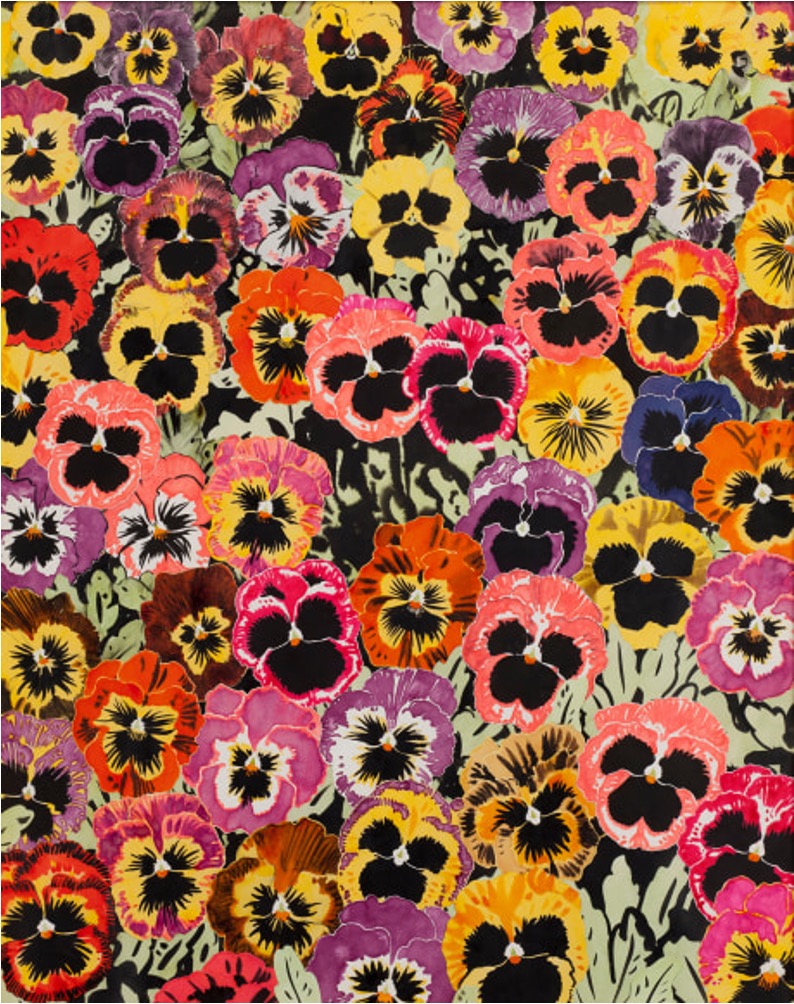
His Garden series embodies the capacious sanctuary of the picturesque commodity in bloom. Brainard's "pansy" collages, forming part of this series, are filled with individually painted pansies depicted in a commercial seed-packet style. They are arranged as "all-overs'" crucially, not as a pattern that flows from its edges like a sheet of wallpaper, but one after the other. The pansies are all individual, but "garden-variety" at the same time. As scholars point out, the pansies had a deverbalizing effect on their audience in their minor beauty: as prototypically "cute" objects they invited closeness while seeking protection from aggression. John Ashbery wrote how, in contrast to Andy Warhol's infamous Campbell soup cans, which suspended the audience at a critical distance with their "chic" "implicit nastiness," in the case of Joe, you wanted to "embrace the pansy."4 Yet the "pansy" refuses the power differential of sympathy. At first, the viewer wants to "make it feel better about being itself, all alone, a silly expression on its face, forced to bear the brunt of its name eternally." Then, they realize that through an aesthetics of "niceness" that links poetic labor and generosity, the work is "doing" for us: "making nice." According to Ashbery, this allows the audience to reach a philosophical place of acceptance, and a sanguine feeling that "everything will be okay if we just look at it, accept it, and let it be itself." Gavin Butt argues compellingly that Brainard's "queer seriousness," his attention to the ephemeral potpourri of life, could imply an argument akin to Judith Butler's Precarious Life: put simply, sitting with difference can make for a more just society and pragmatically improve the lives of minorities by securing their safety.5 Yet for this to work, we have to assume the relevance of a straight "outsider" — whereas Brainard's motivations for making his pieces was first and foremost to delight his queer circle of friends and admirers, who loved his "sissy" sensibility.
- Robert Glück, About Ed, 69.[⤒]
- Joe Brainard, I Remember (Granary Books, 2001).[⤒]
- Brainard, I Remember, 36.[⤒]
- John Ashbery, as quoted in Brian Glavey, "John Ashbery's Shyness, or, Lateral Ekphrasis," in The Wallflower Avant-Garde: Modernism, Sexuality, and Queer Ekphrasis (Oxford Academic, 2015), 144.[⤒]
- Gavin Butt, "Joe Brainard's Queer Seriousness, Or, How to Make Fun of the Avant-Garde," in Neo-Avant-Garde, ed. David Hopkins (Brill, 2016); see also, Jessica Q Stark, "Nancy and the Queer Adorable in the Serial Comics Form," American Literature 90, no. 2 (2018): 315-345.[⤒]