Issue 11: The Potential of Cliché
In an interview with the Paris Review in 2023, Robert Glück described how his writing and gardening processes are similar: "I write the way I do everything — in spurts. Gardening, cooking — Reese [Glück's son] says I'm cottagecore."1 To the uninitiated, "cottagecore" is an internet aesthetic or subculture coined on Tumblr in 2018 that describes cozy, rustic homes made in rural or agrarian landscapes. It is a thoughtfully prelapsarian fantasy of clichéd domesticity that projects a comforting, aesthetically pleasing revision of heteropatriarchal norms. 2 Distinct from conservative "trad" aesthetics, "cottagecore" is worn lightly by the LGBTQ+ community and beyond. The "core" makes obvious this process of appropriation. Ironically, there is no "core" to excavate: cottagecore is played out on the surface of life through the inhabitation of an artificial way of looking at a landscape. Its "core" is happily empty.
Reese has hit upon something profound in this observation: through his reworking of common images to create a sanctuary for the queer self, Glück's writing offers us an affirmative strategy for cliché. Far from being treacherous ground for a writer or artist, the cliché instead facilitates sociability and community at no expense to the minoritized subject. As the philosopher and poet Denise Riley puts it in the introduction to Impersonal Passion, the cliché is "not to be despised: its automatic comfort is the happy exteriority of a shared language which knows itself perfectly well to be a contentless but sociable turning outwards towards the world."3 This note is a small aside but it is significant, countering the maligned reputation of the cliché as something blandly predictable, relied on in a crisis, or sold back to you as wall art in a chain store. Instead, clichés are well-worn examples of ordinary language that sustain meaning not through innovation but iteration. Crucially, in this definition, sanctuary or "automatic comfort" is found through a turning outwards rather than in a secluded, fortified retreat from the multitudes displaced by post-industrialism. To engage sincerely with cliché is to let the individual "I" rest within the communal.
This article tracks how, for Glück, the garden models one such sanctuary. Best known for his novels Margery Kempe (first published in 1994 and reissued by the New York Review of Books in 2020), Jack the Modernist (1995) and the recently published About Ed (2023), Glück also had a minor garden writing career throughout the 1990s.4 His collection of essays, Communal Nude (2016), includes some of the columns he wrote for the San Diego Reader while further commissions can be found on the paper's online archive. Across Glück's body of work, thinking about gardening becomes a way of thinking about writing, and vice versa. Both gardening and writing are ways of tending to the present at a human scale. As he writes in one of his gardening articles, "What We Love Chooses Us": "I have a little garden. It is the most closely watched patch of earth in my experience. My attention is born of obsession and horticulture."5
My aim for this article is to sketch a recuperative theory of the cliché focalized through the garden as a frame. My hopes are that Glück's conceptualization of gardens might help develop ecocritical strategies for writing the present that make room for the mass-produced, the corny, and for powerful emotional attachments to superannuated cultural forms. While much has been written about New Narrative's relationship to Language Poetry and successive waves of gay literature, this scholarship tends to read this cohort on their own terms and less in relationship to the critical approaches that are shaping literary studies today.6 Yet, ecocriticism is enmeshed with queer studies.7 Queer studies has made foundational, if sometimes overlooked, contributions to how to read ecocritically.8 In Bad Environmentalism, Nicole Seymour argues for a less sanctimonious tone of environmentalism, building an archive of texts that are queer insofar as they "associate improperly with environmental phenomena."9 Their use of irreverence, low humor, campiness and self-reflexiveness suggest, for Seymour, models for coping with the climate emergency through an "ironic form of adaptability." Across ecocriticism, queer methods of survival serve as urgent reminders that there are and have always been other ways of living, from lesbian separatist communes to guerilla urban planting. But can we learn from outstanding examples of queer lives, art, and community-building, while also acknowledging the ways that the contours of power have made, or have not made, these possible?
Queer gardeners are often praised for their inventiveness, for flourishing on the neglected margins of public life. But by linking queerness with resiliency and treating it as an abstract magic well of potential healing, we ascribe a hollow formulation of "agency" to historical actors.10 There is no glory in surviving the scene of your own attrition. Lauren Berlant famously characterized how the stretched-out present of "too-late" capitalism demands endless small adjustments to precarity and contingency. Resiliency and self-care are touted as a neoliberal virtue. 11 As Declan Wiffen, Sophie Seita and Naomi Woo discuss in their recent article, gardens can sometimes simply be the queerest spaces to hide out in at the time.12 Sometimes, this withdrawal can be a material necessity to cope with returning to the workplace or hostile public space.
The shape of this sanctuary is contingent on your relationship to housing: whether you live in rented accommodation, an apartment complex with a shared garden, or own private property; whether your council or equivalent local government body are selling off land to developers, or conversely working to actively reduce allotment wait-times; whether you are safe to participate in a visible queer-specific gardening initiative. A scene from Glück's sometimes collaborator Sarah Schulman's 1986 novel Girls, Visions and Everything illustrates this.13 Its protagonist, young lesbian about town Lila Futuransky, visits two of her friends who have transformed a vacant lot in the East Village into a patchy garden where they can hang out with their kids, lovers, and friends, telling tall tales and drinking wine. They recount how a woman in "brand new jeans" told them that the City of New York is so proud of their garden that they decided to adopt it into their Green Apple Program. As the organizer of this committee, she tells them that they need to take the garden apart and make it square. "Look around you," Lila's friend Lacy says, "there's thousands of abandoned apartments and people with no homes and all the city cares about is our garden."14 The survival of their garden is contingent on the gentrification politics of the city. They made it attractive, and in doing so made it legible to heteronormative society as governable land.
My contention here is one that Glück shares. That is: when minorities become legible, they are held up as models for the rest of society to learn from, without a guarantee of safety. When this happens, the complex messiness of human experience produced by a person's specific coordinates in space and time are flattened. At the same time, these flattened narratives are often useful and necessary for building political solidarities across difference. By turning to Glück for more clarification on managing this trade-off, I nod toward a rich history of progressive, politically engaged LGBTQ+ gardeners who made do with the ordinary materials that they had on hand — whose experiments in enriching their lives are not considered "radical" or "groundbreaking" — and often reproduced cultural norms. 15 Glück's own choice to write about gardening during the 1990s might corroborate with his peers' retreat from the Poetry Wars of the Bay Area as the AIDS epidemic devastated their community. For instance, Bruce Boone's few works from this period, written while he also cared for his dying partner, take up religious themes, and Kevin Killian took nearly a decade to settle on a poetic response to this massive loss that did not seem derivative or misplaced.16
Simultaneously, though, Glück's garden writing insists on presence and participation as well as sanctuary. Why should heterosexuals have all the fun of growing roses? His project is underpinned by the Marxist maxim that social conditions produce consciousness and not the other way around. He faces head on that commodity culture creates meaning and, in so doing, indicates he wants in on the most perfected, pleasurably clichéd fantasies denied to him. As Eve Kosofsky Sedgwick reminds us in Touching Feeling, "What we can best learn from such [reparative] practices are, perhaps, the many ways selves and communities succeed in extracting sustenance from the objects of a culture — even of a culture whose avowed desire has often been not to sustain them."17 Glück's is one such additive approach: he writes his community by multiplying up different planes of existence. Gardening teaches him ways of putting planes of existence together and letting them come apart. Often, it is the cliché that holds.
The outline of this article is as follows. Firstly, I spend time elaborating on the potential of cliché by contextualizing Glück's garden writing within the broader scope of his own thought. I set out the tensions that animate his work before demonstrating how some of his most apt solutions to writing the present appropriate cliché. Finally, I discuss how these strategies could be applied, through an "additive" reading of a prolific cliché in queer ecocriticism, British gardener and writer Derek Jarman's garden at Prospect Cottage.
Glück as Garden Writer
Throughout the 1990s, while he was commuting between The Poetry Center and teaching at University College San Diego, Glück wrote a little-known column for the free newspaper, San Diego Reader, "Mr Plantier." He was asked by the Reader to write a 4,000-word cover story on a topic of his choosing, which would be like, for him, he said, "writing War and Peace." Knowing that he could write endlessly about literary topics without ever finishing them — "I'm not an expert at anything but I do know my way around obsession" — he decided, instead, "to interview five obsessed gardeners." "Not hard to find," he wrote, "they were wonderful oddballs, like a right-wing populist who earned his living making hyperreal paintings of cattle drives." His first article of the series begins with a quote from Jean Genet, "the most beautiful flower in the garden was the gardener" and Glück sketches them eagerly. There is Sally, a rose expert and computer lover; Jim, an introvert with a tiny, overplanted collage of a garden made from attic bric-a-brac; Agatha, who "looks for the beauty and sense of occasion in a situation or exchange," who has appropriated the English garden style and commissioned esoteric topiaries (there is one of a herb lady drawn from a medieval woodblock print); and finally there is Gerry, whose bird-filled garden has a "sincere and serviceable beauty." After this cover story appeared, the paper hired Glück to write a regular column and eventually he wrote for so-called "shelter" magazines like Nest and Metropolitan Home.
The other articles that appear on the San Diego Reader archive are a piece describing burying his beloved dog, Lily, whom readers may recognize from About Ed; critical reflections on Glück's own burgeoning gardening philosophy, and a longread on a romantic gardener Sin Jen, who compares gardening to sculpture. "Get that gorgeous girl out of the rock," Sin Jen pronounces, referring to the potential garden that exists latently in any rockface — just needing cuts to be made to throw it into relief.18 This sentiment resonated with Glück (or his editors at the paper) as it was made the tagline for the article. "Get that gorgeous girl out of the rock" is a good description of Glück's multimedia practice. When he puts together books, he collages together scraps to try and get a form out of the infinite field of language, bumping up against the present from as many angles as possible: "my books are collages, they come apart easily, but then, I want that. My overall goal is to wake the book up, putting scraps together that light up." 19 His columns emphasize process and the constant making and doing-over of gardening.
His prose is upfront about his position as an enthusiastic, charming, and easily charmed amateur who is, above all, drawn to beauty and delight. He reflects, 'Honestly, I didn't know much about plants — I would say, "How beautiful. What is this flower called?" and a gardener who'd influenced the landscaping of an entire region would answer very carefully, "Bob, it's a geranium."20 By charting his journey from innocence to relative experience in horticulture, Glück is able to bring the processes of naming and describing the world to the fore. Elsewhere, he writes how "to describe how the world is organized may be the same as organizing the world," and learning about gardening helps to elaborate the scope of description.21 His interviewees are obsessed with creating their own miniature worlds in a way that is eccentric, extreme, but also totally ordinary, totally normative. Their passion is for the clichéd - for prize roses named for movie stars, for English country gardens transposed to a Californian climate, for coffee mugs bearing slogans like "God put me on earth to accomplish a certain number of things. Right now I'm so far behind, I will never die." The owner of said coffee mug saw it and thought, "that's me. I just keep trying to cram one more flower in." Glück is drawn to these, leaving them in rather than pruning them out.
In a reflection on his gardening philosophy, "Let Strong Color Breathe," Glück considers how he might bring his wide range of influences together. To do so, he turns to filmmaking for analogy. Some of the parallels between fiction and gardening that Glück makes are quite blatant: "I don't want my garden to be a Hollywood movie on steroids that clobbers me over the head, more like a foreign film from my formative period, slow and considered, allusive, an expression I bring myself to." In this piece, he satirizes a familiar cultural debate about modernism, postmodernism, and the anxiety of influence. Is his dream garden an invidious aesthetic program? Is it wrong to build a garden to look already-old, to pretend to inherit another culture's nostalgia? Would this be any different from the French chateau next to the fake English cottages that line the streets? Glück likes these: they provide him with the opportunity to appropriate the grandeur of someone else's past. For him, a conspicuously futuristic aesthetic desperately signaling its newness is overrated: "who wants to go back to the future?" The description of his ideal garden that he settles on is as follows:
It is a colloquium of the clamorous voices of memory — urging and intimating, sometimes reaching satisfying agreements and sometimes staking out contradictions, catching allusions and sharing jokes, making asides and getting back to the point, sporting with irony and flirting with whimsy, and finally concluding, somehow, that some particular ideas are right for a particular site at a particular moment. So, I will persevere with my overlapping complexities and endeavor to keep the final result simple, focused and a little dumb. The Poetics of Gardens cites Sakuteiki, an 11th-century book on garden art, which advises us to consider the site, study the past, recall the places that were beautiful, and appropriate that which moves us the most.
This is a philosophy that sounds a lot like his fiction. Like his dream garden, these capture the present as they seek out a new context for pleasure that makes life livable. It is personal and collective; discursive and chatty, at the same time as being a little "dumb" (unspeaking, in outdated ableist parlance that is no longer used).
"Ordinary Ironies": Clichés and the Aggression of Naming
Those familiar with Glück's writing know that it is in commodity culture - the domain of the cliché - where the individual meets the collective. In his own account of New Narrative, "Long Note on New Narrative," Glück looks back to the 1970s and 1980s to articulate how commodity culture was inseparable from writing queer life. Commodity culture elaborated their existence at a time where there was a pressure for the homosexual subject to parse themselves in language. The minority identity is often called upon to speak, to provide teachable lessons, disclose their traumas and make themselves worthy of subjecthood: to reassure the dominant culture of their similarities and thereby flatten difference. Glück writes that there was a simultaneous over and underrepresentation of gay identity in the mainstream that reflected a "resoundingly coherent image of myself back to me — an image so unjust that it amounted to a tyranny that I could not turn my back on. We had been disastrously described by the mainstream — a naming whose most extreme (though, not uncommon) expression was physical violence." 22 While the poetry of disjunction and abstraction represented, to him, a luxurious idealism where the speaking subject could reject the confines of representation and disappear into the vast horizon of language itself, this freedom was not afforded to him: his body was "dense with homosexuality." 23 At the time, gay identity had also "not yet settled into just another nationalism and it was new enough to know its own constructed-ness. 24 In urban spaces, genuine community emerged between strangers, different classes and ethnicities. Crucially, this "community was not destroyed by commodity culture; instead it was founded in commodity culture."25
Glück reminds us that "writing can't will away power relations and commodity life; instead, writing must explore its relation to power and recognize that group practice resides inside the commodity."26 For him and Boone, along with the other gay, lesbian, and working-class writers who associated themselves with New Narrative, narration remained an essential means for writing the self in community. The strained "I" of confessional poetry and talk show disclosures perpetuated a myth of singularity, but a text-metatext style of narration allowed them to multiply the forms of mediation, supplying a succession of frames. This proliferation of narratives felt consistent with the lives that these authors were actually leading. Hence we have a mode of writing that privileges a historically produced, discursive and gabby gay "I" as situated in community: a love of poems lived over the phone (modeled on Frank O'Hara's "Personism" manifesto), friendships lived as idealized collaborations, "an exalted messenger pigeon bearing affect along with the latest gossip through the mediums of the telephone, literature, coffee dates, and of course walks." 27 This "I" shifted depending on context: whether it was presented to the family, experienced among friends, or sexually. Just as the narrative character of shared gossip points to a story that belongs to a group, commodities too supplant an expectation to unreel interiority, offer up sexual disclosures and otherwise expend the self. 28
As we will go on to see, when clichés appear in Glück's work, they create moments of sanctity from the "aggression of naming—an ongoing colonization of the self into one's own language." 29 In other words, they are a means for him to release the pressure valve of reorganizing himself into language, by finding sanctuary in the readymade. The "readymade" commonly connotes visual culture, but in Glück's work he also applies it to "character" and the fiction of personality. A person's stories are framed as "produced, ready to go, generated by the world and by their own histories," that can be offered up as examples in quotation marks. In his fiction, he names the names of his real friends, real community, and in doing so, integrates an active relation between the writer and the reader. In summary, writing the personal in this way, by offering up "selves" that derive from specific political movements and communities as examples is the most gratifying solution to the psychological I. By turning a person into a flat, cut-and-paste surface, self-description can be pleasurable: a composition of stylized registers, desires and in-jokes.
Embracing cliché in this way is an example of one of the productive ironies that Denise Riley argues for in both Impersonal Passion and The Words of Selves.30 For her, accepting "irony" — that is, the inherent cleavage between the world-as-is and the world-as-described can assist minoritized people in inhabiting awkward identitarian categories. But this ordinary irony has a different character from the wry irony that Seymour advocates for in Bad Environmentalism, offering a more sincere mode. This is an irony that reminds us that psychic tradeoffs always occur when trying to account for oneself in language. Irony helps to sit with interpellation, to bear the discomfort that registers affectively in the body at the lack of fit between self-description as a social subject, and its coherent presence as a political subject. There is never a "built-up" subject with its structuring geology of insides and outsides, no topological depth that can be plumbed for latent, authentic meaning. Any attempt at self-description is going to be haunted by "a degree of unconscious which is already externally given." 31 In fact, this communal unconscious behaves most erratically when units of syntax are repeated, as language undercuts, overreaches, and makes itself unexpectedly heard. 32 This ordinary irony chimes with New Narrative because it validates the necessity of a provisionally stable identity while also treating language as a living, inhabitable space of encounter. It is a way of speaking without speaking: of having your cake and eating it, too.
The Pleasures of Cliché: Speaking Without Speaking
Before I return to Glück's explicit reflections on gardening, I want to take a brief detour via the artificially constructed gardens made by Joe Brainard. Brainard's collages can help to further consolidate the positive affinities between cliché, commodity culture, and a gay identity that "speaks" without speaking. Glück has talked at length about the influence of the personal aesthetics of the New York School on New Narrative. They offered an already-existing example of how to earnestly inhabit commodity culture. In About Ed, when his character is snubbed by an object of desire, he writes, "Don't make me feel mighty real. Let me be a porn sketch of five thick lines by Joe Brainard, or the two on-screen whose flesh is powerful light."33 Glück is getting at the syntax of porn: the banality of its choreographed repetition that allows for the saturation of data and gesture. Personality is totally irrelevant — porn is filled with stock characters — giving way to a self-voiding pleasure. Casting Brainard as auteur suggests that these details would be beautifully rendered, finding feeling in things that others consider expendable. Brainard's use of repetition — whether that is in his memoir/long stream-of-consciousness poem "I Remember," in which every line begins with "I remember," or his collage work — offers a viable model for queer self-description.34 In "I Remember," Brainard recalls, "I remember trying to convince my parents that not raking the leaves was good for the grass. / I remember that I liked dandelions all over the yard."35
His Garden series embodies the capacious sanctuary of the picturesque commodity in bloom. Brainard's "pansy" collages, forming part of this series, are filled with individually painted pansies depicted in a commercial seed-packet style. They are arranged as "all-overs'" crucially, not as a pattern that flows from its edges like a sheet of wallpaper, but one after the other. The pansies are all individual, but "garden-variety" at the same time. As scholars point out, the pansies had a deverbalizing effect on their audience in their minor beauty: as prototypically "cute" objects they invited closeness while seeking protection from aggression. John Ashbery wrote how, in contrast to Andy Warhol's infamous Campbell soup cans, which suspended the audience at a critical distance with their "chic" "implicit nastiness," in the case of Joe, you wanted to "embrace the pansy."36 Yet the "pansy" refuses the power differential of sympathy. At first, the viewer wants to "make it feel better about being itself, all alone, a silly expression on its face, forced to bear the brunt of its name eternally." Then, they realize that through an aesthetics of "niceness" that links poetic labor and generosity, the work is "doing" for us: "making nice." According to Ashbery, this allows the audience to reach a philosophical place of acceptance, and a sanguine feeling that "everything will be okay if we just look at it, accept it, and let it be itself." Gavin Butt argues compellingly that Brainard's "queer seriousness," his attention to the ephemeral potpourri of life, could imply an argument akin to Judith Butler's Precarious Life: put simply, sitting with difference can make for a more just society and pragmatically improve the lives of minorities by securing their safety.37 Yet for this to work, we have to assume the relevance of a straight "outsider" — whereas Brainard's motivations for making his pieces was first and foremost to delight his queer circle of friends and admirers, who loved his "sissy" sensibility.
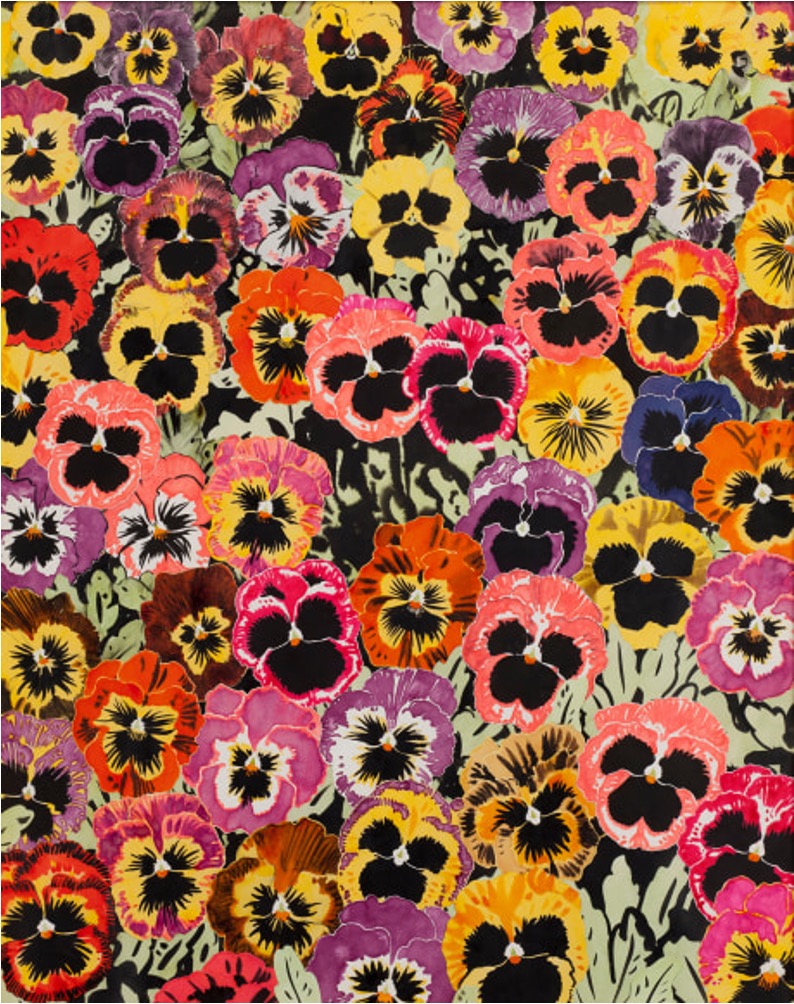
Figure 1: Joe Brainard, Pansies, 1968, watercolor and collage on paper, 28 x 22 inches
What if we considered Brainard's garden collages as surfaces that diffuse identity and pleasure while insisting on presence? Whether framed as cuteness or prettiness, his pansies are an example of feminized aesthetics that have historically been denigrated because of their association with the penetrable. Indeed, Emma Heaney's theory of sexual difference without cisness illuminates how penetrability has been linked with expendability and disposability.38 At the same time, those bodies that are subjugated in this way are often denigrated for bearing too much surface meaning. These bodies (particularly transfeminine bodies) have been made to represent a general freedom that could be made available to everyone, especially given heteropatriarchy's minority rule. But Heaney reminds us that heterosexuality's fiction of sovereignty also disintegrates in representations of desire as eruptions of diffused sensation, where penetrability is experienced as a desirable end. To be able to manage your own penetrability provides a clear, inclusive goal for feminism as a liberatory practice that asks you to surrender identities and receive solidarities as compensation.
Brainard's pansies literalize a surface that maintains this agency over penetrability — where this is a sexual category and a linguistic one — by flirting with the viewer and refusing pathos. The pansy does not need sympathy, it needs safety. Heaney further argues that "sexual difference without cisness" allows us to name the historical reality that a Luce Irigay inflected "vaginality" — the diffusion of sexual sensation and identarian sensation, to feel different from oneself — is not restricted to those assigned female at birth, particularly those who experience penetration as a positive sexual and sexed quality. Indeed, this same pansy, pitied by Ashbery for being all alone, was adopted by Lee Ann Brown as the masthead of her feminist press, Tender Buttons Press, for its multiplicity. In this logo, the pansy becomes an icon of this vaginality (two lips of the vulva touching), with two faces, dressed smartly, "buttoned up" in two dresses and coats. Garments and trimmings, decorative surfaces, multiply to "say all sides of a thing of a feeling all sides of the ways to approach like a flock of birds like an accordion form which rejects closure."39 Taken in this way, Brainard's gardens insist that the "pansy" contains desirable multitudes, even as he organizes under its two-dimensional name.
The Cliché as Picturesque Ruin
Brainard's gardens provide a model of sanctuary that neither discard personality nor flatten complexity. As the maker of these gardens, he boxes off a space where both identity and pleasure are diffused — left open to meaning, gifted to a friend, and lastly turned outwards for a wider audience. He achieves this by playing with already commodified ways of looking and feeling, using scale to manipulate these.
This resonates with Glück's understanding of ornamental niches, too, carved out of mix-and-match culture. In his collected essays, Communal Nude, Glück considers the importance of miniature dream-worlds that are all decorative surface. His analysis of genre television, which I will briefly discuss here, maps on to the garden. For example, he compares programs like Angela Lansbury's Murder She Wrote and Miami Vice to revival architecture or the retro styles of the 1990s typified by Denise Scott Brown and Robert Venturi's Learning from Las Vegas.40 Through their predictable usage of cozy local settings, "decorative malaise" (affect as decoration) and character acting of days gone by, they pitch a fantasy of a knowable community. These cliché "types" — the cowboy, the detective, the travelling salesman, the ivory-tower intellectual — are pleasurable because they "rhyme" or overlap with the audience's point of view, reintroducing human scale. These generic "ruins" are then reintegrated into a new context that is provided by history, "they are a strategy to reintroduce human scale, to bring the already-known into a dynamic relation with the present, a response to our hunger for community and shared experience."41 Made smaller, for the screen, they are more manageable. As the Marxist historian Raphael Samuel reminds us, these popular theatres of memory act out a meta-commentary on the present. 42 They achieve this not by purporting to historical accuracy, but through style, "the symbolic space into which or imaginative categories into which representations are fitted."43
What is crucial to note here is that these ruins do not look ruined. These clichés hold their shape, even as they register more forcefully as ruins than other fragments of language because they are worn smooth. Clichés are the port in the genre-flail; they are Joe Brainard's favorite hard Christmas candies with 2D flowers punched all the way through like a stick of rock.44 In a reversal of expectations, they can feel more true in their capacious impersonality than the custom-made. As Lauren Berlant puts it, "when crisis is ordinary, flailing — throwing language and gesture and policy and interpretations at a thing to make it slow or make it stop — can be fabulously unimaginative."45
How, then, to activate these fragments? In the same essay, "Fame," in which Glück describes genre television as a ruin, he also references the presence of art in gardens as one such model, writing that:
Robert Smithson's little essay on art in gardens allowed me to understand the fragment in writing. It may clean the windows of perception, or combat the tyranny of unitary meaning, or express women's experience, or convey spiritual states, or escape the confines of self, or bring the finished work closer to the process of writing, or break the fiction of narration, or make words opaque; but more, the fragment of language evokes the melancholy pleasure of a ruin, the destruction of a place to live, the falling away of human scale, the relinquishing of meaning, the falling away and recontextualizing of human scale to include the nonhuman, the unshared, mysterious, and unsharable—which is shared. 46
Glück is most likely talking about Smithson's essay from 1968, "A Sedimentation of the Mind." 47 This is curious, because from reading this piece, you would think that Smithson despises gardens. In a section titled "Better Homes and Industries," he critiques a photoshoot of the sculptor Anthony Caro's work in outside settings. In one of these photos, the luminous yellow painted steel Prima Luce, 1966, sits atop a well-cut lawn and is matching to the daffodils that peek out from behind it. Caro's work "picks up its surroundings" and suggests the "contrived, but tamed wilderness" of English gardening traditions. Smithson acerbically asks, "could one say that art degenerates as it approaches gardening?" Going further, it is the kinds of upscale "shelter" magazines that Glück himself wrote for, such as Better Homes and Gardens and House Beautiful, that perpetuate the "wasted charm" of tranquil gardens masquerading as "ideal nature." Smithson dedicates his sole footnote to working out why gardens are so abysmal, setting upon the reason that they always involve a "fall from somewhere or something and the certainty of the absolute garden will never be regained."48 Even worse than the idea of a "degraded hell," America abounds in degraded paradises or "banal heavens." So, how does Glück transpose this for his own ends, when he clearly loves gardens in all their everyday delightfulness?
In the next section of this article, I turn to Glück's staging of fictional gardens to illuminate how his integration of these "banal heavens" into the space of the novel — that vast, contextual field of language that is cast as a dimensionless utopia — activates the melancholy of ruin. As I will go on to elaborate, these garden settings capture an entwinement of desire and loss, and a jumbling of human pasts, presents and futures.
"Banal Heavens": Memorial Gardens in Glück's Fiction
Cliché really comes into play in Glück's fiction, where gardens register the dialectical cleavage between real life and life as it wants to be. In a piece that was first written for the San Diego Reader, "I buried my dog Lily in the garden" (1995) and republished as "Dog Soup" in Communal Nude, Glück stages the pain of trying to construct a suitable tomb for his dog Lily.49 He dramatizes this attempt as a corrupted heaven that rejects Lily's body and turns her into a "monster," emitting a foul-smelling stench that means she has to be dug up and reburied. Burying someone that he loves, who has "just stopped" in a hole in the ground is more incredible than heaven or resurrection. And yet as in the most clichéd of tearjerkers, the dog always dies.
Glück, though, would happily settle for an even more banal vision of heaven than Robert Smithson's corrupted national parks and public spaces. Glück describes how even the most modest garden is a vision of paradise, a place where you can enjoy the pleasures that you would be enjoying continually if life were more like heaven. These are the pleasures of an unbeleaguered "I" that floats happily in sociality between a series of treats that could go in any order: "I sit and talk with a friend, I drink a cup of tea, I look at buds that will turn a wisteria into a blue river free of gravity, I daydream, I flirt, I attend a wedding, a party." The scenery confers on these a sense of occasion. Heaven is the present tense.
If heaven is a richly decorated place where you can do the meaningful things that late capitalism and governmental neglect steal from you, then this is not at odds with agitating for better political conditions, but an expression of it. A tomb is an effort to dig out a future for someone that now exists in the past while your present marches on. Glück's difficulty jackhammering through the shale describes the difficulty of this task and the freshness of mourning. After the sublime pain of burying Lily once, the garden humbles him with its indifference to his life: "the plants didn't seem to mind the smell even as it got stronger and more negative. I guess they were making the point that plants are not people." Glück's sentence wanly echoes the trajectory of Donna Haraway's thought, as companion species gives way to compost poetics.50 Plants, with their own generational times and their own narratives (that unfortunately for them do not include campy horror B-movies), have better things to do than commune with him.
The portrait that Glück draws is one of generosity at a human scale: all this in the world and I am still writing an elegy for my dog. One of the most gut-wrenching moments comes when Glück slips into gardening catalogue register as he describes the rose he has chosen to plant on Lily's grave. He has chosen a Gloire de Dijon, "a lovely Tea from 1853, with creamy buff flowers containing a dazzle of apricot-gold in their middle," which were the colors of her fur. It is only more moving that this rose, with its proper name, is framed by the language of the commodity.
Loving a dog is in some ways easy because of the impossibility of speech: when a dead dog emits messages, they are encoded as flowers. Both dogs and flowers bear their human-given names lightly. Glück excitedly points out the corner of Peggy Guggenheim's famous sculpture garden where she is buried along with her "babies," "Sir Herbert, Lola, Lulu, Kachina, Imperator, and finally Peggy herself!" (Glück leaves out my personal favorite, Cappuccino). These diminutive names are made more emotive when etched in the lapidary style, carving a gap between reality and the tomb as time slows its flow.51 In contrast, an ex-boyfriend can be far worse at cohabiting, can hurt you in myriad ways, can talk back to you.
If Glück's tender elegy for Lily is a form of container garden that undergoes a "haunting," then About Ed, Glück's book for his ex-partner, artist and professional floriculturist at the San Francisco Conservatory, Ed Aulerlich-Sugai, is another. This book is Glück's attempt to carve out a space to locate his tender and complicated feelings for him. It comprises of a series of hybrid texts written and worked on after Ed's death from complications with HIV in 1994. Like gardening and, like Glück's other works, he plays with scale to try and get the duration of a life into the book, to create a space that he can visit, that can weather the change and decay of shifting context: "What can I write for Ed?" The question puts faith on the cafe table with the mealy apple and chopped orange, meaner allegory garden of decay and orderly renewal. Scale falls off the map: To die and return from the grave."52 To do this, he decides that he needs to bring Ed into the story because he is "capable of a talkative grief that can still be trusted."53 It takes a while to meet Ed. First, we get to know the fictional Bob and his world of narrative. This first section is titled "Everyman," named for the fifteenth-century allegorical play where man tries to justify his time on earth. The wholeness of allegory splinters in its twentieth-century context. The most whole things that the twentieth-century "everyman" has access to are clichés.
Before we meet Ed, we meet Bob's neighbor Mac, who is dying from lung cancer. Bob casts Mac as a fellow novelist working outside of the medium: he is a "master of ephemera" who loves to meddle in his neighbors' gossip and surveil the comings and goings of the street. Mac's face "inhabits the sky," scooping out space so that the drama has its theatre.54 Bob wants his fantasy of community romance, with its easy trading of quotidian stories, intact. Good fences make good neighbors describes their inner lives, but this is challenged when Mac pejoratively calls his neighbor a Jew. Bob would rather not know if Mac and his wife Nonie "casually make chitchats from racial slurs over dinner in their yellow kitchen."55 Bob wonders if this unjust interpellation, as homegrown and exotic as fascist demons in movies, is punishment for forcing Mac to represent the past. Bob does not want anything to change, he needs the fantasy of neighborliness and the tit-for-tat simplicity of gossip.
That disjunction between Mac's speech, his actual life, and the romance Bob invents, is too much to bear: he needs the fiction of the local to hang onto, even if it is cliché. In the next section of the story, Bob visits Mac in the hospital. A slice of pecan pie bleeds amber syrup on a Melmac plate in his imagination, an image that is more corporeal, more sculptural, than the "dull summary" of illness at the hospital. The hospital's ambient anxiety mirrors the list of headlines for the week that are reproduced on the pages before. A choice sentence: "Pharmaceutical firms scrambled for the profits from the new AIDS blood test, the Dow surged 15.35 points to a record high, and an earthquake killed at least eighty-two on Chile's coast."56 Bob and his then boyfriend, Denny, escape into daydreams about shared domesticities while browsing Architectural Digest, trying on myths of habitation like new hats.57 They consider "a glazed chintz, silver peonies drifting on grassy green — the brief entertainment of lifting a flower to your nose." Their game, flicking through the heavy pages of this expensive magazine, is "so retro" but above their acted-out feelings, retro, neo, post and pseudo, "arched a rainbow of pleasure."58 Then Mac breaks the social contract by dying — an intimacy that seems to shame Bob. It is so shocking to be friends with a corpse. After Bob misses the funeral, he stages a secular communion by eating Mac's monument, a fish almondine ready meal: "to eat Mac's food, which was anyone's food — a generic confrontation with salt, oil, too sweet, pumped up with flavor, empty and exciting, a little sensational."59 This memorial garden is the living room. The ready meal is inflated, bombastic even, but it feels true.
When it comes to Ed, Glück finds it hard to write because doing so "opens the weave of experience, unlocks the present, and gives it density."60 Glück's existing New Narrative strategies for writing about the present flail when they come to Ed's new existence in multiple tenses. Glück admires Ed's faith in the future, which will go on without him. He is interested by Ed's "powerful optimism that a graveyard or a story might open a 'beyond,' conveying an inside-out-ness of time."61 Ed believes in the future audience for the tomb that he designs for himself, which depicts a heaven with a lack of detail. His faith in a world to come, against the backdrop of the debased public sphere of the Reagan and Bush years, astonishes Bob, who is stuck in the present with its inventory of stuff.
When Ed dies, Bob becomes obsessed with a line from Frank O'Hara's poem, "A Step Away From Them": "is the earth as full, as life was full, of them?" O'Hara's poems are stuffed with the transient consumables of everyday life, a malted milk, a film star, poetry that fits squarely in your pocket. If this array of things adds up to the fullness of a life, what is it that Ed takes with him? He cannot account for this himself. Bob's familiar encounter with an individual's alienation from language is supplanted by the more profound alienation of a state before language: "I say, 'He died, but...' and there is no but. But when I improve a sentence, I'm that much closer to him."62 Ed never felt the same relationship to language: in the seventies, Bob is the one who teaches "Silent Ed" how to talk. Every evening, Bob asked him to report on his daylong journey. Standing in line at the bank took as long to relate as actually standing in line at the bank.63 Ed used language at a 1:1 scale, to lubricate his access to other people's bodies, "a higher form of utility;" meanwhile Bob tends to "swamp" interpersonal experiences, bartering information instead. But the reader is there with him, in this swamp of language.
Reading About Ed, it is hard to see Ed's terminality as a condition that can give rise to moral lessons (I will return to this in the final section), not least because he is not the one who must grieve his own absence. Glück is the one who is left behind in the weft of the present, embedded in the cliché that is language. In order to assemble meaning from this expansive field — to "get that gorgeous girl out of the rock!" — he treats the prose architecture of the book like a garden that is constantly being made and decomposing. About Ed ends with Ed's own dream journal, moving backwards in time. Each section of "Inside" begins, "Before that," until we arrive back at the start of the book, with Mac's readymeal, taken inside Bob. It reads as though Brainard's "I remember" was a VCR tape that could be played on rewind, spooled back in— finishing the book, you are tipped back out of suspended "garden time," taking Ed inside you. Like a memorial garden, the reader can revisit Ed, and every visit will be different: what will remain in common is that this cultivated "patch of earth" will receive your devoted attention while you are there. Glück's clichés, with their counterintuitively durable quality, hold their shape even as the precise vernacular of commodity culture moves on. It is a picturesque ruin even though there are no visible signs of decay, furnishing that historically produced, artificial and miniaturized stage-set that is novelistic space. Ed is diffused across this textual surface, in its pockets of pleasure, pain, silence and chattiness.
Ecocriticism and The Potential of Cliché
In the final section of this article, I want to reflect on whether this positive, recuperative conceptualization of cliché might suggest possibilities for queer ecocriticism. Specifically, there is a prevalent cliché in criticism: the endlessly renewing potential of queer gardening as mitigating the climate crisis. A popular example is the writing and gardening of filmmaker Derek Jarman.64 While the contrasts between Glück and Jarman are perhaps obvious — Glück's garden is in the urban Bay Area, Jarman's Prospect Cottage is sited on the Kent coastline in England — both cast the garden as a manmade sanctuary decorated with fragments of history, conditioned by ecological destruction and governmental neglect. Glück was a member of the nuclear protest group Enola Gay; a nuclear power plant looms over Jarman's house. They both hosted and entertained friends and lovers in their gardens, reclaiming sociality and domesticity where they could. Yet no one would describe Prospect Cottage as "cottagecore," even though it kind of is: Jarman just called it "modern nature." The pleasurable ruins that Glück makes use of are closer to the "trashy" pulp of feminized mass culture than the repurposed trash, or objets trouvés, Jarman scavenged from the coastline.65 For my purposes thus far, this has been helpful because cliché makes it easier to see how this aesthetically denigrated, easily replicable content plumbs the imaginative commons. Whereas Prospect Cottage almost works in reverse. His stylized aesthetics of decay have come to symbolize exceptional resiliency and adaptivity, obscuring the widespread appeal and acclaim of this incredibly influential figure.
Ecocriticism takes the site-specific beauty of Prospect Cottage and suggests that it offers an ethical code for life in the Anthropocene. The ways that Jarman "defiantly" pursued pleasure and creativity despite his terminal diagnosis are made to point to how people should inhabit other landscapes that are irrevocably damaged by climate change. For example, for scholars such as Melissa Zeiger, the semiotics of his garden model a way of living with "terminality" — an acknowledgment of 'too-late' capitalism that cannot be reversed.66 Rather than imbibe his diagnosis as imminent emergency, she argues that Jarman's meditative and reflective gardening practices engage with terminality as a condition to be lived, exploited and shared. For Zeiger, this is conditioned by his acknowledgement of Dungeness as "post-nature" and Prospect Cottage presents "exemplary images of persistent vitality in the damaged world."67 Facing head on the non-existence of "unspoilt" nature, he tends to the already-harmed. His relation, improvement, and investment are predicated on the knowledge that things are going to end: he does not veer chaotically from puritanism to paralytic despair, he scavenges, repurposes, reconsiders. Thus, as Sarah Ensor suggests, Jarman shows us that, "our task may be to train ourselves and each other how to steward within this terminal temporality." 68 Similarly, in their latest book, The Garden Against Time, Olivia Laing describes how Prospect Cottage is a "manual" for improvising a "spent fuel pool" or "dry cask storage" for deeply-buried trauma. 69 Anahid Nersessian is more explicit about this being a question of how to read the landscape. For her, the porosity and lack of boundaries at Prospect Cottage model an ethics that cuts against paranoid reading. This can teach us how to read better: she advocates for an ignorant epistemology that rejects personal identity and self-interest as a catalyst for moral action. 70 The garden itself is a cohesive semiotic expression of flourishing beyond rigid borders and picket fences that bely a paranoic desire for human control: it is a place where "improbable beauty and eroticism" blossoms where no soil for them exists. Lichen, rust, roughness, salt, sharpness, rotting wood, tough, prolific, and self-seeding plants mount a "queer" critique of a traditional hierarchy of horticulture and the proprietary that is represented by cultivated roses and other labor-intensive, expensive plants, or the monocultural lawns of the nearby seaside town of Bexhill. Chance and contingency yield more diverse and beautiful futures than Jarman's most-hated, water-guzzling, chemical-laden visual blanks: "I am so glad there are no lawns at Dungeness. The worst lawns, and for that matter the worst gardens, are along the coast at Bexhill in close and crescent. These are the 'gardens' that would give Gertrude Jekyll a heart attack or make her turn in her grave." 71
This gives an important insight into the evolution of Prospect Cottage's aesthetic: Jarman interprets Gertude Jekyll's traditional English cottage garden with its picturesque principles. Jekyll herself formalized the cottage garden as a conscious rejection of Victorian modernity's destruction of a former, artisanal way of life. Not her way of life, I should add — but it took with it her favorite cottage gardens, as seen from the road on a drive in West Surrey, writing that "cottage folk are a great lover of flowers, and their charming little gardens, in villages and by the roadside, are some of the most delightful incidents of road-travel in our southern counties." 72 She goes on to praise how the smaller the space, the more is crammed into it, exemplifying how much could be done with "little means but much loving labour."73 These "little gardens always seem to speak to me of the joy of life and cheerfulness of disposition, that are such fine attributes of the character of our genuine country folk. It was more clearly shown two generations ago, when men's lives were less hurried and more concentrated, and when the simple country life was fuller and more satisfying."74
Neither Jekyll nor Jarman were descended from these two-dimensional "genuine country folk" and they both benefited from belonging to the taste-making class. But more important than litigating the line between Jarman's aristocratic snobbery and campy snark, Prospect Cottage has been celebrated for its innovation for at least twenty-five years.75 In the late 1990s, high-profile professional gardeners Beth Chatto and Christopher Lloyd admired his application of drought-resistant gravel and applied it to their own work. Prospect Cottage, and indeed Dungeness, has a totally different status now.76 A brief glance on the UK property site, Rightmove, reveals that a single-story refurbished fisherman's hut with a "fabulous" view of the shingle spit will set a buyer back roughly half a million pounds. The Pobble House by Guy Holloway Architects was longlisted for the best new home in the UK in 2015 and is clad in Siberian larch, Core-ten steel mesh, and grey cement fiberboard, chosen to withstand harsh winds and rain and to weather beautifully. Simon Conder Associates have built two new fisherman's huts clad in eco-friendly black rubber: one of these has a steel 1954 airstream caravan for an extra guest bedroom. Holiday makers can stay in a choice of stylish, minimalist accommodations boasting no neighbors and fresh shellfish. All of these have been built to exacting planning regulations specifically put in place by Shepway District Council for environmental conservation. It is now consensus, enshrined in legislation, that this stretch of coastline is English heritage worth protecting. If anything, Prospect Cottage and its neighboring dwellings demonstrate the necessity of financial and legal backing in ring-fencing sites of ecological interest — to enforce low intervention from developers.
So, is it possible to say that writing about the garden at Prospect Cottage might be approaching the territory of cliché? And if so, what can we do with that? I have been arguing that cliché is actively positive because it is shared currency, agreeing with Glück that group practice resides inside the commodity. If we can recognize that Prospect Cottage performs a lot of imaginative work for a lot of people, perhaps we might help retain some specificity — to honor Jarman's embodied life and work — while also acknowledging its more general valence. The work that Prospect Cottage often does as a critical object is as a powerful container for fantasies about the present that are tended to through beautifully crafted description. These arguments for thinking differently are made aesthetically — furnishing the essayistic space like retrofit, picking and choosing what speaks to an audience at a particular moment. A well-behaved critical object propels the narrative of an argument but leaves it open to lateral interpretation. But the power of a good metaphor can be seductive: especially when material-ecocriticism's storied matter demands a vast and lively terminological landscape of "whirling" and "veering".77
For instance, we might think of Natalia Cecire and Samuel Solomon's critique of the cultural trend towards "mycoaesthetics." Here they demonstrate how fungi often populate fictions about surviving the end of the world without illuminating or changing anything about the actual workings of capital. Mushrooms spontaneously appear as an untapped miracle resource that thrive on nothing, bowling us over with a sense of sublime wonder at the representation of networks of information, coursing through the cybernetics-redux nodes of the wood wide web. 78 Just as fungal networks appear too dizzying to grasp, writing about Prospect Cottage tips the reader out of the ambiently crisis-strewn present and into the more pleasurable "garden time" of the essay. Here, the reader encounters the sublimity of the looming power station, the traumatic weight of history, the beauty of decaying fragments, coming together in the miniaturized space of the book or journal that — just like Gluck's clichés — reintegrates the fiction of human scale by disturbing it. Then you are right back where you started, plotting the future, imagining how you are going to survive your personalized end of the world.
Textual space is one of the only spaces where it is possible to rearrange the world in this way, to interrupt what Anna Kornbluh calls "the hegemony of the immediate," defined by immanency, personalism, blur, and flow.79 If you want, you can erase the fact that "making do" in your own life as-lived means shopping in the reduced aisle of a chain garden center. You can orient yourself toward fantasies, create a thick wedge of mediation between live as-lived and life as you want it to be. I can think of a few relevant examples concerning Prospect Cottage. The revival of British folk heritage claims a leftist, people's history rooted in the lost traditions of the land.80 A yearning for a less commodified queer community that subsequent generations have never known. A mobilization against the emboldened transphobia and anti-immigration in Britain, embodied by the small boats in the English channel that can be seen from Dungeness. A cottagecore fantasy of withdrawing from this debased public sphere into a protective commune. Perhaps, also, a pastoral rejection of the suburban trappings of patio heaters and fire pits — a lo-fi desire to be free from consumerism, or, conversely, a desire for clean, expensive minimalism worthy of Architectural Digest? A niche to put all the above feelings? A site to grasp the weight, the risk, of history — of different kinds of loss that stretch far beyond this plot?
I am not suggesting that the function of literary criticism is merely diagnostic. Rather, Glück's treatment of clichés wakes them up, shaking up the relationship between the text and reader. His textual strategies experiment with combining the different pleasures of text, metatext and narrative to analyze the present, foster solidarities and get rid of meaning: all without mining his community to extract stories or lessons. The beauty and the profundity of the surfaces that he tends to make a case for forms of mediation that can account for the wholeness of clichés and then keep adding. In a field proliferating with "better stories to live by," we undoubtedly need strategies for integrating them with the residual, comforting stories of the "already-known."81 And in the meantime, we'll keep reading, organizing, and talking among ourselves — striving for banal heavens, sitting on the curb admiring the dandelions.82
Kate Schneider is a writer, artist and library worker based in Dublin. Schneider's work includes Denim Jeep (2026), Flake (2025), and Deli Poem (2023).
Banner Image from Harold A. Taylor's Autochromes of California Flowers (early 20th century), The Public Domain Image Review
References
- Robert Glück, "The Art of Fiction No. 260," The Paris Review 245 (2023).[⤒]
- Erin Barbeau et al, "Queer Fragmentation and Trans Urban Aesthetics: From Cyberpunk to Cottagecore," Glocalism: Journal of Culture, Politics and Innovation 1 (2022).[⤒]
- Denise Riley, Impersonal Passion: Language as Affect (Duke University Press, 2005), 4.[⤒]
- Robert Glück, Margery Kempe (Serpent's Tail, 1994), Jack the Modernist (Serpent's Tail, 1995), About Ed (New York Review Books, 2023).[⤒]
- Robert Glück, "Secret Gardens in East San Diego, East County, University Heights, Rancho Santa Fe: What we love chooses us," San Diego Reader, June 2, 1994.[⤒]
- See the special issue, "New Narrative now", of Textual Practice 35, no. 8 (2021) edited by Diarmuid Hester and Kasia Boddy for a carefully drawn genealogy.[⤒]
- For instance, Rachel Stein, ed., New Perspectives on Environmental Justice: Gender, Sexuality, and Activism (Rutgers University Press, 2004); Maya J. Bird and Noreen Giffney, eds., Queering the Non/Human (Routledge 2008); Catriona Mortimer-Sandilands and Bruce Erickson, eds., Queer Ecologies: Sex, Nature, Politics, Desire (Indiana University Press, 2010); Nicole Seymour, Strange Natures: Futurity, empathy, and the Queer Ecological Imagination (University of Illinois Press, 2013).[⤒]
- See Nicole Seymour, "Queer Ecologies and Queer Environmentalisms," in The Cambridge Companion to Queer Studies, ed. Siobhan B. Somerville (Cambridge University Press, 2020).[⤒]
- Nicole Seymour, Bad Environmentalism (University of Minnesota Press, 2018).[⤒]
- Walter Johnson, "On Agency," Journal of Social History 37, no. 1 (2003).[⤒]
- Lauren Berlant, Cruel Optimism (Duke University Press, 2011).[⤒]
- Declan Wiffen, Sophie Seita, and Naomi Woo, "bingenTV and the Hildegard von Bingen Society for Gardening Companions: A Conversation Between Sophie Seita, Naomi Woo and Declan Wiffen," Green Letters 29, no.1 (2025).[⤒]
- Robert Glück and Sarah Schulman, The Elder Series #2: Robert Glück and Sarah Schulman (Belladonna, 2008); Sarah Schulman, Girls, Visions and Everything (Seal Press, 1986).[⤒]
- Schulman, Girls, Visions and Everything, 21.[⤒]
- I am thinking, for instance, of Cathy Cade's container garden on the edge of a sea of concrete in industrial Oakland, which she writes about in Garden Variety Dykes: Traditions in Lesbian Gardening, eds. Irene Reti and Valerie Jean Chase (HerBooks, 1994). She gardened in between two part-time jobs, raising her kids, political organizing and photographing the LGBT+ community. She wrote, "If there is a bare spot in my garden, I do not work hard and I don't wait very long. I go to the store and for one dollar I buy a plant and fill in the bare spot. If the blooms and colors are unbalanced, I move the pots around until I like the effect. No more deferred gratification for me," 27.[⤒]
- Kaplan Page Harris, "Avant-Garde Interrupted: A New Narrative After AIDS," Contemporary Literature 52, no. 4 (2011): 630-57.[⤒]
- Eve Kosofsky Sedgwick, Touching Feeling: Affect, Pedagogy, Performativity (Duke University Press, 2002), 150-151.[⤒]
- Robert Glück, "Sin Jen, a romantic gardener in Ocean Beach: Get that gorgeous girl out of that rock," San Diego Reader, July 27, 1995.[⤒]
- Robert Glück, "The Art of Fiction No. 260."[⤒]
- Robert Glück, "The Art of Fiction No. 260."[⤒]
- Robert Glück, "Long Note on New Narrative," Poets.org, 2004.[⤒]
- Robert Glück, Communal Nude (Semiotext(e), 2016), 15.[⤒]
- Glück, Communal Nude, 224.[⤒]
- Glück, Communal Nude, 15.[⤒]
- Glück, Communal Nude, 15.[⤒]
- Glück, Communal Nude, 17.[⤒]
- Glück, Communal Nude, 294.[⤒]
- Glück, Communal Nude, 41.[⤒]
- Glück, Communal Nude, 41.[⤒]
- Denise Riley, The Words of Selves: Identification, Solidarity, Irony (Stanford University Press, 2000).[⤒]
- Riley, The Words of Selves, 16.[⤒]
- Riley, The Words of Selves, 12.[⤒]
- Robert Glück, About Ed, 69.[⤒]
- Joe Brainard, I Remember (Granary Books, 2001).[⤒]
- Brainard, I Remember, 36.[⤒]
- John Ashbery, as quoted in Brian Glavey, "John Ashbery's Shyness, or, Lateral Ekphrasis," in The Wallflower Avant-Garde: Modernism, Sexuality, and Queer Ekphrasis (Oxford Academic, 2015), 144.[⤒]
- Gavin Butt, "Joe Brainard's Queer Seriousness, Or, How to Make Fun of the Avant-Garde," in Neo-Avant-Garde, ed. David Hopkins (Brill, 2016); see also, Jessica Q Stark, "Nancy and the Queer Adorable in the Serial Comics Form," American Literature 90, no. 2 (2018): 315-345.[⤒]
- Emma Heaney, Feminism Against Cisness (Duke University Press, 2024).[⤒]
- Lee Ann Brown, https://www.tenderbuttonspress.com/aesthetics.[⤒]
- Robert Glück, Communal Nude, 39.[⤒]
- Glück, Communal Nude, 38.[⤒]
- See Raphael Samuel, Theatres of Memory (Verso, 1994).[⤒]
- Samuel, Theatres of Memory, x.[⤒]
- "I remember 'hard' Christmas candy. Especially the ones with flower designs. I remember not liking the ones with jelly in the middle very much." A line from Joe Brainard's 1970 memoir, I Remember, 89.[⤒]
- Lauren Berlant, "Genre Flailing," Capacious: Journal for Emerging Affect Inquiry 1, no. 2 (2018): 157.[⤒]
- Robert Glück, Communal Nude, 38.[⤒]
- Robert Smithson, "A Sedimentation of the Mind: Earth Projects," Artforum, September 1968.[⤒]
- Smithson, "A Sedimentation of the Mind."[⤒]
- Robert Glück, "I buried my dog Lily in the garden: A stench fouls paradise," San Diego Reader, February 23, 1995.[⤒]
- I refer you to Donna Haraway, The Companion Species Manifesto: Dogs, People, and Significant Otherness (University of Chicago Press, 2003) and Staying With the Trouble: Making Kin in the Chthulucene (Duke University Press, 2016).[⤒]
- See Denise Riley, "On the Lapidary Style," differences 28, no. 1, (2017): 17-36.[⤒]
- Robert Glück, About Ed, 44.[⤒]
- Glück, About Ed, 32.[⤒]
- Glück, About Ed, 3.[⤒]
- Glück, About Ed, 3.[⤒]
- Glück, About Ed, 9.[⤒]
- Glück, About Ed, 15.[⤒]
- Glück, About Ed, 15.[⤒]
- Glück, About Ed, 30.[⤒]
- Glück, About Ed, 158.[⤒]
- Glück, About Ed, 80.[⤒]
- Glück, About Ed, 159.[⤒]
- Glück, About Ed, 77.[⤒]
- For example, Melissa Zeiger, "Modern Nature": Derek Jarman's Garden," Humanities 6, no. 2 (2017); Joe Crowdy, "Queer Growth: Peace and Refuge in the Garden," Architectural Review, January 26, 2021; Gardening (Against) the Anthropocene special issue of Ecozona 14. no. 1 (2023); Olivia Laing and Richard Porter, eds., A Garden Manifesto (Pilot Press, 2024).[⤒]
- The relationship of trash to cliché has been discussed at length. Some critics argue that cliché is the verbal equivalent of detritus. They seek to recover cliché from this "trash heap" through strategies like juxtaposition and defamiliarization. Art, this argument follows, has the power to make ordinary language surreal. Yet, as C. Namwali Serpell points out, this first approach treats cliché as kitsch, and the second gives it the gloss of camp — undoing cliché until it is no longer cliché. Serpell suggests a phenomenological approach that attends to clichés shared affective and material affordances. See C. Namwali Serpell, "A Heap of Cliché" in Critique and Postcritique eds. Elizabeth S. Anker and Rita Felski (Duke University Press, 2017), 153-182.[⤒]
- Zeiger, "Modern Nature."[⤒]
- Zeiger, "Modern Nature."[⤒]
- Sarah Ensor, "Terminal Regions: Queer Ecocriticism at the End," Against Life, eds. Alastair Hunt et al. (Northwestern University Press, 2016), 54.[⤒]
- Olivia Laing, The Garden Against Time: In Search of a Common Paradise (PanMacmillan, 2024), ebook.[⤒]
- Anahid Nersessian, The Calamity Form: On Poetry and Social Life (Chicago, 2020).[⤒]
- Derek Jarman, Derek Jarman's Garden (Thames and Hudson, 1994), 7.[⤒]
- Gertrude Jekyll, Old West Surrey (Longmans, Green and Co., 1904), 208.[⤒]
- Jekyll, Old West Surrey, 208.[⤒]
- Jekyll, Old West Surrey, 217.[⤒]
- Beth Chatto, Beth Chatto's Gravel Garden: Drought-Resistant Planting Through the Year (Viking, 2000).[⤒]
- Prospect Cottage is profiled in a range of mainstream gardening advice books, including by the BBC's Gardener's World regular, Carol Klein in Making a Garden: Successful Gardening by Nature's Rules (Octopus, 2015); Deborah Jolley, Planting Design: Seaside and Shelter (Liverpool University Press, 2013); Thomas Rainer and Claudia West, Planting in a Post-Wild World: Designing Plant Communities for Resilient Landscapes (Timber Press, 2016); Scott Calhoun, Designer Plant Combinations: 105 Stunning Gardens Using Six Plants Or Fewer (Storey Publishing, 2012).[⤒]
- Jeffrey Jerome Cohen and Lowell Duckart, "Welcome to the Whirled," in Veer Ecology: A Companion for Environmental Thinking, ed. Cohen and Duckart (University of Minnesota Press, 2017); this line of investigation is influenced by Dixa Remirez-D'Oleo, who argues in her recent book This Will Not Be Generative that environmental criticism's mobilization of metaphors such as tentacles and tendrils, and an assumptive "we" and redemptive sympathy of "care" disguises extraction from Black people and Blackness. She argues that speculative rhetoric is often abetted by fantasies of white communion with indigenous groups and knowledge. (Cambridge University Press, 2023), 70.[⤒]
- Natalia Cecire and Samuel Solomon, "Mycoaesthetics," Critical Inquiry 50, no. 4 (2024).[⤒]
- Anna Kornbluh, Immediacy or, The Style of Too Late Capitalism (Verso, 2024).[⤒]
- For instance, the headlines proclaiming that "Derek Jarman's Prospect Cottage" has been "saved for the nation"; on magic and capitalism see Jamie Sutcliffe, et al., Documents of Contemporary Art: Magic, ed. Jamie Sutcliffe (MIT Press, 2021); Matthew Cheeseman, "English Nationalism, Folklore, and Indigeneity," in The Routledge Companion to Folk Horror, ed. Robert Edgar and Wayne Johnson (Routledge, 2023): 404-418.[⤒]
- See Jennifer Hamilton, Emily Potter, and Killian Quigley, "Do Stories Need Critics? Environmental Storyism and the Ends of Ecocriticism," Textual Practice 39, no. 8 (2024).[⤒]
- In addition to calling back to Brainard's dandelions, I offer one last shoutout to Small Press Traffic Literary Center, of which Glück is a co-director. Their visual identity, a dandelion, is inspired by the ambient character of the organization: "lots of standing on the sidewalk talking in clusters before and after the events. Having witnessed the warmth of these conversations ourselves, we now sat with this scene in our minds and saw in the background, growing through the margins of the sidewalk, dandelions; in full bloom, going to seed, and dispersing on the clothing and shoelaces of those attending the event. We imagined these seeds traveling with attendees, germinating and proliferating from event to event and throughout the community."[⤒]