Asian American Mass Culture
Mark Greyson, a pubescent mixed-Korean American boy, gazes up at his white father, Nolan, as they sit together on the roof of their house.
"Okay, Son, bear with me," Nolan begins slowly. "This is gonna be a little awkward for both of us. You may have noticed that I'm not like other dads. Your mother and I think it's time you knew the truth. We think you're old enough for me to tell you where I really come from."1
Such is an early scene in the first episode of Invincible — an animated superhero television series created by Robert Kirkman, first released on March 25, 2021 through Amazon Prime Video. Based on a comic book series of the same name, also authored by Kirkman, Invincible follows seventeen-year-old Mark Grayson, voiced by Steven Yeun, as he develops superpowers inherited from his dad and becomes the series' titular hero. Mark's dad, Nolan, voiced by J.K. Simmons, is Omni-Man, a Superman-like figure, born on a foreign planet named Viltrum and tasked to protect Earth. He revealed the truth of his identity when Mark was a young boy, intermixing it with the quintessential "talk" that parents often give their young children:
Millions of miles from here, out in deep space, is the planet Viltrum . . . It's a cool blue oasis alone in a solar system much like our own. I was born on this planet. Viltrumites are very similar to humans, except we can fly, move at super speed, and possess great strength. When our people come of age, we leave Viltrum, and venture out into the galaxy, using our abilities to help lesser-developed worlds. I volunteered to relocate to Earth, and be its sole protector. That's when I met your mother...and we eventually had you. I know this is a lot to take in at one time, but you're half-Viltrumite, Son, and you're getting older. Things are gonna start to change for you in a few years as you hit puberty. You're gonna get acne. Your voice will start to crack as it begins to change. You'll begin to grow hair in strange places, and you're gonna start to develop superpowers of your own, just like me. Super strength, and speed, and flight, the whole bit.2
It's a superhero origin story that is, for lack of a better word, corny. This story has been told before. It's unoriginal. That's because it's a lie. In a dramatic twist near the end of the first season, Nolan/Omni-Man reveals that he has been sent from Viltrum to slowly weaken Earth, preparing it for acquisition from the Viltrumite Empire, which has been slowly colonizing the galaxy. Intergalactic colonialism and imperial expansion serve as thematic throughlines in the show as Mark defends Earth from alien invaders, monstrous supervillains, and treacherous robots.
This paper offers what I am calling model minority militarism, a masculinist political project that reformulates the model minority from student to soldier. Rather than examining stereotypical cultural figurations of Asian Americans as geeky, nerdy, and sexless, this paper turns to cultural objects such as Invincible to argue that model minority militarism rearticulates the Asian American as a new tool — one that is physically formidable, heroic, and ostensibly masculine, while, ultimately, still a cog in the machine of the American empire.
To make my argument, I situate Invincible alongside our present political moment in the United States, looking specifically at how alien subjectivities are produced in both popular culture imaginaries and socio-political agendas. Tracing how both deployments of the alien are mutually imbricated, I seek to mine the precarious slippages around the alien's racialization for insight as to how Asian American subjectivities are used to reify the United States' national borders, contour notions of citizenship and belonging, and obfuscate imperial expansion. This paper's critical lens is informed by ongoing scholarship within Asian American cultural studies. Utilizing an Asian Americanist approach, I seek to simultaneously expose the ideologies latent in mass popular culture while reformulating shortcomings into potentialities. In other words, by interrogating how the narrative of Asian American belonging in Invincible belies imperial, white supremacist ideologies, I linger with Mark Greyson to ask how Asian American unbelonging reveals the contradictions of the nation state and how Asian American culture might, to borrow the words of Lisa Lowe, "give rise to new forms of subjectivity and new ways of questioning the government of human life by the national state."3
"THEY WALK AMONG US"
In the realm of science fiction, "alien" typically refers to an extraterrestrial lifeform that did not originate on Earth. The trope of the alien invader in science fiction media is nothing new, and in fact, has historic links to socio-political global tensions, particularly as such tensions involve Asia and Asian-raced bodies. Thomas Clareson, in tracing how early twentieth-century science fiction literature was influenced by industrialization, notes how fears of Asian invasions amid racialized paranoias, like the Yellow Peril, informed such writing at the time.4 Carter F. Hanson further articulates how Orientalist racial anxieties insidiously manifested in science fictional writing, implicitly taking on the form of political rhetoric:
The imminent crisis of competition for the "white race's" resources perceived by race theorists and science fiction writers was in part a product of the long history of immigration restrictionism based on the supposed detrimental effect of immigration on wage labor, which, concerning Asians, began as early as 1882.5
In 1920, Lothrop Stoddard, a known white supremacist and eugenicist, published The Rising Tide of Color: The Threat Against White World-Supremacy, in which he likened "the question of Asiastic immigration" to "truly alien hordes of the East and South."6
On Thursday, May 29, 2026, the White House launched the site alien.gov — an official government page that reads like the exposition to a science fictional film or novel. Against a galactic backdrop, the webpage's header reads: "THEY WALK AMONG US" in glowing green typography. "For 60 years, the U.S. government has kept a closely guarded secret," the webpage begins, "Aliens have been walking among us, living in our neighborhoods, and interacting with us in our daily lives."7 The webpage then offers President Donald Trump as "one man [who] finally had the courage to tell the truth. Bold. Unapologetic. Unafraid."8
The webpage takes clear cues from science fictional media, boasting an interactive "Alien Arrest Map" that charts where undocumented immigrants have been arrested by U.S. Immigration and Customs Enforcement (ICE) as well as an ever-rising counter that claims to track over three million "encounters" (presumably ICE arrests).
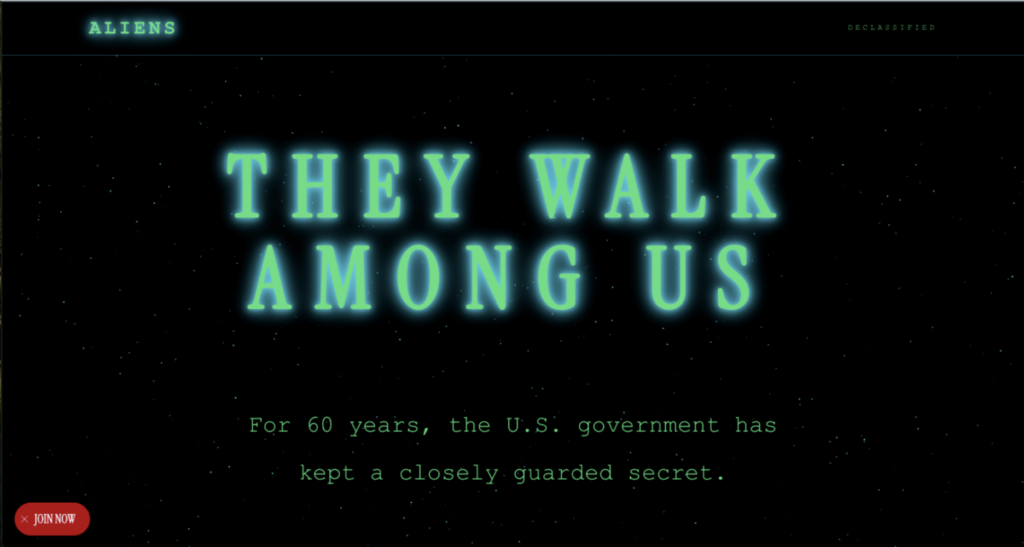
We see here how aesthetics from science fictional media are used to mobilize political agendas, configuring citizenship as a requisite to subjecthood, and more specifically, to human subjectivities. In any reference to undocumented persons, the webpage uses the language of "little green men," "aliens," "illegals," and even "it" — a rhetorical move that antagonizes undocumented persons as antithetical to the legal, human, United States citizen. Drawing from cultural studies scholars analyses of culture's role in structuring and propagating hegemonic structures of power, I point to this webpage as a clear entanglement between culture (science fictional tropes and aesthetics in particular) and political ideology. And it's with this current political backdrop that I turn to Invincible.
Refiguring the Alien/Asian in Invincible
Invincible's opening scene takes place at the White House. There, as two security guards discuss "superhero evasion training," the ground erupts, and out crawl the Mauler Twins — two blue-skinned Hulk-like figures, intent on killing the President. The Mauler Twins are bulletproof, and the White House's defensive guns do little to deter the two of them as they saunter toward the building. One twin raises his fists, about to deliver a deadly punch to one of the security guards, when suddenly, a team of superheroes soars in to save the day. It's the Guardians of the Globe — an Avengers-like assembly superheroes, led by The Immortal and composed of Martian Man, Aquarus, Darkwing, Red Rush, Green Ghost, and War Woman. As they battle the Mauler Twins, Omni-Man flies in, joining to help them. While not officially a member of the Guardians of the Globe, Omni-Man is a close ally of the team. The following fight scenes unfold predictably: Omni-Man and the Guardians of the Globe rescue all the nearby civilians and subdue the Mauler Twins, saving the day.
A couple notable things happen here. First, the opening scene locates the show in the United States. Understanding the White House as synecdochic for the United States more broadly, the Mauler Twins' attack on the White House can be understood as a terrorist attack on America. Their blue skin immediately denotes a non-white racialization, and their indistinguishable identicality calls to mind the "Siamese twins" Chang and Eng Bunker who toured the US and Europe in 19th century world's fairs and sideshows. In her writing about "the interchangeable Asian" through the trope of the clone, Michelle Huang explains, "the ubiquity of Asian interchangeability in predominantly white institutions reflects 'cross-racial bias,' or the psychological phenomenon by which the less familiar a person is with people of a different race, the more likely they are to use featural, rather than holistic, processing."9
Simultaneously then, the Guardians of the Globe's defense positions the team as defenders of America, and likely, American defenders. Further, the Guardians of the Globe are managed by a CIA-like entity called the Global Defense Agency. While the Global Defense Agency protects Earth, it is located in The Pentagon, implying that while its interests may be global, it is a branch of the American military industrial complex. There is also an "American-izing" of the Guardians of the Globe in the ways their characterization is unsubtly inspired by other classic American superheroes. The Immortal resembles Captain America; War Woman resembles Wonder Woman; Aquarus resembles Aquaman; Darkwing resembles Batman; and Red Rush resembles The Flash. It's also worth noting how, before the attack, the security guards speak casually about military training procedures such as "superhero evasion training." Through this exchange, we understand that superheroes have been absorbed and normalized within the American military and social imaginary. Importantly, although Omni-Man is not a part of the Guardians of the Globe, he presumably is an American citizen as well, as it's later revealed that he is married to Debbie, a Korean American woman living in an American suburb, and father to Mark.
The end of the pilot episode takes a dark turn when The Guardians of the Globe are all mysteriously summoned to their headquarters. Nobody is quite sure who sounded the alarm that called them all to HQ until Omni-Man steps out of the shadows to attack the Immortal. What follows is a mass murder. The Guardians attempt to fight off Omni-Man but ultimately fail; each one of them is brutally murdered by Omni-Man's fists. Omni-Man himself barely survives, and when medics arrive at the scene, nobody is sure of what happened. Through the rest of the season, government agents slowly piece together that Omni-Man is responsible for the Guardians' deaths, but they aren't sure why he killed them. While this is happening, Mark, Omni-Man's son, lives his life as a typical superhero teenage boy: dating, hanging out with his friends, and training to be like his father.
At the season's climax, Omni-Man reveals the truth to Mark. While he is an alien from the planet Viltrum, his home planet isn't quite as he originally explained. Instead, decades ago, Viltrum engaged in a eugenic-like process in which all inhabitants were required to battle one another. "It was a long and difficult process," Omni-Man explains. "When it was over, our population was cut in half, but what emerged from the ashes was unstoppable."10 Viltrum then set out to colonize the galaxy, taking over other planets through brute force and calculated genocides. Omni-Man explains:
Once I was old enough, I joined the war effort. It was hard, but I believe in our cause. Some species resisted, of course, but no one could withstand us for long. Soon, our empire encompassed thousands of planets. But as our territory grew, our forces were stretched thin and our expansion stopped. We needed a better, more efficient way to conquer worlds. Our most trusted officers were each given a planet to weaken by themselves. I was one of those lucky few. I couldn't tell your mother why I was here. But that time's come to an end, and now we need to get Earth ready to join the Viltrum Empire. Mark, this is good news. We can finally do what we were meant to do. Be who we were meant to be.11
In this way, Invincible reiterates historic anxieties of foreign infiltration, duplicity, and domination. The Viltrumites are portrayed as technologically advanced with sophisticated weaponry, machine-like physicality, and uncompromisingly brutal tactics. Such a portrayal echoes World War II media narratives of the Japanese as similarly minded, with such racial anxieties prompting the US to incarcerate approximately 120,000 Japanese Americans out of fear they might secretly serve the foreign enemy. In its characterization of the Viltrumites, Invincible also plays on techno-orientalist tropes, linking the foreign with a technological advancement that poses an existential threat to the West.
After Omni-Man tells Mark the truth, Mark refuses to join him, and the two battle. The aftermath is gruesome, with countless civilian casualties. Omni-Man eventually takes the upper hand but is unable to kill his son. When Mark wakes up, he is told that he has been in a coma for two weeks. "Aren't you going to tell me what happened?" Mark asks Cecil, the director of the Global Defense Agency. "That depends," Cecil replies. Mark asks him, "On what?" To which Cecil answers, "On if you still want to be a hero or not."12 A minute later, Cecil reiterates this point: "We need a replacement. Your dad didn't leave me with a lot of options, Mark. If I can't call on you, well, there's not really a list past the Guardians of the Globe."13
In this scene, we see Mark being recruited by Cecil as a military agent — a layer of defense against the colonizing Viltrumites. We might also read here the conditions for Asian American belonging. Broadly speaking, Mark is the defender of Earth, but ultimately, he is an American hero. Even Cecil, the director of the Global Defense Agency, wears an American flag pin on the lapel of his suit.14 In answering to Cecil, Mark then becomes a literal agent of the American military state. As Stephen Hong Sohn points out, science fiction tales that have an antagonistic Alien/Asian figure typically have an American subject that is the "embattled and resistant fighter" against the East. Yet Invincible offers an ostensibly different narrative, one in which the "embattled and resistant" American fighter is Mark — half-Asian, half-Alien. He is literally Alien/Asian. But he is also Alien/Asian/American.
However, this narrative is a tired one. Historically, Asian Americans have been tasked with proving their loyalty to America, and often, it has been a price paid with blood. Ellen Wu traces the origins of the model minority myth as well as the multiplicity of forms the model minority may take. Wu points out how, following their internment, many Japanese Americans sought to prove how "American" they were by joining the US military.15 The Japanese American Citizens League (JACL) engaged in a series of public relations campaigns to put forth the idea of the "Nisei soldier." As Wu explains, "Nisei fighters guaranteed their claims to assimilability and national belonging by responding to the call to arms, recasting them from enemy aliens to loyal citizens in the process."16 Importantly, this militarization was a move away from being "enemy aliens," which was how most Japanese Americans were regarded, following the bombing of Pearl Harbor.
Mark is half-Viltrumite; thus, he is half-alien; he is half-enemy. Cecil and the rest of the Global Defense Agency aren't entirely sure how to regard him. Will Mark eventually join his father?
When Cecil asks Mark to join their military branch, calling it the behavior of a "hero," Wu might call that "minority behavior deemed the prerequisite for white acceptance and social equality."17 Nisei soldiers found themselves in a unique predicament as they were fighting an enemy that shared their racial lineage. Japanese American bodies on the front lines meant more white lives could be saved. We see here how the figure of a militarized model minority is a position of disposability; Nisei soldiers died for an America that incarcerated them, with some soldiers calling it a "'baptism of blood.'"18 Similarly, in Invincible, Mark finds himself positioned against his father, his own people. So while Mark is an American hero, as an Asian American, his story cannot be extricated from histories of the entanglement of militarization and nationalism as conditions of belonging.
Takeo Rivera offers a theory of "model minority masochism" to name "a foundation for the psychic and affective condition of being racialized as Asian in the United States," arguing that Asian Americans form a masochistic relationship with the model minority myth.19 Through affective attachments to the myth, ones that are simultaneously perversely pleasurable and painful, Asian American subjectivity emerges through both "desubjectification, and equally, self-objectification."20 Mark is seemingly a masculine subject. Militarized and engaged in a series of heterosexual romances throughout the series, Mark provides a counterweight to cultural narratives that have depicted Asian American men as effeminate, weak, and sexless. Yet Rivera reminds us that to be a model minority is to relinquish agency: "To become the machine, in other words, is to assume the position of the patriarchally consigned feminine, the used as opposed to the user [...] The techno-orientalization of the Asian American masculine subject, then, engenders not only a masochistic relationship, but also a valence of feminization, of ornamentalism."21
Invincible's Revolutionary Potentialities
What, then, might Asian Americans do with cultural objects like Invincible? Is Invincible Asian American culture? While the television series is led by Asian and Canadian actors Steven Yeun and Sandra Oh, it was written and developed by Robert Kirkman and Simon Racioppa — two white men. Must Asian American culture emerge entirely from Asian Americans to be qualified as such? Can we glean any insight into Asian American ontological or epistemological formations by examining Invincible?
I'm inspired by the turn toward "subjectless discourse," as articulated by Kandice Chuh.22 In her monograph Imagine Otherwise, Chuh prompts an Asian Americanist discourse that moves beyond a focus on Asian-raced bodies. "Subjectlessness, as a conceptual tool, points to the need to manufacture 'Asian American' situationally. [...] Subjectlessness as a discursive ground for Asian American studies can, I think, help to identify and trace the shifting positionalities and complicated terrains of U.S. American culture and politics articulated to a globalized frame."23 Applying such thinking to cultural objects like Invincible allows for interrogations into the ever-shifting constituents that compose Asian Americanness. Bringing this analytic to cultural studies, I see interlocking thought with Lisa Lowe's assertion that Asian American culture "is the site of more than critical negation of the U.S. nation; it is a site that shifts and marks alternatives to the national terrain by occupying other spaces, imagining different narratives and critical historiographies, and enacting practices that give rise to new forms of subjectivity and new ways of questioning the government of human life by the national state."24
Invincible, then, might be useful for its engagement with contradiction — specifically, contradiction that exposes the failures of the US to adequately manage racial difference along notions of belonging and citizenship. Indeed, Mark is deeply conflicted by his own positionality as an alien/Asian/American. As Lisa Lowe explains, "if the law is the apparatus that binds and seals the universality of the political body of the nation, then the 'immigrant,' produced by the law as margin and threat to that symbolic whole, is precisely a generative site for the critique of that universality."25
Invincible is currently slated to release its fifth and sixth seasons, and notably, as the show has progressed, Mark's suspicions and discontents with Cecil and the United States government has exponentially grown, with Mark preferring to move as an independent entity. Perhaps Mark's growing vigilantism sows the seeds for a revolutionary act — one that refuses affiliation to a nation state and the violent acquisition of territory, one in which Mark's unbelonging equips him to imagine new futures.
Alex Chun (he/him) is a PhD candidate in the Department of American Studies at Brown University, with research and teaching interests in media studies, queer studies, and Asian/American studies. His ongoing dissertation project utilizes media and cultural studies analytics to examine how Asian/American masculinities are managed and negotiated within the contested terrain of the sexual. Before coming to Brown, Alex studied journalism and American Studies at Northwestern University. He previously worked as an assistant editor for Camera Obscura: Feminism, Culture, and Media Studies.
References
- Invincible, Season 1, Episode 1, "It's About Time," directed by Robert Valley and written by Robert Kirkman, aired March 25, 2021, on Amazon Prime Video. https://www.amazon.com/INVINCIBLE-SEASON-1/dp/B08WJN83XZ ↩︎
- Invincible, "It's About Time." ↩︎
- Lisa Lowe, Immigrant Acts: On Asian American Cultural Politics (Duke University Press, 1996), 29. ↩︎
- Thomas Clareson, Some Kind of Paradise: The Emergence of American Science Fiction, (Praeger, 1985), 14. ↩︎
- Carter F. Hanson, "1920's Yellow Peril Science Fiction: Political Appropriations of the Asian Racial 'Alien.'" Journal of the Fantastic in the Arts 6, no. 4 (24) (1995): 312-29. http://www.jstor.org/stable/43310218. ↩︎
- Lothrop Stoddard and Madison Grant, The Rising Tide of Color against White World-Supremacy (New York: Charles Scribner's Sons, 1920), 263. ↩︎
- "Aliens," The White House, published May 29, 2026, https://www.whitehouse.gov/aliens/ ↩︎
- "Aliens," The White House. ↩︎
- Michelle N. Huang, Racial Beings: Experiments in Asian American New Materialisms (Duke University Press, 2026), 58. ↩︎
- Invincible, Season 1, Episode 8, "Where I Really Come From," Season 1, Episode 8, directed by William Ruzicka and written by Robert Kirkman, aired on April, 29, 2021, on Amazon Prime Video. https://www.amazon.com/INVINCIBLE-SEASON-1/dp/B08WJN83XZ. ↩︎
- Invincible, "Where I Really Come From." ↩︎
- Invincible, "Where I Really Come From." ↩︎
- Invincible, "Where I Really Come From." ↩︎
- Invincible, "Where I Really Come From." ↩︎
- Ellen D. Wu, The Color of Success: Asian Americans and the Origins of the Model Minority (Princeton: Princeton University Press, 2013), 73. ↩︎
- Wu, The Color of Success, 74. ↩︎
- Wu, 74. ↩︎
- Wu, 88. ↩︎
- Takeo Rivera, Model Minority Masochism: Performing the Cultural Politics of Asian American Masculinity (Oxford University Press, 2022), xxvi. ↩︎
- Rivera, Model Minority Masochism, xxvi. ↩︎
- Rivera, xxix. ↩︎
- Kandice Chuh, Imagine Otherwise: On Asian Americanist Critique (Duke University Press 2003). ↩︎
- Chu, Imagine Otherwise, 10-11. ↩︎
- Lowe, Immigrant Acts, 29. ↩︎
- Lowe, 9. ↩︎
Related reading
 Introduction: Asian American Mass Culture
Has Asian American Studies . . . Succeeded?
The Arrival of Asian American Mass Culture
The Model Majority: Asian America and the Making of American Professionalism
Celeste Ng’s Our Missing Hearts and the Asian American Bestseller
The Violent World-Remaking of Anti-Colonial Asian North American Fantasy
How to Live Safely in a Disheartening World: Asian American #PlantMoms in the Post-Pandemic Digital Age
Introduction: Asian American Mass Culture
Has Asian American Studies . . . Succeeded?
The Arrival of Asian American Mass Culture
The Model Majority: Asian America and the Making of American Professionalism
Celeste Ng’s Our Missing Hearts and the Asian American Bestseller
The Violent World-Remaking of Anti-Colonial Asian North American Fantasy
How to Live Safely in a Disheartening World: Asian American #PlantMoms in the Post-Pandemic Digital Age