The Specter of High School English
In 1874, Harvard University, frustrated with the inconsistency of incoming students' composition skills and literary knowledge, established its first entrance exam for high school students to ensure their readiness for the demands of the university. Harvard required each high school applicant to "write a short English Composition, correct in spelling, punctuation, grammar, and expression," about texts such as The Tempest, The Vicar of Wakefield, or Ivanhoe. Other universities soon designed similar exams.
As one school superintendent pointed out in a 1905 Journal of Education article, high schools in New England "base[d] their reputation" upon their students' acceptance to universities like Harvard. So almost immediately, teachers in New England high schools revised their syllabi and tailored their instruction to prepare students for that test. To help their students pass, wrote scholar Percival Chubb in 1909, teachers felt obliged to take entirely text-centered approaches to instruction, drilling their students to "almost word for word familiarity" with poems and stories. At the same time, teachers protested the constraints of these exams. In the words of Fred Scott, an educator from the period, the exams "say to the teacher: 'You must teach these books whether you care for them or not,' and to the pupil it says: 'You must be coached on these books...or you won't get into the university.'"
Below is a Princeton entrance exam from 1894—you can see why high school teachers felt duty-bound to drill their students:
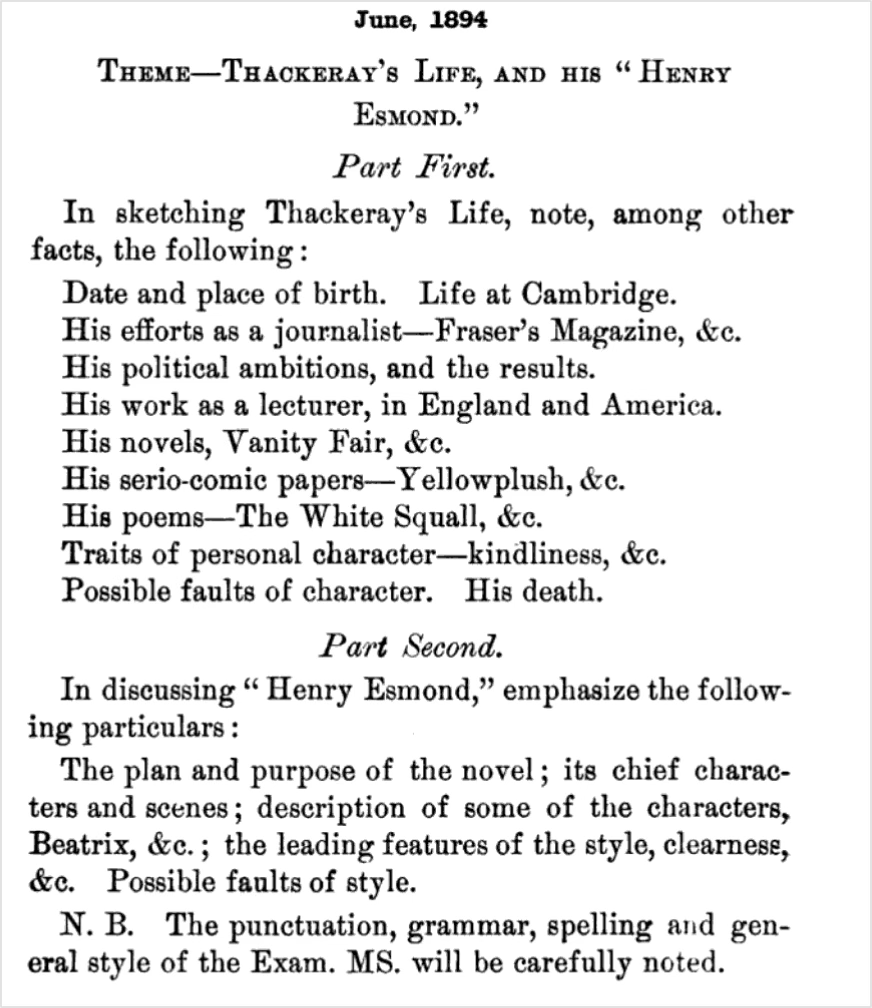
Since then, high school English test-makers have designed their exams with college in mind, and high school teachers have worked to prepare their students for these exams. Today, students do not need to memorize Ivanhoe to achieve admission to a college of their choice. Today's tests (for example, the S.A.T. and A.C.T., or the Common Core standards-aligned Smarter Balanced exam or New York Regents exam) use essay prompts, short answer questions, and/or multiple-choice items to evaluate students' skills in comprehension and interpretation. All of these exams demand a text-centered approach to reading, with no room for personal response, transactional experience, or cultural critique—such readings do not accommodate standards-based grading.
Meanwhile, students' test scores are sometimes attached to teacher pay and always attached to school rankings and reputation (for more detail, see Smagorinsky and Johnson's piece in this issue.) so teachers feel enormous pressure to align their curriculum with these tests, even as such alignment confines them and their students to rigid, formulaic approaches to literature. As one teacher in a recent study said: "I am torn between a love of literature...as a humanity and what it can do for you, [the reason] why I became an English teacher, and this drive to prepare my kids for college: skills, skills, skills." Despite many teachers' best efforts, David Koretz points out that "the test becomes the curriculum," and "teaching to the test" becomes business as usual.
We are former high school English teachers who now research and teach English education at the university level. We study how the United States' current and historical testing regimes influence literary instruction at the high school level and beyond. We want to give the college English community a clear picture of ways that the practices and discourses of standardized testing shape not only the high school English classroom, but the college classroom too. Why do students falter at long reading assignments? Why are they still looking for one thematic message? Why do many faculty feel that they must, as Fanetti and colleagues write, "spend the first half of their semester unteaching the skills and traits students acquired during high school"? Most importantly, what can faculty do besides "unteach"? In what follows, we offer responses to those questions.
How does the culture of high school testing leak into college English classrooms? Consider representative multiple-choice and essay questions from standardized English Language Arts exams. These questions generally ask students to show literal comprehension of a text, evaluate authorial tone, identify the effects of authorial craft, or interpret characters' actions or feelings—foundational skills for supporting rich transactional reading experiences and experiments in meaning making. But by nature, these questions privilege a "known-answer" approach to literary reading that high school students carry with them to the college classroom.
For instance, this question from the standardized Smarter Balanced exam asks students to read an excerpt of a narrative, notice an underlined phrase, and decide on "the best phrase" to replace it:
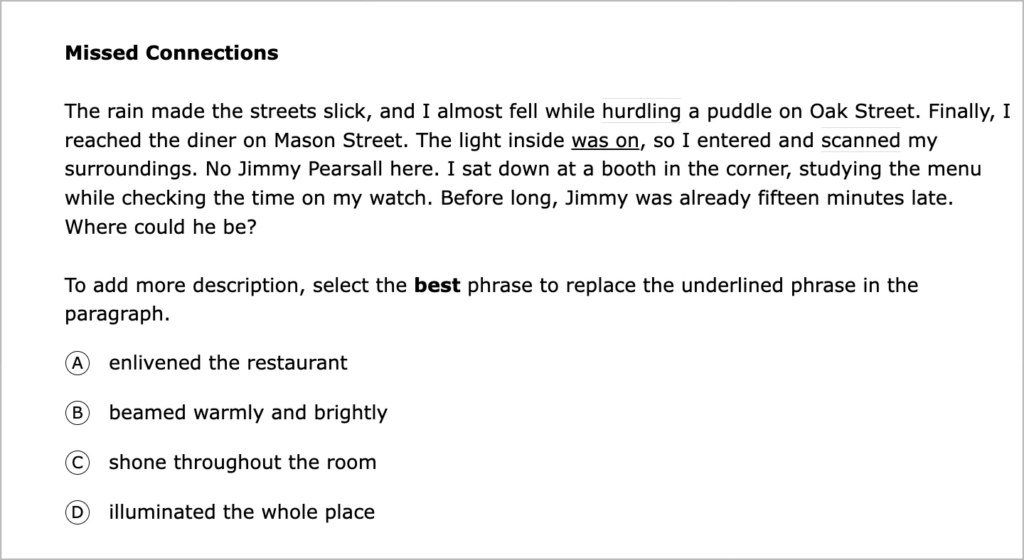
The test-sanctioned answer is B. In terms of plot moves, perhaps B makes the most sense. The light beckoned, so the narrator entered. But in terms of style? The cheery verb "beamed" and its perhaps overdone "warmly" and "brightly" do not necessarily align with the more matter-of-fact, noir-y style of the rest of the paragraph. And it's just not great writing. Is it really "best"?
It is easy to nitpick someone else's work, and we know that in general, test designers are thoughtful experts working in good faith to guide teachers and help students succeed. Even so, this question—and really, any multiple-choice question—promotes a conservative vision of reading and writing that does not make room for students to engage in transaction with texts. Instead, these questions require students to interpret not the text but the test-maker, ultimately leading students on a meta-level guessing game. These tests reflect and feed into what Newman and Perillo in this issue call "the broken culture of reading," in which reading is seen as a "purely analytical skill." It is this broken culture that college instructors find themselves fighting when they meet their new students.
This same broken culture of reading gives rise to and is enshrined by exams' short answer and longer essay prompts. First, these essay prompts are generally accompanied by a poem or short piece of excerpted prose from which students are meant to excise a theme. To prepare students for those prompts, teachers are compelled to mimic the test format, focusing on snippets of texts as opposed to longer works. One teacher recalled her principal's evaluations when she taught whole novels: "Every time that I got observed while trying to teach a whole novel, the comment card was always along the lines of, 'Focus on shorter passages and multiple choice. We need to get our reading scores up.'"
Second, these essay prompts generally ask students to analyze the rhetorical and literary effects of authorial craft without attention to social or cultural context of either reader or author, as illustrated by this prompt from a 2024 New York Regents exam:
Closely read the text provided...and write a well-developed, text-based response of two to three paragraphs. In your response, identify a central idea in the text and analyze how the author's use of one writing strategy (literary element or literary technique or rhetorical device) develops this central idea. Use strong and thorough evidence from the text to support your analysis. Do not simply summarize the text.
This prompt is not terrible: it acknowledges that a text may contain more than one central idea, and it asks students to consider the relationship between technique and effect. But overall, such questions reject the idea that literary response can inspire personal reflection or exploration of others' worlds. The questions imply that the value of reading literature lies in a bloodless examination of authorial craft and a location of thematic messages that are embedded in the text, as opposed to constructed in transaction with the text. The tests make no room for personal or critical response. Meanwhile, a look at just about any essay in Post45 makes clear that English instructors want more for their students (and so do high school teachers).
So how can college instructors help students transcend the hundred-year-old text-based discourses that constrain their enactment of appreciation, uncertainty, curiosity, and critique? We have a few ideas. First, many post-secondary instructors follow an understandable instinct to tell students to "forget what you learned in high school." However, most research on the high school to college transition, as well as most research on learning in general, indicates that students will fare better if they can build on what they have learned so far. We suggest using high school tests as a starting point for inviting students into the culture of the discipline, as you see it. For instance:
- Engage your students in a discussion of the differences between the discourses they know and the discourses you hope to share with them. Take a look at a few multiple-choice questions from a high school test and then trouble the idea of one right answer. Ask students to add other possible interpretations beyond the four options offered by the test. Ask them how it feels! Point out that they are now moving away from a "one-right-answer" approach to interpretation, and that doing so is a good thing.
- Together, look at one or more standardized essay prompts and accompanying short texts (or use a short text that you prefer). You can choose prompts from an AP English or Smarter Balanced exam, or any state exam built on Common Core standards. Ask students to talk together or write about their experiences building an essay in response to that prompt. Ask them to share affordances and constraints of those prompts and consider what might be missing from those prompts. Ask them how such prompts frame the purposes and value of literary reading.
- Try responding to a prompt yourself, just with a paragraph or two. First, try faithfully adhering to the prompt's formalist, text-centered expectations. Then, try responding in ways that breach those expectations. For instance, show your students your first response, and then show them a response in which you have engaged the social or historical context of the excerpted text, or applied a critical lens to the excerpt. Show them a response in which you dared to use the first person. By introducing these multiple approaches to a text—some of which students did not know were acceptable—you can begin to invite students to a new and broader set of discourses around textual engagement. You do not have to condemn students' high school stances toward textual interpretation; instead, you can let students know that they get to expand their stances now. Let them know that you are excited for them to try new things in your class.
In this short essay we offer one final suggestion: Share your own uncertainty and curiosity about texts. Use phrases like "I struggle with..." "I wonder..." "I am really curious about..." and even "I need help thinking about..." Ask your students to try these phrases too. Show them that you experience pleasure in appreciation, uncertainty, curiosity, and critique, and one right answer may yield to many.
Sarah Levine (she/her) is the Academic Director of the Professional Learning Extension at Stanford University's Graduate School of Education. She studies literary interpretation and writing in high schools, AI and education, and coaches pre- and in-service high school English teachers.
Emma Bene (she/her) is a postdoctoral fellow at Stanford's Center to Support Excellence in Teaching. Her research explores adolescents' in and out of school literacies and the role of curriculum and professional learning in shaping teacher pedagogy. Before she got her PhD in Education, Emma spent more than a decade teaching English Language Arts at a range of public and charter schools.
Daniel P. Moore (he/him) is an Assistant Professor at Seton Hall University in the Department of Educational Studies. His research interests include literacy education and teacher education. He previously taught English language arts for ten years, mostly in New York City.
Michael W. Smith (he/him) is professor emeritus in the Department of Teaching and Learning in Temple University's College of Education and Human Development. He joined the ranks of college instructors after 11 years of teaching high school English. His scholarly work focuses on understanding what motivates and supports adolescents' reading and writing both in and out of school. He has reported his award-winning research and the instructional ideas that derive from it in 18 books/monographs and a variety of articles and chapters.