The Specter of High School English

In July, I'll teach an introduction to humanities class for a group of soon-to-be high school seniors. A month later, I'll teach a general education writing class to first-year college students, many of whom will have just graduated from high school. While the age gap between the students in these two classes is only about twelve months, the gaps in how they are perceived-and taught-as writers feel much larger.
On one side of this gap, high school English teachers are working hard to prepare college-bound students for "college-level writing," often with little exposure to the current and myriad variations of what that means beyond their own college writing experiences. On the other side, college writing instructors are making all kinds of guesses and assumptions about what their students may already know about writing and what they may need to ask them to "forget." For those of us working at the intersection of high school and college writing instruction, the institutional and infrastructural divisions that bifurcate the two domains necessitate frequent re-calibrations as we move between classrooms and conferences, feeling ricocheted between theoretical orientations, methodological approaches, and even citation styles.
I recently attended the Conference on College Composition and Communication (4Cs), which is generally considered to be the central gathering place for college writing teachers and researchers. I am a co-chair for the High School/College Connections Special Interest Group there, and this year, I presented a session with colleagues from high school, community-college, dual-enrollment, and four-year teaching contexts about creating more connections between our campuses and practices1. The session was surprisingly well attended considering its 8 AM timeslot, proof of a collective curiosity about what is happening in our counterparts' classrooms, which is also evidenced by this Post45 cluster.
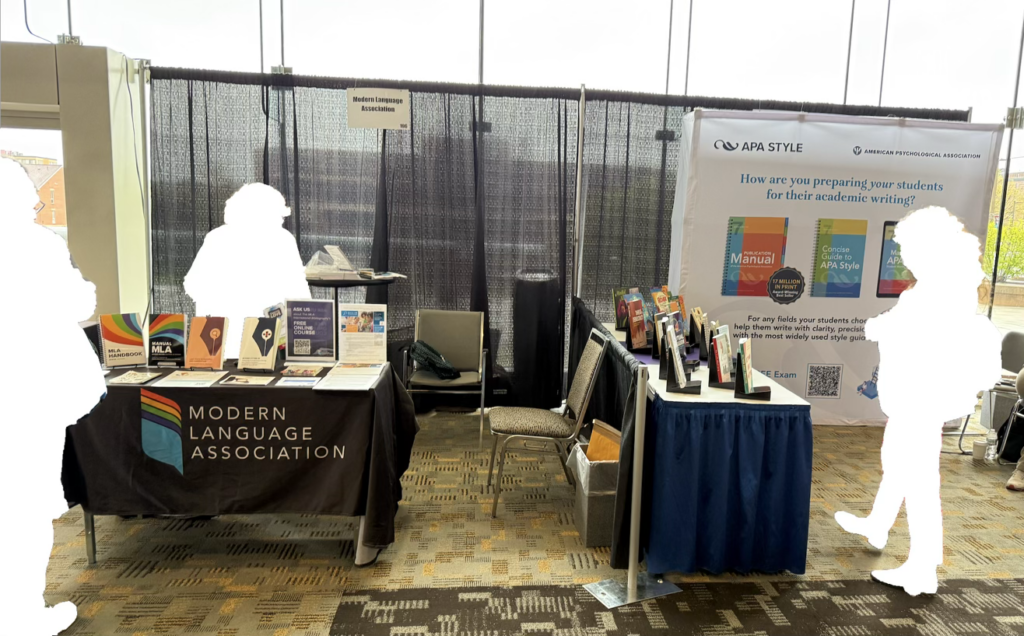
After our session, I wandered into the exhibit hall, where I snapped a photo of the MLA and APA booths positioned side-by-side like friendly rivals, ready to duke it out over which citation style is best. (This is a recurring debate amongst writing teachers.) I took the photo because I had just finished introducing APA citation styles to my first-year college students the week before, and I was excited to prove to them that there are actual people and organizations behind what often feels like an archaic and arbitrary list of capitalization and punctuation rules. And if there is, in fact, a rivalry between the two organizations, I would give APA the win at the 4Cs convention. In a citational coup of sorts-and for the small price of a $4,000 sponsorship-those of us attending the convention walked around all weekend wearing APA-branded nametag lanyards.
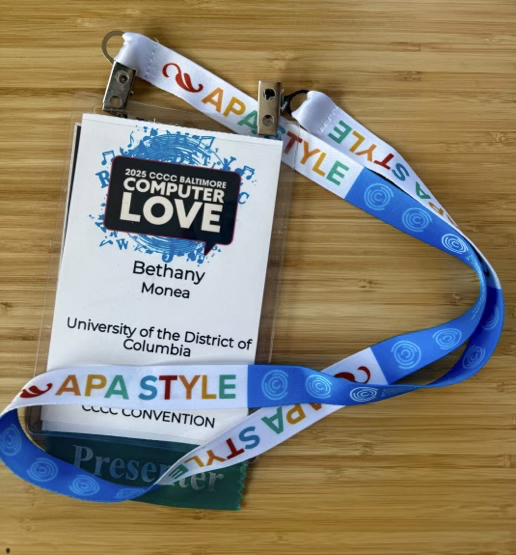
I should have worn this lanyard to our first-year writing instructors' meeting back at my university a few weeks later, where a fellow professor once again brought up which citation style we should be teaching in our first-year writing classes-a long-standing question that has seemed to haunt our meetings for years (to invoke a spectral metaphor in keeping with this conversation's theme). I will admit that during these debates I often find myself eye-rolling, side-texting, or rage-doodling in frustration with the disproportionate amount of time we spend talking about citation styles, when we could be discussing almost anything else: writing processes, source verification, language use, critical thinking, the list goes on. I'm sure my students were feeling similarly when I was talking about APA style in my own classroom two weeks before.
Conversations about which citation style to teach also come up in a Facebook group for high school AP (Advanced Placement) English teachers of which I am a member. While MLA is still the prevailing citation style in AP English classes-where students are often writing five paragraph essays about literature-every now and again a discussion will break out in the comments section about whether anyone still requires MLA in college and whether teaching APA better prepares students for college-level writing. Both sides make good points. The next time someone asks, I will be tempted to post a photo of my APA-branded lanyard from 4Cs.
Discussing citation styles for going-on-three paragraphs in this essay may feel about as productive as it does in my faculty meetings. But I think there's something lurking beneath these conversations that forces them to keep bubbling up, something to do with the shifting foundations of writing instruction and how they impact our assumptions about each other's teaching contexts. Our debate about the shift from MLA to APA in faculty meetings, for example, is really a synecdoche for our anxieties about the purposes and definitions of college composition, which stretch back decades to the foundational debates defining composition's raison d'etre.
The argument goes something like this: if we accept the (hotly debated) premise that general education writing classes in college are meant to prepare students to write in their various fields of study, does it make sense to keep teaching the citation style of the language-and-literature focused humanities-now one of the least-enrolled academic disciplines? Or should we leave MLA behind, along with literary analysis, in favor of a more commonly used style across multiple disciplines, such as APA?
For at least four decades, first-year college writing programs have been moving away from a literature-based curriculum rooted in humanistic analysis toward a more process-based, research-focused approach, debating the role of literature in composition classrooms the whole time. Take, for example, the well-known Lindemann/Tate debate of 1993, in which Erika Lindeman suggested that literature does not belong in the composition classroom, since-among other reasons- "interpreting texts also represents only one way of knowing, a process of knowledge-making peculiar to the humanities." Tate, on the other hand, suggested that we question "why we are neglecting literature" in favor of other disciplinary writing styles, especially since he was "far more interested in my students as individual human beings who will have private and maybe public lives that transcend whatever disciplines they associate themselves with." While these debates may appear to be settled for many compositionists, there are plenty of college writing teachers who may still feel that giving up on literature (and MLA) in the college writing classroom feels like giving up on general-education writing classes as a bastion of humanistic writing and thinking at the college level.
These are hard, important conversations, but they are not the ones dominating the comments section of the Facebook group for AP Literature and Composition teachers, where high school teachers are understandably more focused on teaching strategies that will prepare students for the rigorous demands of the College Board's AP exams than rehashing the Lindemann/Tate debate. However, when questions about citation styles do crop up, teachers often discuss how to best prepare students for the various citational tasks they may encounter in college and whose job it is do teach different citation styles in which courses, conversations that feel very similar to the ones in our first-year writing faculty meetings.
The teachers discussing MLA in this group are teaching in high school English classes that are explicitly billed as "college preparatory" (such as AP), where, perhaps paradoxically, a substantial amount of instructional time is spent not on preparing students for college writing classes at all, but for AP and IB exams that will perhaps replace students' first-year writing classes altogether. The equivalency of these two experiences (AP English and First-Year Composition) has been called into question, and writing instruction that is primarily oriented toward high-stakes testing is at odds with the process-oriented writing favored in college classrooms, as documented by Arthur N. Applebee and Judith A. Langer all the way back in 2009, as well as other scholars in this Post45 cluster. However, it is important to remember that the (false) equivalency between high AP test scores and college readiness does have the potential to tangibly lessen a student' tuition bill, student loan debt, and time to degree completion. And, of course, we must also remember the simple fact that not all high school writers will become college writers. High school English teachers know this and are often very rightfully invested in their students' current success as high school writers and their literacy experiences outside of school contexts, rather than narrowly focusing on preparing them for success in a college writing contexts. Again, we must revisit our assumptions about the purpose of high school English instruction.
Let me be clear: I am not saying that high school English teachers should not be teaching literary analysis or MLA, nor am I saying that college writing instructors should be. But I do think it's important for writing teachers in both high school and college contexts to be honest with our students (and ourselves) that there is a good chance high school English class may be the last place they write a literary analysis essay in their lives. Whether this is evidence for or against teaching it is an open question.
Regardless of the answer, we can probably agree that there are still unquestioned assumptions about how learning to write a strong literary analysis in high school does or doesn't prepare students for college-level writing. As Sarah Levine, Emma Bene, Dan Moore, and Michael Smith point out in this very cluster, this is an assumption we can trace all the way back to the Harvard entrance exam of 1876. (Interestingly, contemporary Harvard also mandates a Writing Exam for all incoming students, which requires MLA formatting.) In this essay, I've highlighted these unquestioned assumptions as a vehicle for questioning our larger assumptions about "preparation" more generally: How much of writing instruction in high school is oriented toward preparing students for the assumed demands of college writing? How much of first-year composition is still oriented toward preparing students for the assumed writing demands they will face in their various disciplines, particularly when our classes and jobs are justified as performing this "service" to the university? How often do we justify a lesson to our students by promising they will need to know such-and-such citation style in order to be successful at the next presumed step on a linear, progressive, educational pathway?
When we examine the assumptions we are making when we teach writing, we must acknowledge the backward-facing as well as the forward-facing ones. In the same way that it's important for high school English teachers preparing students to write in college to be aware of the range of disciplinary writing tasks students may encounter if they attend college, it is equally important for college writing instructors to remember the array of writing experiences their students have had across their high school curriculum and out of school experiences. In my own research about the writing experiences of students transitioning from high school to college writing, I asked students about the most meaningful composing experiences they had experienced in both high school and in their first semester of college.2 When talking about their college writing experiences, almost all of them named an essay written in their first-year writing classes. However, when they told me about their meaningful high school composing experiences, the majority of students named projects they had done not in English class but in history, Spanish, art, or anthropology classes. These were often multimodal, interest-driven projects, not MLA-formatted literary analyses.
This finding helps me remember the breadth of writing experiences behind and beyond my students' experiences in my first-year writing classroom: all the places they have been-and are-writers. Students, like their teachers, often see first-year writing in college as an extension of high school English, and they carry their dispositions toward writing and beliefs about themselves as writers from one context into the next. Reflecting on the full gamut of students' composing experiences in high school, from writing lab reports in biology to creating videos in art class, can expand the frame of prior knowledge that we can build upon when we ask students to write in college. As a bonus, it gives us a nice entry point for talking about disciplinary differences in citation styles too.
I hope that this essay does not end up simply perpetuating conversations about how high school teachers might better prepare students for college-level writing and how college writing teachers might better build upon students' previous high school writing experiences. It is easy for such conversations to reiterate a one-size-fits-all scaffolded approach to education that sees the function of each educational stage primarily in terms of how it serves the next. Too often, the way we talk about the connections between our writing classes places them on a staircase, in which the purpose and direction of high school writing (especially in "college preparatory" high school classes) is primarily oriented toward the next step: college-level writing, much like the way first-year writing is often oriented toward the writing students may do in various academic disciplines. As pictured above, the question plastered across the APA booth at 4Cs was "How are you preparing your students for their academic writing?" Of course, this is an important question. Another important question to consider, however, is this: how we are teaching students to write for the here-and-now of their lives?
Currently, my first-year college writing classes are filled with students who did not bypass their general education writing requirements. Some are international students, some are returning to college after years in the workforce, many were never advised into "advanced" or "college-prep" high school classes, and some have taken AP English classes in high school without achieving the requisite exam score. Many have learned (or at least heard of) MLA formatting before, but many have not. This means that, even though I am more familiar with high school writing curriculum than many other college writing faculty, I have to teach each college writing class without any assumptions about the specific writing skills and knowledge students are bringing with them to my classroom. In many ways, loosening the curricular tether between high school and college writing frees me up to more expansively recognize and build upon the rich and various disciplinary, extracurricular, and community-based knowledges that my students are bringing with them, from contexts ranging much wider than their high school English classes.
Acknowledging the diversity of paths from which students enter writing classes and the diversity of paths they will take after they leave cannot help us decide whether to teach MLA or APA formatting. But it can help us remember that decisions about what to teach in either context should not be primarily driven by assumptions about the other.
Bethany Monea is an Assistant Professor of English at the University of the District of Columbia. She studies writing across secondary and post-secondary contexts, often researching and writing alongside young people through participatory and arts-based methods. Her work has appeared in journals such as Written Communication, English Journal, and Reflections: A Journal of Community-Engaged Writing and Research.
References
- Co-conveners of this session were Robyn Russo, Darin Jensen, Bruno Yupanqui, Amber Jensen, Christine Kervina, Christian Aguiar, and myself. ↩︎
- My focus on "meaningful writing" in this research was inspired by Michele Eodice, Anne Ellen Geller, & Neal Lerner's long-term Meaningful Writing Project. ↩︎
Related reading
 How High School Testing Changes College English Classrooms and What To Do About It
The Death of the Book: Mourning Literature Lost
The Institution(s) of High School English
Teaching in the Age of Attention: A Conversation with High School English Teachers
Post 451 : English Without Books
Teaching Writing in the Digital Age
Introduction: The Specter of High School English
How High School Testing Changes College English Classrooms and What To Do About It
The Death of the Book: Mourning Literature Lost
The Institution(s) of High School English
Teaching in the Age of Attention: A Conversation with High School English Teachers
Post 451 : English Without Books
Teaching Writing in the Digital Age
Introduction: The Specter of High School English