Summertime Sadness: Remembering Ricardo L. Ortiz
"Mentor" is a word that we throw around frequently in the academy, yet it seems to mean many (and often incompatible) things. I once read that mentorship is one of things that most disappoints initiates into the profession. Many who enter academic life find that the mentoring they receive never matches what they imagined. Perhaps the mismatch between the symbolic value of mentorship and its lived reality stems from how the term often conjoins a host of fantasies and largely inarticulate needs. We begin our careers imagining a generous intellectual partnership in which a wise scholar not only engages our work and pushes us toward better ideas but also invites us into their own ways of thinking, all while somehow intuiting our needs and expressing forms of care that sustain us through our crises. Most of us, I suspect, encounter someone who fulfills at least part of this ideal. There is often a person who helps us through a difficult conceptual impasse or guides us across some bewildering corner of the profession. But these figures often recede, turning their attention to newer generations or retreating for reasons that feel puzzling in retrospect. I begin with these reflections on mentorship because Ricardo's passing has pushed me to ask what it means to lose a mentor, and to consider what kind of mentor he was.
The word "mentor" traces back to The Odyssey, where Mentor is the trusted figure Odysseus appoints to care for his son, Telemachus, during his long absence at war. Athena sometimes takes Mentor's form to counsel the young man as he develops into a leader. That Athena takes various forms to transmit her wisdom perhaps accords with the idea that mentorship rarely arrives in a single vessel. Although Mentor in The Odyssey is hardly an uncomplicated figure, I find this figure who endures with Telemachus intriguing.1 That quality of endurance was, for me, one of Ricardo's defining gifts. Some of what he offered resembled what we conventionally call mentoring: he read drafts, opened doors, wrote recommendations, and connected people. But the greater part of his generosity lay elsewhere in the quieter, less visible practice of continuing to show up, year after year, and bearing witness to another person's intellectual life.
This may seem like a modest gesture, but it is not. To know that someone continues to take an interest in your work is to be given the sense that what you are doing matters. For a young scholar, whose work is so often performed under conditions of uncertainty, that confidence is a profound gift. There is also a reciprocity to such regard. You unconsciously look for approval or criticism and follow that mentor's own intellectual trajectory, trying to remain attentive to the evolving currents of their thought. The relationship grows into a long conversation, even when that conversation unfolds intermittently across years. I cannot claim that I knew Ricardo in any deeply personal sense. But I knew him in academic life for nearly thirty years. Over that time, his presence became one of the quiet constants of conferences and professional gatherings. It is there that I have felt his absence most acutely this past year: it's like some beat in music that you enjoy suddenly disappears and makes the whole feel dissonant.
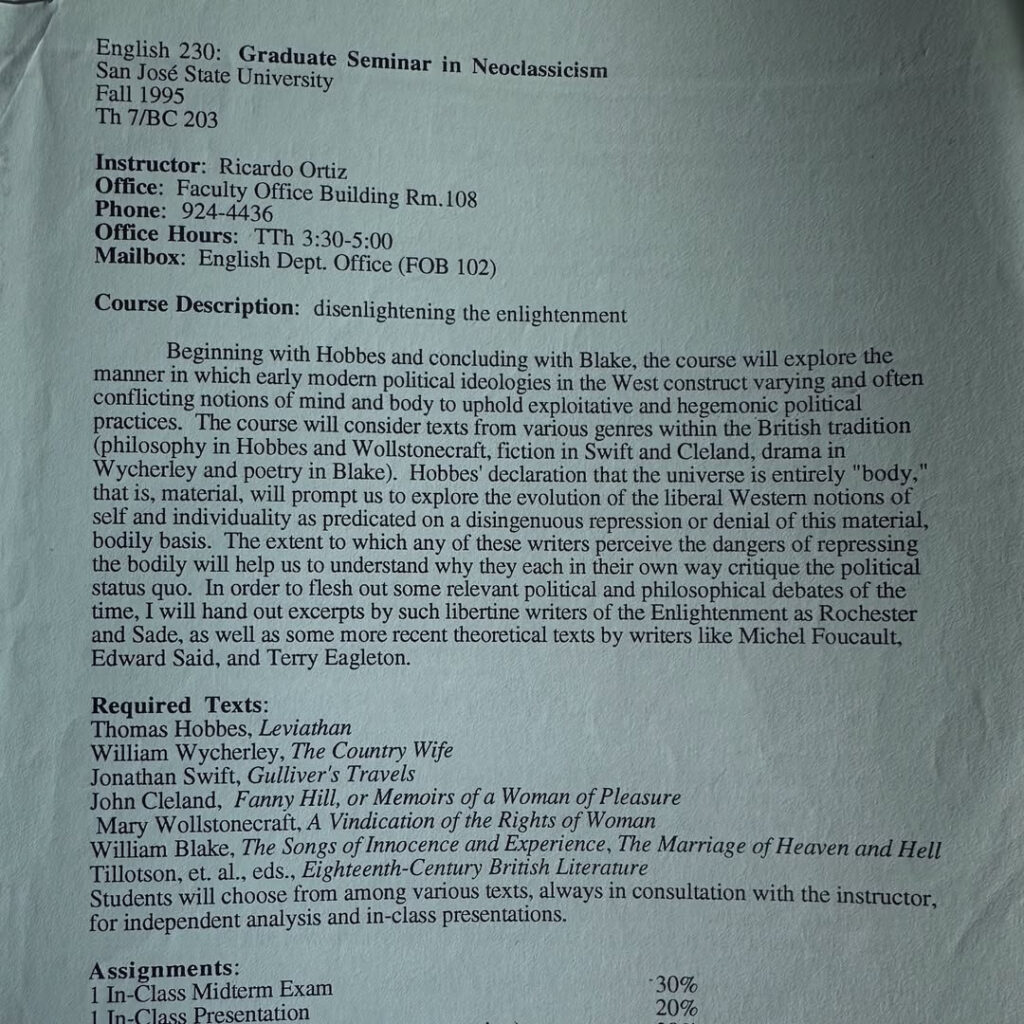
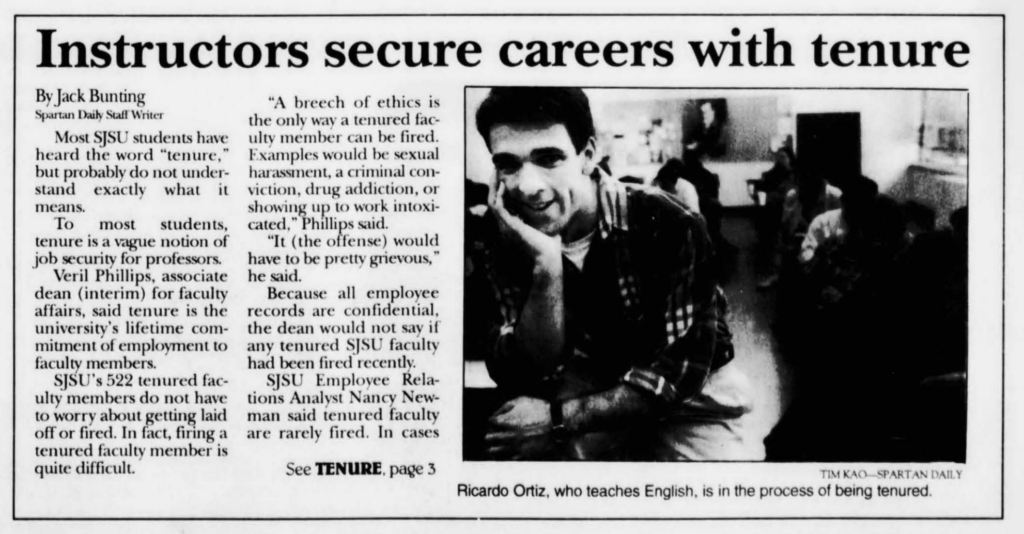
I met Ricardo in 1995, when I enrolled in his first graduate class at San José State University, on what we then called "Neoclassicism." It was a class on eighteenth-century British literature that he had renamed "disenlightening the enlightenment" (Figure 1). Ricardo would have been about thirty-four at the time, and, at that age, he was strikingly beautiful in ways that did not go unnoticed: graduate students remarked upon it, and undergraduate women sometimes left their phone numbers at the ends of the papers they turned in. I remember him recounting one such incident to a group of new composition graduate instructors, explaining how he told one young woman, "First, you've grossly misread the situation . . ." before warning her about the realities of predatory men and the importance of recognizing uneven power dynamics in academic settings. Even then, there was something characteristic in this response: he met an awkward situation with clarity, care, and humor, turning what could have been an uncomfortable encounter into an opportunity for guidance. A photograph of the young Ricardo from this same period appeared in The Spartan Daily, the San José State student newspaper, accompanying an article about instructors on the tenure track (Figure 2). Although grainy and not as clear as one would hope, the photograph nevertheless preserves a glimpse of the handsome young professor who so impressed the students who then encountered him.
He was probably the first out professor that I had, and that outness extended beyond his self-presentation into the way that he taught. In a graduate program in which classes covered predictable canons and conventional critical approaches, Ricardo offered us a different picture of the British eighteenth century. His syllabus displaced the staples of "Neoclassical" classes of that period—figures like Johnson, Pope, or Dryden—with John Cleland's pornographic novel Fanny Hill (1748), the ribald poetry of the Earl of Rochester, and William Wycherley's anti-Puritan sex comedy The Country Wife (1675), alongside theoretical work by Michel Foucault, the Marquis de Sade, Theodor Adorno, Roland Barthes, and Terry Castle, among others, creating a syllabus that refused to separate literary history from questions of sexuality, power, and desire. Sexuality was never treated as a peripheral topic or a special interest. Instead, it functioned as a central analytic through which literature and culture could be understood, here explored through an emphasis on "the bodily." As the semester ended, I remember seeing flyers posted around the department for an undergraduate course he was offering on literary responses to AIDS, illustrated with an image of the cover of Susan Sontag's AIDS and Its Metaphors. In 1995—the deadliest year of the epidemic in the United States—the course felt not only daring but urgently necessary (Figure 3).

While it may seem surprising that I first encountered Ricardo's teaching and work in a class on eighteenth-century literature, the connection makes perfect sense in light of his own account of his intellectual trajectory. As he explained during a 2022 forum at American University on the Future of Latinx Studies, although he completed a dissertation that nominally centered on Henry Fielding's novel Tom Jones (1749) and was hired as the department's neoclassicist, he actually "found a home in this thing called critical theory." It was that intellectual home—more specifically, what he described as a "post-structuralist Marxist-feminist-deconstruct[ive]" optic—that he carried into Latinx studies, a field that was still emerging in the mid-1990s, even as predecessor formations such as Chicano studies and Puerto Rican studies had already established vibrant scholarly traditions. Rather than abandoning one field for another, Ricardo brought the conceptual tools of critical theory into conversation with Latinx literary studies and helped to shape it at a formative moment in its institutional development.
If students were drawn to him at this time for his good looks, charisma, and wit, they were also drawn to him for a new theoretical vocabulary that he brought to class, which for many of us transformed what literary study could be. If you've been lucky, you have probably encountered a figure like this during your own intellectual formation: a teacher who permanently changes the way you read, think, and ask questions. Or perhaps, later in your career, you have welcomed a younger colleague whose commitment to an emergent field or innovative methodology revitalizes a department and expands students' sense of what literary scholarship can accomplish. (When I see this happen now, I cannot help but feel happy for those students, who are discovering the exhilaration of having their intellectual horizons widen, their sense of what is possible expand, and their minds blown in all the best ways.) Ricardo was that rare version of this figure maintaining that inspiring aura over the long haul, continually renewing the intellectual lives of both students and colleagues.
Like many graduate students drawn into a professor's intellectual orbit, I sought out what he had written. It was through this process that I encountered "Sexuality Degree Zero: Pleasure and Power in the Novels of John Rechy, Arturo Islas, and Michael Nava" (1993), his first essay in the field of Latinx Studies. The essay introduced me to three writers whose works would eventually become important to my own personal canon. Revisiting the essay recently, I was struck by the way it frames what initially appears to be a straightforward comparative question: why do these three gay Latinx writers adopt such different formal strategies, and what do those choices reveal about their relationship to pleasure? The questions crystallize a larger critical proposition that reverberates throughout his subsequent scholarship. Formal choices are never merely aesthetic; they register a structure of desire, a particular orientation toward pleasure, intimacy, and sociality. Aesthetic form, in this account, becomes a way of thinking through the conditions under which subjects are made and worlds are imagined. In retrospect, this early essay already contains the conceptual threads that would define his work for decades. Its sustained attention to aesthetics, its insistence on pleasure as a critical category, and its understanding of form as constitutive of political and cultural life all anticipate the concerns that would continue to animate his scholarship.
Because this early essay introduced me to works like Islas's The Rain God (1984) and Migrant Souls (1990), I think of Islas as framing my intellectual relationship with Ricardo. Ricardo and I most recently appeared together on a panel at the 2025 Modern Language Association conference in New Orleans, commemorating the fortieth anniversary of the publication of The Rain God, along with Julie Minich, Yolanda Padilla, Annemarie Perez, and José David Saldívar. In my opening remarks, I noted how The Rain God is one of those rare texts that has attracted the attention of so many of the field's most influential scholars. Beyond the panelists themselves, the roster of scholars who have written about the novel reads like a who's who of the field: Erlinda González-Berry, John Alba Cutler, Marta Sánchez, Rosaura Sánchez, Joshua Javier Guzmán, José de la Garza Valenzuela, and others. It's as though the novel has served as a whetstone against which some of our field's finest critical minds have been sharpened. Ricardo's contribution to this scholarly conversation included the aforementioned early essay as well as a 2009 article titled "Arturo Islas and the Phantom Rectum." Ricardo didn't arrive at the panel with a prepared paper. I had seen him do this before. On another occasion, he showed up with no written remarks, only a stack of books he intended to discuss. Rather than reading from a script, he arranged and rearranged the books before him, using them as prompts as he improvised his remarks. There, as in the Islas panel, things began haltingly and then gathered momentum, as he fired off dazzling insight after dazzling insight until time was called.
As frustrating as it might be to have someone arrive with no paper in tow, we might see this as connected to his proclivity to "show up." At a session honoring his life and work at the 2026 Latinx Studies Association (LSA) Conference, I was struck by how frequently people returned to this quality. But this proclivity to show up was also evident a few years prior, in 2023, when a group of us prepared his nomination for the American Studies Association's Richard A. Yarborough Mentoring Award. As we gathered testimonial letters and reviewed his curriculum vitae, I was astonished by the sheer range of people for whom Ricardo showed up. There were, of course, the students at Georgetown: Latinx students, students of color, queer students, and first-generation students. His service to these communities was recognized with multiple awards. And then there was also the extensive network of people he mentored beyond his own institution. Some of these were doctoral students writing dissertations. That may not sound unusual, except that Ricardo never taught in a PhD-granting department. Then there were scholars seeking refuge from difficult professional circumstances: faculty at institutions that didn't appreciate their talents or students at schools that discounted the importance of work in the field. The scale of his generosity was matched only by his modesty about it. I began these remarks by recalling his physical beauty, but in the process of assembling that nomination, another kind of beauty came into view, one grounded in his care, attention, and a genuine commitment to others.
At the Islas panel, he read through the introductory pages of his "Phantom Rectum" essay. In between his reading segments of the essay's introduction, Ricardo would offer additional commentary, and this line of commentary began to gather force when he discussed Joshua Javier Guzmán's essay "Beside Oneself: Queer Psychoanalysis and the Aesthetics of Latinidad" (2019), which appeared in Psychoanalysis and the Barrio, edited by Patricia Gherovici and Christopher Christian. He remarked that the essay "critiqued, took down, and mopped the floor with my argument." Rather than being dismayed or defensive about this, he spoke these words with a kind of delight. He seemed proud—proud that it was a former student from Georgetown who had done this work, and even more excited by the way such critique opened new pathways for thinking about Islas and Latinx studies broadly. His investment was less in the preservation of his own authority than in the ongoing transformation of the field.
At the LSA panel commemorating Ricardo, Guzmán offered another brilliant reading of the "Phantom Rectum" essay that, among other things, made a case for that essay as a phantom chapter to Cultural Erotics in Cuban America (2007). In Guzmán's reckoning, the Islas essay stands outside of the monograph because, at the moment of the book's publication, imagining a sustained connection between a queer Chicano text and Cuban American writing ran counter to how the field understood itself. It's worth noting that, in the roster of eminent scholars that wrote about The Rain God, Ricardo was the only non-Chicano. Perhaps, as a Cuban American who grew up in predominantly Mexican American Southern California, he had long been attuned to the many ways Latinx communities are connected to one another. Biographical speculation aside, within literary studies, Ricardo was an important early formulator of latinidad within literary studies. He consistently drew on the resources of emergent queer theory alongside the critical theory that shaped him in graduate school to produce an answer. This project is especially evident in his great essay, "Edwidge Danticat's Latinidad," which represents one of the field's earliest efforts to consider Haiti's place in Latinx literary studies:
No invocation of latini- or latinidad should be made to do the kind of police work it too often still does around borders that could just as readily disappear, or at least relax. Here, I hope to dislodge, if not expel, a certain construction of US/Latino/Latina identity, not through diminution but through augmentation and complication.4
Here, Ricardo cautions against using latinidad to enforce rigid social, cultural, or national boundaries, because those boundaries are not natural or fixed and could become less important or even disappear. By saying borders could "disappear, or at least relax," he moves to formulate latinidad as a flexible and evolving project rather than a rigidly defined identity.
This understanding of latinidad as an ongoing project continues in later essays that attempt to theorize the term "Latinx." One noteworthy essay in that body of work is "Burning X's: Critical Futurities within Latinx Studies' Disidentifying Present" (2014). When I teach this essay, we often linger on the following passage from the essay's introductory section:
The x in this case isn't an alternative ending to Latina/o that refuses a conclusion in and as binary gender, but instead acts as refusal to allow Latin_ an ending at all, in either or any gender. The x acts here instead as a suspension in time's unfolding, a pause to consider and to accommodate what might take place next in the place of and as an alternative to gender, especially heteropatriarchal, binary cis-gender. The space that opens in that pause, thanks to the x, doesn't then just "include" queer and trans more visibly or strategically into some standing and stable construction of latinidad, but instead saturates latinidad with queerness, with transness, insisting instead on an alternative construal of a latinidad that itself now becomes unthinkable, and unsayable, without queerness, without transness.5
Drawing on Derrida's concept of différance, in which meaning is continually deferred rather than fixed, as well as Muñoz's notion of disidentification, Ricardo argues that the x in "Latinx" suspends the closure of latinidad, keeping it open to continual transformation. Rather than simply adding queer and trans subjects to an already existing category, the x reconfigures latinidad itself, making it impossible to conceive apart from queerness and transness. As in the Danticat essay, latinidad appears in its making, rather than its settling.
His theorization of Latinx repeatedly draws from Muñoz's thought while at the same time insisting on the importance of the literary. During the decade or so in which "Latinx" animated many of our conversations before giving way to other terms, Ricardo's essays were instrumental in helping many of us chart a direction for the field. In a late essay reflecting on the ways Cruising Utopia galvanized the field in the wake of Muñoz's passing in 2013, Ricardo concludes with an exhortation "to devote an equal weight of attention to the process—the practice of cruising—as to the content and character of utopia."6 The point is to focus less on utopia as a distant destination than on cruising as an ongoing critical practice of searching, interpreting, and remaining open to possibility. The force of Muñoz's theory, in this reading, lies not in arriving at an ideal future but in sustaining the speculative process through which literature continually generates new forms of (queer) knowledge and possibility. The terms employed across these essays—the call for borders to "relax" in the Danticat piece, the celebration of "cruising" as method, the emphasis on world-making in "Burning X's," and even the emphasis on pleasure in the early essay on Islas, Nava, and Rechy—show how a sense of play has been central to his thinking from the start. Play isn't just trivial fun, but rather the serious play of intellectual experimentation and the pleasures that come from trying to work out an idea in communion with others.
Over the last decade, I was fortunate to be a part of a group of scholars who met at different conferences to engage in this shared process of searching and interpretation with Ricardo. At one of these gatherings, the 2024 conference for the Association for the Study the Arts of the Present (ASAP) held at the CUNY Graduate Center, Ricardo prefaced his paper with a reflection that indicated that he was moved by how a group of younger scholars in Latinx literary studies found his later work inspiring and how, through their writing and his, they gave a new critical edge to the field of Latinx literary studies. This later body of work would include generative essays he wrote on queer Latinx studies as well as his 2019 book, Latinx Literature Now, which, despite its provocations, feels like an incomplete work—a series of beginnings that we were and are maybe completing in dialogue with each other. Ricardo's essay on Cruising Utopia and its afterlives appears in 2025 in Latinx Literature in Transition, 1992-2020, a volume that I edited. He closes that essay with a dedicatory note naming many of the scholars who participated in these conversations over the years:
This is for Josh and Israel and Joe and Maia and Marion and Renee and Tommy and Tony. And, always, for José.7
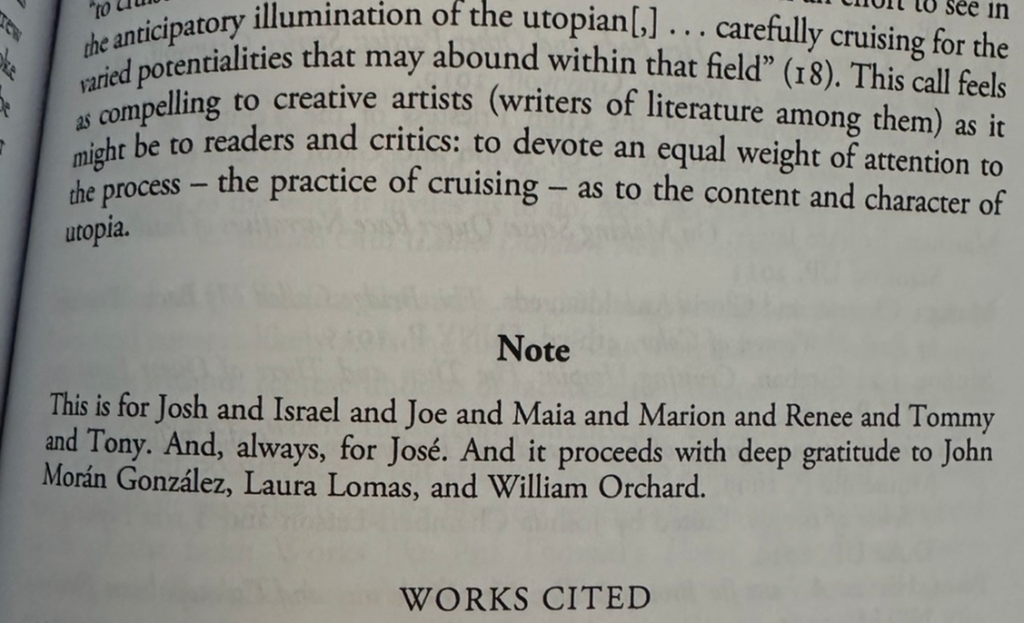
It is difficult not to read those lines now as both an acknowledgment and a bequest. If one thread running through these remarks has been the idea of Ricardo's beauty, then perhaps the most enduring form it takes is this: the community he helped to gather, sustain, and inspire. If we have lost our guide—our Mentor—on this journey, he has not left us alone. I can easily say that I admire the minds of every person named in this dedication (as well as those in this cluster of essays and other fellow travelers through the years) and that I love each for how they remind me of Ricardo and his finest qualities. I look forward to continuing the journey with them, toward the ongoing work Ricardo leaves us: the task of thinking with and beyond his provocations, and of building, together, the better field he so clearly believed was possible.
William Orchard is Associate Professor of English at Queens College and the Graduate Center of the City University of New York, where he teaches classes on Latinx literature and culture, comics and graphic narratives, and queer studies.
References
- As social psychologist Jean Rhodes notes, Mentor "provided very little in the way of support, protection, advice, or counsel to young Telemachus. Mentor actually allowed Odysseus's household to sink into ruin and be overrun with unwanted suitors who bullied Telemachus and harassed his mother, Penelope. This is a far cry from the image of a wise and nurturing advisor." Our contemporary sense of the term "mentor" is probably more indebted to François Fénelon's Les aventures de Telemaque (1669), a reimagining of the Mentor-Telemachus relationship. Jean Rhodes, "Who Exactly Was Mentor?: A Stunning Revelation." The Chronicle of Evidence-Based Mentoring, 26 May 2025, accessed August 1, 2026, https://www.evidencebasedmentoring.org/who-was-mentor-a-stunning-revelation-with-important-lessons/. ↩︎
- Jack Bunting. "Instructors Secure Careers with Tenure," Spartan Daily, February 25, 1994, pp. 1, 3. ↩︎
- Chris Morris. "New Classes Educate About AIDS in Society." Spartan Daily, December 1,1995, pp. 1, 4. ↩︎
- Ricardo Ortiz, "Edwidge Danticat's Latinidad: The Farming of Bones and the Cultivation of (Fields of) Knowledge" in Aftermaths: Exile, Migration, and Diaspora Reconsidered, ed. Marcus Bullock and Peter Paik (Rutgers University Press, 2009), 152. John Ribó places this essay in dialogue with the work of Haitian-Canadian-American novelist and scholar Myriam J.A. Chancy to further consider the place of Haiti in Latinx literary studies. See John D. Ribó, "Haiti in the Latinx Literary Imaginary," in Latinx Literature in Transition, 1992-2020, ed. William Orchard (Cambridge University Press, 2025), 76-95. ↩︎
- Ricardo Ortiz, "Burning X's: Critical Futurities within Latinx Studies' Disidentifying Present." Aztlán 45, no. 2: 203. ↩︎
- Ricardo Ortiz, "Cruising Utopia and the Queering of Latinx Literature" in Latinx Literature in Transition, 1992-2020, ed. William Orchard (Cambridge University Press, 2025), 365. ↩︎
- Ricardo Ortiz, "Cruising Utopia," 365. ↩︎