Pus, wound, ooze, rash: flesh opened up and scraped raw has long been a favorite subject of what we call the alternative comics tradition. I mean something more than subject "matter" here; in fact, the stylized depiction of vital fluids, exposed flesh, and internal organs — laid out as sequence, scrawl, or diagram — constitutes not only a material but an idiom, a method, and a bid for value.
It's often by way of cartoon viscera that a comic wrenches "an interior landscape" of experience (to borrow from Hillary Chute) into concrete existence and intelligibility.1 Flayed and iterated into graphic sequence, the oozy-scratchy flesh materializes agonies and ids as evidence that can be read, or better yet experienced, by a public. A confrontation with abraded and abrasive flesh can mark a work's participation in the alternative (or "indie") press: unfiltered, ecstatic, DIY.2 More broadly, this way of pulling the insides out has sometimes been heralded as a built-in upside of the comics medium, as though graphic form itself provides a singular intensity and directness to secondhand experience that plugs one exposed nervous system (the subject's) into another (the reader's). The idea that either the medium or the alternative tradition is uniquely visceral, with a special capacity to transgress the boundaries within and between people, has had a strong hold on our discourse. It is used to articulate all that comics can do, as potential — accessing intensity, authenticity, mess, and the unspeakable. Yet it shadows, and often delimits, how the body's wet interiors might be styled and read on the comics page.
In developing a concept of "cartoon viscera," I want to bring together two related facets of the visceral: First, the various fleshy openings (abrasions, lacerations, mutilations) and corporeal material (fluids, fat, meat, bone), through which comics "graphically" materialize otherwise hidden insides, or simply gesture at their imminent exposure. Second, the broader vocabulary of viscera and visceral qualities through which comics are described and theorized as a medium, and through which different relationships to value can be asserted, negotiated, and/or disavowed.
In its most conventional form, cartoon viscera is an act of savvy self-subjection, converting the historical expulsion of the comic book from acceptable or worthy reading into a position of autonomy and prospective value. By marking out its own abjectly potent waste, a cartoon desecration of the primly bounded, regulated body-form can carry out a paradoxically valorizing gesture, maneuvering from prurience to provocation to an uncompromised, exterior position of freedom outside of moralistic prohibitions and capitalist production. Of course, it's not every body that can slough off the preexisting marks or metaphors of value, and not every crime against the (graphic) flesh is treading new symbolic ground.3 Race is itself a way of being marked with economic metaphors and meanings, and of being thus precluded from the imagined subject of freedom, so this account of cartoon viscera will also necessarily be a reading of the idiom's racial preconditions and projections.
Wherever it is used, cartoon viscera pulls a complicated double duty. It's on one hand an idiom through which comics' potential (ethical/representational) value gets articulated to new publics, as with graphic medicine and documentary nonfiction. It is on the other hand an idiom through which comics maintains a claim on the avant-garde, relying on the loosely psychoanalytic image of viscera's "affective force" (returning the repressed to us in a decanted body) and wrestling with the resulting need for savvy publication strategies (the underground, the alternative, the indie).4 Françoise Mouly and Art Spiegelman — two editors who have powerfully shaped the landscape of American alternative comics — staked exactly this claim with the title of their alt comics magazine, Raw. Raw's 1989 issue, with its memorable subtitle "Open Wounds from the Cutting Edge of Commix," works at once as a bid for symbolic capital (incorporation into the economy of avant-garde prestige) and a tacit rejection of such assimilationist desires.
These figures of the open wound and the cutting edge exemplify the teetering predicament — effortful, torturous, and tricky — of making an appeal for comics value on the basis of bodily openings into the obscene and unseen. By keeping ahold of the mid-century accusation that comics addictively "depend on the administration of violent shocks to the nervous system," visceral discourse endeavors to redeem the equation of comics to violence, delinquency, and drug use.5
Ramzi Fawaz, for example, has argued for the medium's value on a formal register by asserting that its "inarticulable affective intensity" (or "affective force") offers a potent representational tool to queer artists, capable of representing and unleashing somatic experiences that "words, no matter how powerfully crafted, cannot fully convey."6 He presents an argument of queer/comics form anchored by images of literal viscera — and in fact, the essay opens with a splattered scene of "visceral carnage" from the David Wojnarowicz graphic memoir Seven Miles a Second (1996), a frenzied two-page spread of lovers "exploding into one another," their entrails and blood vessels entwined.7 For Fawaz, the affective force of "[b]lood, organs, bone shattering outward like a red and blue starburst" is a demonstration of comics' formal power and potential.8
This broader discourse of form, value, and visceral force traffics in two different senses of the graphic: graphic as in the explicit or obscene (sexuality, violence, and overwhelm); and graphic as in the communicable, communicating image (drawing, printmaking, and design). The trade between these two — which can be crudely restated as a trade between the inundations of graphic affect and graphic form — has been of recent interest to media studies, where debates over affect theory's "levers of immediacy" have alleged that visceral shocks are a prevailing mode of contemporary media culture and criticism, not its radical exception.9 In her work on the "double graphic," Rebecca Clark suggests that the (un)easy slippage between these two senses of the graphic (between "disgust and data") registers a "crisis within the politics of affect and identification," set off by contemporary culture's density of graphic mediation and complicating the aesthetics of the grotesque.10 Eugenie Brinkema writes more polemically, condemning affect theory's repetitive dead-ends for cinema and its so-called "body genres" (horror, melodrama, and pornography) of spectacular sensation.11 Despite its air of heterogeneity, she notes, affect gets "deployed almost exclusively in the singular, as the capacity for movement or disturbance" a conceptual shorthand for the "visceral, immediate, sensed, embodied, excessive."12 While its visceral associations promise a free, promiscuous "outside" to language, form, and structure, affective force often impedes the more rigorous or daring stakes of formal interpretation.13 For Brinkema, engaging conceptually with the body genres demands the "uncertain investment" of sustained formal analysis over affect's interpretive economies of "high returns and predictable yields."14Brinkema does not make much of this economic metaphor, except to implicitly contrast it with the "well-behaving commodity," but I take it as a covertly central aspect of viscera's relationship to capital — since as Sharon Snyder and David Mitchell write, that which "is created as off-limits in public spaces" predictably becomes the "constitutive excess produced as the key commodity in body genres."15
Given the appeal of live-wire reading in an era anxious about literacy and attentional wear, the view of comics as uniquely visceral can be as much an expedient promise as it is a descriptive statement, asserting the immediate and future value of graphic form (a notoriously "uncertain investment").16 Cartoon viscera is therefore not the medium's incontrovertible value or essence, or a direct encounter with uncensored interiority, but a historically specific idiom of alternative comics that brokers simultaneous claims and disavowals of graphic value. In what follows, I first discuss the critical trajectory of visceral discourse, moving from EC Comics to graphic medicine. I then revisit a "classic" example of cartoon viscera in Justin Green's canonical 1972 work, Binky Brown Meets the Virgin Mary, before turning finally to two contemporary works: Hellen Jo's A Bleeding Cut and Sloane Hong's MARROW. These later artists, as I will show, work the idiom to very different ends: each makes use of the economic metaphors inscribed on/as the Asian body, and thus returns to cartoon viscera a type of flesh and feeling that it originally disavowed.
Viscera as Origin Story and Form
The medium's palpable (or excessive) corporeality has been a frequent and fruitful subject of critical discourse, which often addresses somatic representation, the embodied readerly experience, and the material trace of the artist's hand.17 Yet the relationship between graphic flesh and graphic value (whether institutional, aesthetic, and/or economic) has largely been discussed in static terms, repeating the historical association between dangerous excess and devaluation. That association is neither groundless nor all that distant: one of the most commonly repeated stories of comics publishing history is the mid-century moral panic which further discredited, censored, and almost bankrupted the American comic book. This history has been thoroughly explored by Qiana Whitted, David Hadju, and Amy Kiste Nyberg, but it's worth noting that two images from EC Comics continue to serve as its narrative exemplars: a Crime SuspenStories cover depicting a woman's severed head and a bloodied axe, and the climactic final panel from the science-fiction comic "Judgment Day!," revealing the astronaut-protagonist to be a black man.18 In the censorship struggles around both images, the debate over graphic excess became fixated on bodily fluids both graphically visible and implied. Even the relatively minor somatic cues of the blood dripping from the dead woman's mouth and the beaded sweat that "twinkled like distant stars" on the astronaut's skin became contentious examples of the comic book's incorrigible — and dangerously transmissible — bad taste, as though the limits of the publishable could only be named through the idiom of fleshy/fluid excess, regardless of the censor's real objection.19 Though nearly financially destroyed by the institution of the industry's self-censoring regulatory body, the Comics Code Authority, EC would return in triumph with the success of MAD magazine, whose visceral sensibility would inform the underground comix movement of the 1960s and '70s, and in turn the phenomenon of "alternative comics."20 Decades of telling this history have also helped to canonize EC's earlier horror and crime comics as a foundational predecessor to alternative comics, representing both a daring nobility and tongue-in-cheek depravity.
Against the containment of parental-censoring-governmental limits, comics' inner life surges, tears, bubbles, leaks. Even when literal viscera is nowhere to be seen, comics are often imagined through its metaphors. Aline Kominsky-Crumb describes her visual style as a "tortured ... primitive, painful scratching," comparing her own work to "meatloaf" and other artists' to "sushi."21 In a citational gag to EC's infamous cover, Scott McCloud's famous chapter on the narrative grammar of comics, "Blood in the Gutter," uses a cheekily overdetermined example — a lurid axe-murder — to demonstrate the reader's active role in putting together narrative sequence from chopped-up intervals and the gaps ("gutters") between them. For McCloud, comics are defined by their involvement of the reader's intuition and imagination, and even where no blood or guts are shown, the formal substructure of gutters makes the reader see and feel them: "I may have drawn an axe being raised in this example, but I'm not the one who let it drop or decided how hard the blow, or who screamed, or why," McCloud's avatar tells us. "All of you participated in the murder. All of you held the axe and chose your spot."22 Thus implicated in the gestalt, the reader becomes an artist's "partner in crime," taking part in the implied severing of the body by putting together what is given to them in parts. McCloud's metaphor suggestively overlaps the viscera of subject matter and the visceral quality of reading comics sequence, drawing on the relation of "gutter" and "gut."
Formal density gets its own visceral metaphor, originating with the MAD magazine cartoonist Will Elder and expanded later by Spiegelman as a pet concept known as "chicken fat" style. For Elder, chicken fat describes the maximalist process of thickening an image with "extra gags" or "sub-gag[s]" that advance the "flavor of the soup" but not the comic's plot.23 He would later reminisce about MAD as a workplace where he could finally "expose this ... bottled-up zaniness ... really burst forth, you know. Explode."24 While he viewed his "serious work" on EC's horror and crime titles as "the genuine labor," cartooning for MAD was "just what I wanted and needed" — allowing him to "harness" his energies by releasing them as densely ornamental gags.25 His longtime collaborator Harvey Kurtzman also nicknamed these sub-gags "eyeball kicks" (propulsive little blows) and "chotchkes" (tasteless, but flavorful).26 As terms of endearment, both nicknames relay an affection for the cheap, childish, and unnecessary — the gimmicky and the indulgent.
Spiegelman mobilizes the concept of chicken fat in his advocacy for comics art: its associations of abject surplus stave off an "arid and genteel" respectability, holding onto both the "guilty pleasure" and "avant-garde" of an art form "born with a kind of unsavoriness...[as] an unwanted byproduct of a printing process."27 Christopher Pizzino argues that Spiegelman renders chicken fat into a claim on literariness that can resist incorporation into the virtuous, middlebrow category of "graphic novel," in that "it makes the reading of comics both richer in hermeneutic possibility and more heavily weighted with libidinous shame."28 Fat becomes a suitable metaphor for this richness that will nonetheless "cause cardiac arrest eventually"29 — a riff, perhaps, on an infamous quotation about comics work: "Cartooning will destroy you. It will break your heart."30 The notable difference is chicken fat's suggestion that you might enjoy the wreckage, which is to say that there is something to be gained in its dangerous indulgence.
And why not? In cartoon viscera's most literal forms, the exploding/rotting/leaking body signals the form and force of release, opposite oppressive mechanisms of government regulation and containment. Fleshy/fluid overflow makes a particularly intuitive symbol for "the return of the repressed."31 But it takes up a particularly incomplete version of the psychoanalytic model, seeing the repressed material and the unconscious as something that could be accessed directly in cathartic moments of burst-and-release.32 (Never mind that in psychoanalysis, the most salient feature of repression is actually "not that affect is suppressed," but "that it is displaced and unrecognizable."33) The idealized catharsis of overflow allows cartoon viscera to function as both a sign of hermeneutic potency (inexhaustible, undetermined, unfixed) and, at the same time, an authentication of personal truth (live, embodied, experiential).
Viscera's power draws upon obscenity's transgressive excess — a risky and perhaps counterintuitive resource for arguing the medium's untapped potential to new publics, but one that has gained ground in its promise of authenticity and immediacy.34 In the discourse of "graphic medicine," a relatively new field addressing the "intersection of the medium of comics and the discourse of healthcare," we find explicit — if paradoxically respectable — versions of cartoon viscera's promise, which articulate what comics can do for its new audiences. Chief among these is the claim that graphic texts can "convey immediate visceral understanding in ways that conventional texts cannot.35" MK Czerwiec, a co-author of the Graphic Medicine Manifesto, writes that the comics medium is uniquely capable of tackling medical communication's two-fold problem: "We can't see inside our bodies, and no one else can feel our pain."36 Fortunately, as Sathyaraj Venkatesan and Sweetha Saji tell us, the comics medium can "viscerally and emotionally" deliver a graphic experience of otherwise invisible suffering.37 The sentimental optimism of such accounts makes it easier to perceive the shifting role of cartoon viscera in a broader discourse of transgression and value. What makes comics dangerously reviled in one historical moment becomes a currency of potential in another — vulgarity changed out for vitality.
Justin Green and the Masochistic Machine
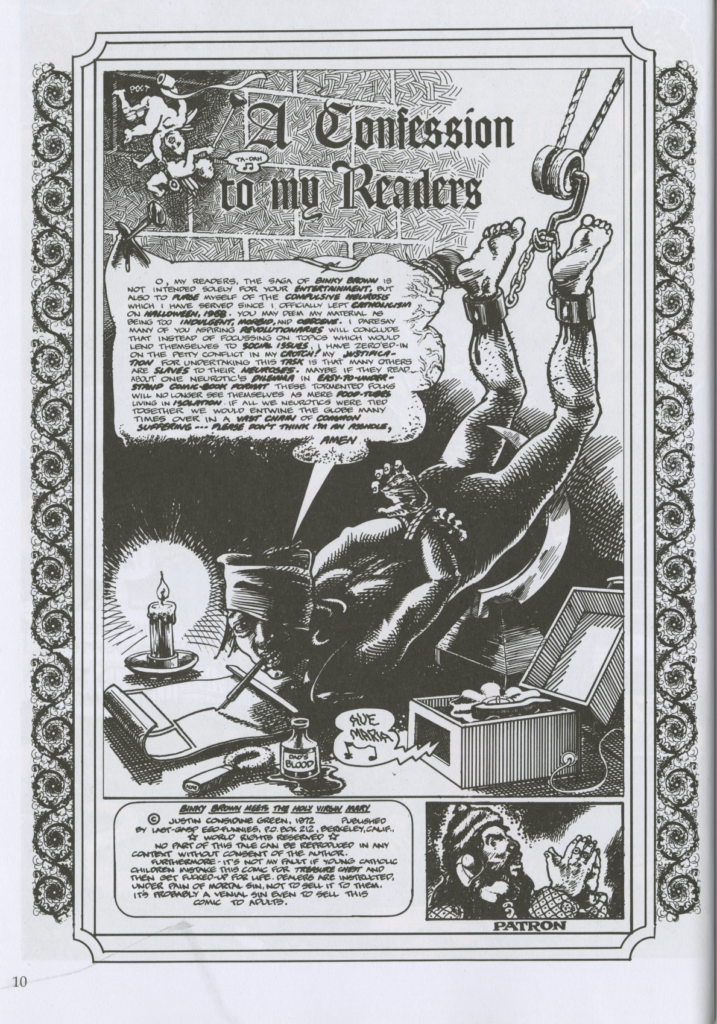
As an orienting example, consider the frontispiece (Fig. 1) to Justin Green's 1972 Binky Brown Meets the Virgin Mary, a comic dramatizing Green's struggles with neurotic obsessions and which itself constituted an effort to "purge" those neuroses in auto-fictional confession.38 A relative bestseller of the underground era, Binky Brown has often been framed as the originating work of autobiographical comics, without which, according to Spiegelman, "there would be no Maus."39 Its influential afterlife positions the work as an exemplary reference point for both the alternative tradition (as transgressive, "soul-baring" progenitor) and the academic fields at pains to prove comics' social utility (as "graphic medicine," among other things).40
In his introductory essay to the 1995 edition, "Symptoms of Disorder / Signs of Genius," Spiegelman describes Green's work with an admiring lament — "too disturbingly real" — that echoes the comic's self-description as "too indulgent, morbid, and obscene."41 Before Binky Brown, Spiegelman jokes, "cartoonists were actually expected to keep a lid on their psyches and personal histories, or at least disguise and sublimate them into diverting entertainments"; Green's "too disturbingly real" cartooning broke open the medium's capacity to directly portray an artist's psyche — unconscious and all.42 As Spiegelman sees it, Green thus "pioneered brand new territory for comix to colonize" — a graphic territory of the uncensored psyche, with its rich (and risky) surplus of flesh and fluid.43 Others, such as Charles Hatfield, have since written of Green's "self-scourging" blend of "scarifying psychological content" and "extravagant visual metaphors"; Hillary Chute credits Binky Brown with "demonstrat[ing] the powerful effect of comics" to materialize an exterior "visual body" for the "interior landscape."44 I read Green's work against this tradition, focusing on its gimmickry, diversions, and literal restraints to show first what the purgative framework misses in Green's masochistic performance, and second how cartoon viscera brokers the valuable potential of comics for which it often serves as uncomplicated proof.
The frontispiece to Binky Brown takes as its conceit the literally tortured artist. Green's avatar, Binky Brown, dangles by his shackled feet, ankles dripping blood as he cranes his neck up to face the picture plane. Between Brown's thighs, a crescent-shaped blade hovers just out of castrating range, a threatening twin to the graphic curve of his own contorted body. It's a vertical reversal of The Pit and the Pendulum's descending, swinging crescent: here, body swings over blade in predicament bondage, forcing a continual choice between painful effort and genital peril. The pose references the tarot iconography of the "Hanged Man" card, with Brown's straining form putting a literal twist on the card's quiet surrender.
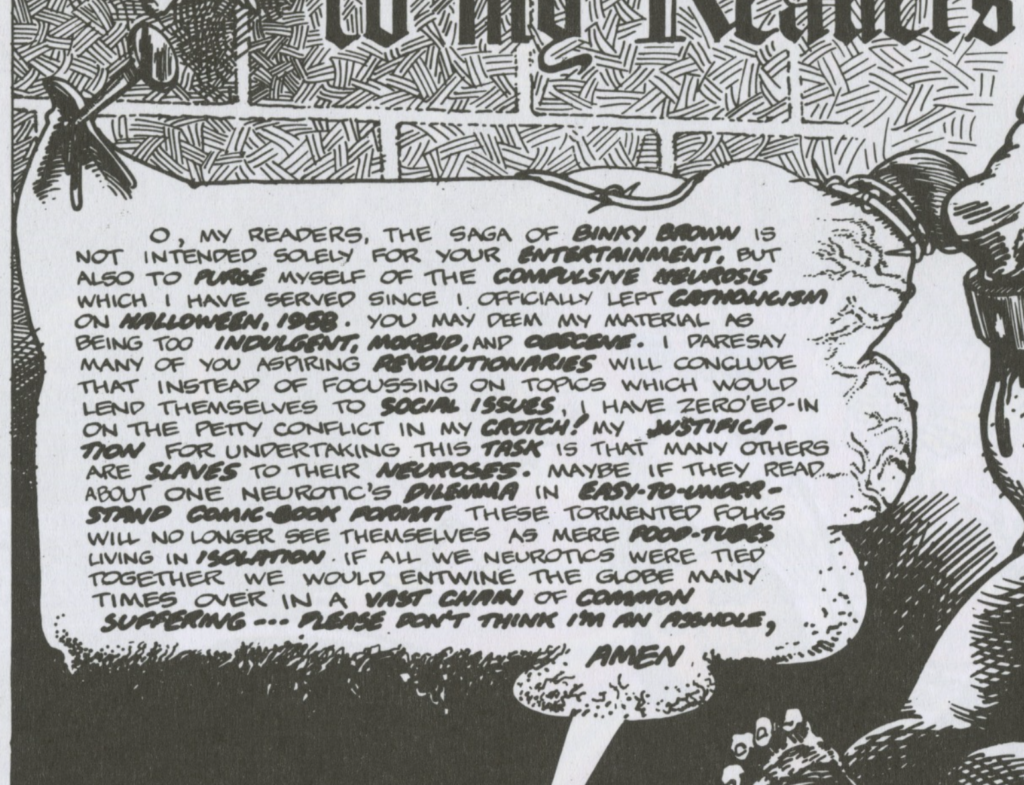
Is this penitent confession or defiant testimony? From his position of wrenched self-exposure — and in a miraculous act of multitasking — Brown uses his mouth both to draw and to speak. He emits a veiny, vaguely testicular speech balloon (Fig 2), one corner of which is nailed to the wall above him; there's a fountain pen propped loosely between his teeth. The pen's tip draws empty panels on the curling page below him, presumably using "DAD'S BLOOD" as ink. Any of these details could serve as evidence of cartoon viscera's most conventional claim: that graphic flesh allows what was otherwise unsayable or unrepresentable to be expressed in the raw; that it frees both artist and reader from artificial constraints to expression; that its jolt of feeling closes the distance between reader and referent. But to approach viscera in this way leaves little room to read the squeezed, leaky, and contorted bodies on a comics page beyond an analogy of blood to ink, or the demonstration of felt intensity.
If we move our reading of the visceral from the page's individual details to its larger arrangement of body and props, we get a notably convoluted, and quite literally contrived, picture of auto-graphic production. An array of hooks, manacles, pulley, and blade simultaneously arrange, arouse, and restrain Brown within a supportive structure of masochistic machinery. Brown's body is wounded, but it is also wound-up like a spring — suspended in an unexpected and upside-down scene of work, which is also indulgence, which is also torture. His flipped, torqued spine becomes one part of a strangely medieval Rube Goldberg machine, one that processes cartoon flesh into the output of serious, visceral, disturbingly "too real" comic.45
Surveying the original Rube Goldberg cartoons, Michael North notes that the machines are often powered by pain or bodily fluids: "Tears are especially popular."46 The machines are remembered for being comically over-engineered, but North reminds us that the point (and the gag) was also their DIY technological crudeness, with animals and humans far more common as components than cameras or radio. A Rube Goldberg machine is a gimmick par excellence, and a gimmick, as Sianne Ngai has proposed, makes us experience "an uncertainty about labor — its deficiency or excess — that is also an uncertainty about value and time."47 We call something a gimmick if it seems to be working too hard and yet not enough; when its form is dubiously elaborated, belabored, and laborious for the work it does. A gimmicky object calls into question its own value by advertising its "extravagantly impoverished ... flagrantly unworthy" form, alerting us to a possible mismatch of time, labor, and value.48 In Green, the convoluted set-up for his bodily confession makes an "extravagantly impoverished" elaboration out of autobiographical cartooning. In doing so, Green dramatizes the laborious — and dubiously useful or valuable — extraction of his own pain.
This prostrate self-subjection sets Green up to make an especially bold play for the comic's redemptive value. On the raw, wounded surface of the fleshy speech balloon, Binky Brown delivers a compensatory prophecy-apologia-sermon for the comic that follows.49 He goes through the familiar motions of begging serious consideration for his comics, even offering an ethical "justification for undertaking this task."50 Despite the submissive posture, Brown's ironic supplication drives a hard bargain for the reader's judgment, trading each possible assessment for another: this work isn't just entertainment, he insists, but an effort at auto-exorcism. You might mistake this for pointless depravity, but it's also a hopeful work of personal testimony, intended to uplift neurotic "slaves" from isolation. By making this confessional comic, Brown imagines that his fellow sufferers ("these tormented folks" / "food-tubes") will finally be "tied together ... in a vast chain of common suffering" — a universal, intestinal bondage recoded as freedom.51 But he switches this grandeur out for one final, undersized appeal: "Please don't think I'm an asshole, amen." This punchline seems to undercut the liberating value of Binky Brown's own bondage, but this minor "gag," which plays off of both Catholic and readerly indulgence, permits him to make the rest of his ambitious justifications, to arrange for the reader's indulgence. The gimmick's "extravagantly impoverished" elaboration (its tortured and upended form) works ultimately to negotiate a deferral and estrangement of readerly disdain. Catholic indulgence is a central concept of Binky Brown, designating a temporal currency — or "celestial coupon" — for repaying spiritual debt.52 But here, the hopeful exchange between sinful and celestial indulgence plays on the productive or unproductive gag of self-abuse.53 These rhetorical gestures, both compensatory and predictive of the medium's cultural impotence, perform a self-reflexivity that also legitimizes the work's avant-garde potential. By graphically mortifying his flesh, Green gets off relatively easily in another sense: that is, he finds a way out of the accusation that his work is mere masturbatory juvenilia.
Toward the end of his life, Green himself would express ambivalence about the comic's self-conceit of a cathartic purification. It had succeeded all too well as a bid for value, he argued, but failed utterly as a therapeutic auto-exorcism of his neuroses.54 One such neurosis — neither pictured or mentioned in the comic itself — was Green's feeling of being "trivial" in his safe distance from the Vietnam War: "Everyone I knew knew at least someone who was killed in Vietnam ... I didn't want to present myself as hero, but rather as a specimen."55 Green wondered if "the thought of a sudden release from suffering weighed too heavily" on the production of Binky Brown, and he regarded the 2009 McSweeney's deluxe reprint with intense anxiety over its production value.56 "I was surprised at how the context changed the original intention of the project," he said in a 2010 interview: "What was originally conceived and produced as ephemera (the humble comic) now has the permanence of literature."57
Green's ambivalence expressed a discomfort with becoming a site and avatar of exceptional value. Even the masochistic position of specimen, as opposed to hero, now evokes Binky Brown's canonization as a graphic medicine text. In graphic medicine's purifying framework, the auto-narrating medical subject is in fact a heroic specimen, able to show their suffering as well as tell it. Thus, in the Routledge Handbook of Health and Media, Binky Brown appears as a "stand-out example of unmediated graphic self storytelling," able to visualize OCD "in its purest form ... largely uninfluenced by cultural stereotypes of the condition."58
Spiegelman's settler-colonial metaphor for Binky Brown's psychic landscape ("brand new territory for comix to colonize") feels appropriate to this play of visceral waste and worth. It pictures an unoccupied and disused cultural ground, waiting to be seized for cultivation — or, given the purgative themes, cleansing and extraction. There is thus a surprising resemblance between the accounts that Spiegelman and graphic medicine give of the psychic landscape that Binky Brown represents, differing mainly in their relative stress on purge (raw, unmediated expulsion) or purification (cleansing, cleaning out). If the purge describes a process of graphic creation, then what the reader receives is rather ironically a newly purified object.
Hellen Jo's Cutting Girls
I'll move now from Green's classically visceral confessional to Hellen Jo's 2019 minicomic, A Bleeding Cut. Jo is well known for her scenes of Asian mean girl mystique, which feature figures who invite the reader's (aspirational) identification precisely by disallowing it. Jo's women are always fighting, skating, squatting, and smoking together, inevitably looking glamorous and gritty and totally bored. No one is invited in who isn't already in the picture frame; to read or register their affect (as cool, as languid, as "fuck-off") occurs by the very experience of being shut out from it. Their faces are deadpan or pinched, if they are visible enough to be read at all.
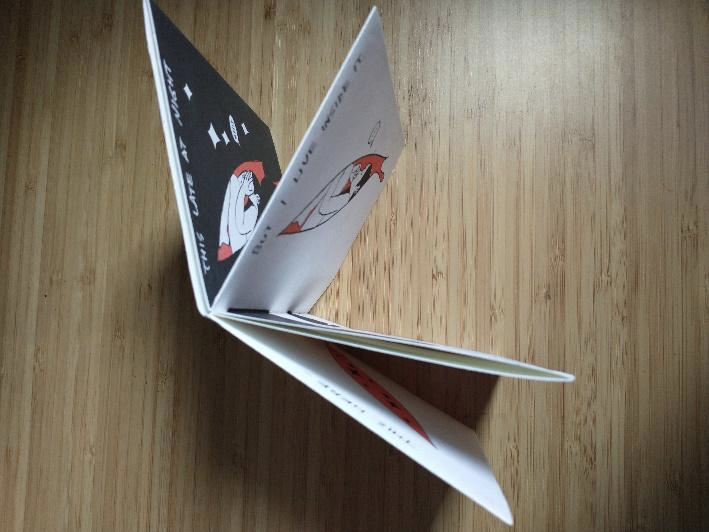
In A Bleeding Cut, Jo brings this characteristic disdain to a brief account of a minor wound. The minicomic (subtitled a "poem & comic") is printed in an 8-fold zine format, and each of the six interior pages is doubled-over to form an open slit with the spine, replicating the "cut" of the title (Fig 3).
A Bleeding Cut reads at first like an edge case of cartoon viscera; its graphically flattened and abstracted cut offers only a bare resemblance to the guts, pus, and x-ray views of the idiom's repertoire. The comic approaches feeling through a bratty kind of understatement and formal constraint. In contrast to the messy spilling-over of vital feeling expressed by, say, RAW's "Open Wounds from the Cutting Edge of Comix," Jo offers a minor cut, one that is visually abstract and contained — and that also abstracts and contains the lyric subject.
The comic opens by introducing us to this titular injury in the demonstrative: "This here — / is a bleeding cut." Our view into the cartoon cut — an eye-shaped opening — is straight-on, but our view of the figure that this cut belongs to is limited to oblique angles and profiles. Then, at the mini-comic's midpoint, Jo pulls the established scale and logic of the bloody opening inside-out. Opposite a page on which the speaker licks at her wounded hand, we get a view of her curling up in fetal fashion inside the cut, now naked (Fig 4).59 "It tastes bitter, emits gas, the foundation is cracked, & the resale value is worthless," the narrative voice says of this cut. "But I live inside it." Rather than a mark and opening on the speaker's skin, the cut becomes a frame (a panel, a domestic space) that houses her — not that she's thrilled about it. The comic ends with her resigned complaint, a question so rhetorical it lacks a question mark: "Where else am I gonna stay / this late at night" ("Sigh / Shit").
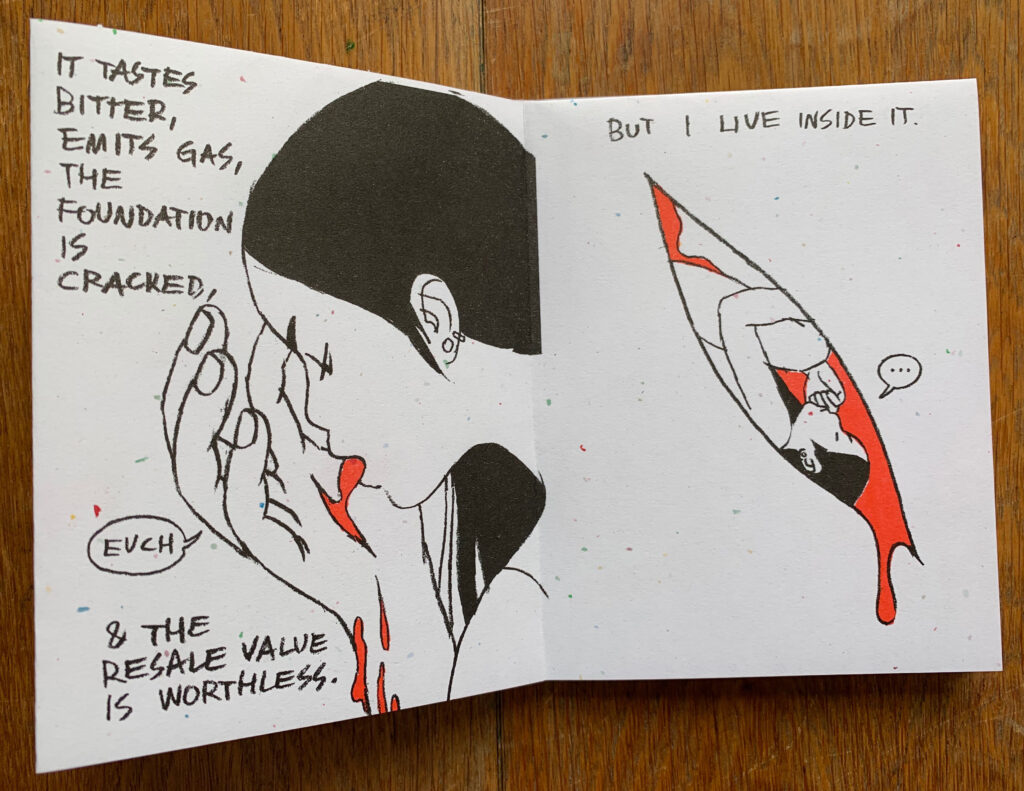
The visceral logic of "pulling the insides out" to get at psychological depths is made playfully literal with Jo's inside-out cut, which is at once an opening into the body, an opening that holds the body, and an opening that turns the single sheet of paper into an 8-page booklet. This literal paper-cut necessary to the work's construction convenes cartoon viscera's layered registers of feeling, publishing, and value, linking the production of communicable, externalized affect to the production of a zine.60 The artist cuts herself and her subject open, unfolds an interior landscape; the zine-maker cuts the paper, folds it into the 8-page booklet that is, like the bleeding cut itself, functionally "worthless" by design.
Zine culture relishes the minor and the cheap — or even better, the free — as an ordering principle of both zine aesthetics (freedom) and economy (free-of-charge). They should be cheap or free to produce (discussions almost always cite the honorable practice of making zines on the sly at work, stealing not only company time, but copy machines and mail services). They should also be cheap or free to receive. To the extent that it remains a commodity, the zine has an intentionally low and unstable exchange value, often circulating as a functionally "worthless" object. When zines start to appear too valuable — either as "overproduced" objects or by being incorporated into institutional archives — the tension generates anxiety. Mimi Thi Nguyen, for example, asks what changes when the "minor threats" of her own Race Riot zines become a "productive site for archival accumulation and intellectual inquiry."61 In this way, zine-making offers an autonomous cultural form where both production and exchange are not fully mediated by capital (literal or symbolic), a respite in the minor that intentionally precludes substantial artist profit.
Jo's perversely contained version of cartoon viscera — her insistence on the cut as a compromise — apprehends this aspect of zine economy and turns it against the image of zine affect as an uncensored view into "uncompromising life." Her speaker tongues the cut ("euch") even as she lists its flaws — bitter, gassy, cracked — and evaluates its exchange value as "worthless." Distasteful as it is, the bleeding cut is something to taste and something to live in, at least for now; like A Bleeding Cut itself, its cheapness provides a provisional kind of shelter. Here lies no wounded inner landscape. Instead, A Bleeding Cut uses flatter affective states like enduring, waiting, and managing to make a point of its familiar — we could say tired — central metonym, a cliché whose deadened rhetorical quality becomes part of the zine's performance of weariness.
Like all metonymy, the cut works by substitution, trading one concept for a related image: inner pain; bleeding cut. But rather than making that concept more concrete or clear, Jo's trade enigmatically substitutes a translucent, red-ink screen for the visceral entry/excess apparently promised. The economical two-color printing fills the cut, tongue, and blood with the same red, making it ambiguous what is positive or negative space, what is an object or an opening, what is a fluid dripping out or a further rip opening the body. The resulting ambiguity of the almond-shaped cut — both figure and ground, fill and frame — also brings out a second metonymic layer: cut as a stylized eye, dripping gooey tears rather than blood. This cut/eye doubles the visceral twist, ironizing another idiomatic "window to the soul" by which feeling is assumed to be naturally and easily communicated in a comic that bypasses those very routes of conveying feeling. Whatever lyric-subject assumptions we might bring to a piece labeled "poem & comic," Jo pointedly denies us entry by either the bleeding cut or the weeping eye. Her speaker rehearses the list of disappointments like an aunt or uncle in the groupchat: bitter flavor, gassy gut, troublesome property. And the resale value is worthless!
This performance of emotional flatness brings to mind Vivian Huang's Surface Relations, a recent book on the uptake of inscrutable aesthetics in queer Asian American art which features another of Hellen Jo's cutting figures on the cover (Fig 4).62 Huang asks us to reconsider inscrutability as an artistic strategy that can make room for "forms of being or becoming that elude — whether strategically or compulsorily — official narration," given that entry into legal and cultural citizenship is shaped by "liberal mandates of self-testimony and transparency."63 One chapter addresses literary scenes of cutting (a practice ordinarily narrated as self-harm) and appraises its effects as a "vitalizing stopgap," "an embodied spatial corollary to waiting."64 Here Huang aims to unsettle the gendered position of Asian skin/flesh as "(physically) penetrable and (psychically) impenetrable," without losing sight of the military and sexual violence that has been the embodied history of this penetrative script.65 Cutting into one's own skin, they argue, may offer decisive possibilities for physical and psychic life that cannot be discerned when the practice is narrated only as pathology/passivity. Placed alongside the ecstatic self-negations pictured by canonical queer theory, the minor threat of cutting "may be thought of not as a self-shattering but as an effort to endure."66
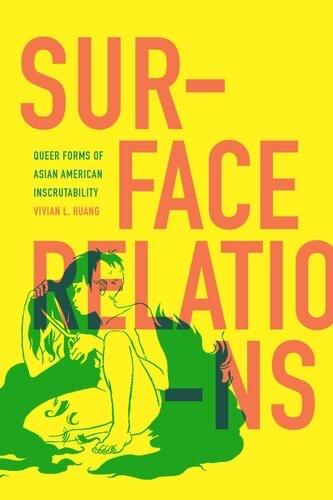
Huang builds on the research of scholars working between cultural studies and histories of capitalism, including Colleen Lye and Iyko Day, who have argued that the inscrutable Asian type comes into existence as an economic figure of nineteenth-century changes to transnational labor following the British empire's abolition of slavery.67 Chinese workers specifically were imagined to have passive, indeterminate, and unfeeling bodies — perfectly adjusted to enduring modernity's demands on production, but ill-suited to acting as "free," active subjects in the political sphere.68 Lye and Eric Hayot propose that for the United States, the inscrutable menace projected onto the Asian body was "modernization rendered visible" as an adjustment to the processes of industrial labor. The imagined Asiatic deluge, unlike the deluge of visceral affect, threatened a future in which the compliant, industrial, incorporeal coolie would become "the condition of all bodies everywhere."69 The archetype of Asian "endurance" (automatic, feminine) remained a scapegoat for the devaluation of white labor's "strength" (human, masculine) well into the twentieth century. As Paul Nadal and others have argued, these racial formations continue to operate post-1965 in the model minority myth, which uses a primarily East Asian subset of Asians as the exemplary neoliberal subject: an "entrepreneur of himself."70
This history poses an aesthetic and political problem for any straightforward visceral fantasy — not in terms of representational exclusion (inscrutable Asians locked into an economic body and out of the expressive one) but rather representational dependence. Eric Hayot puts it this way: modern bodies, having become "vehicles of historical and economic meaning," can't also remain "naked, fleshy apertures of some purer and more apparently original form of being."71 For cartoon viscera to bring the insides out as a powerfully legible yet "unrestrained" interiority, the flesh in question must be presumed unmarked by overriding metaphors of value or abstract labor.72 Whiteness thus requires certain racial projections to carry the figuration of value on its behalf, keeping open an independent position from which to claim viscera's unruly subjecthood and explosive self-shattering.73
This autonomous subject position (however fictive) corresponds to the real economic autonomy (however partial) that alternative comics has attempted to secure between the worlds of fine arts, institutionalized publishing, and zines.74 The efforts toward building an autonomous space for comics — one that could contest the deadening effects of capital — have been at once considerable and regularly compromised by its intractable situation "within the wider structural antagonism of labor and capital and generalized relations of exploitation," as Maggie Gray lays out in her history of the Birmingham Arts Lab, an experimental community arts center and alternative comics press of the 1970s.75 Three of the problems Gray identifies from the Arts Lab Press's (ALP) case are especially relevant to this discussion: (1) that "creative autonomy was predicated on low wages and voluntary work," since the cooperative could not produce enough surplus value to support itself and its contributors; (2) that taking funding from the state required an economic assimilation into nonprofit structure, undermining the original experiment in horizontality; and (3) that the same state funding co-opted ALP's democratic arts into a program of "outsourced social work."76 Although the ALP in some ways had a greater capacity to contest hegemonic culture through "economies of scale," it could not shoulder its own reproductive costs without compromises that wore away at its capacity to create and contest.77
If only because the zine's reproductive costs stay as minor as the form itself, zine-making has provided a more stable base for visceral narratives of production, compared to more ambitious projects of alternative publishing. Mimi Thi Nguyen lists and affectionately deflates some of these romantic associations in her keyword essay on zines: "radical egalitarianism," "eruption," "a foundation of emotional intimacy and immediacy," "a nonalienated relation to labor ... that spills into or implies otherwise a nonalienated, or at least less alienated, relation to self and to others."78 We might situate zines today as striving to enjoy being stuck within the "negative relation to capitalist value" that Sarah Brouillette proposes as the context for most aesthetic practice — drawing parasitically on work time and technology, for example.79
Though it invokes the intimate and immediate temporality of a zine, A Bleeding Cut also turns away from the vital, liberating eruption promised by viscera's "naked, fleshy apertures."80 Jo remakes the personal injury and the lyric subject as flat, abstracted figures of endurance in this "poem & comic," as if wearied by the fantasy of visceral disorder exploding modernity's "bland surfaces" to deliver jolting intensity.81 She delivers an ambivalent rewriting of the lyric subject as a consciously — and somewhat unhappily — economic subject, surviving on/in the bleeding cut.
Like much of Jo's other work, A Bleeding Cut invites our delight in being deliciously cut off, cut out, and cut down. This minor masochistic pleasure hints at a different fantasy at work here, compared to Green's purgative contraption: for Jo, bitchy inscrutability is a minor graphic cut that houses, screens, and even feeds the speaker, but never promises a freedom after or outside itself. Jo's cartoon viscera fails to appreciate in either value or affect, remaining minimal and minor and flat; this makes it a canny reprieve from the neoliberal distortions of "human capital," where even artistic self-expression cannot be cordoned off from the injunction to "invest in yourself" and where few alternatives have been able to stay afloat for long. Jo — in compromising the visceral idiom and articulating the compromise that viscera's alternative already is — tenders both the reprieve and the sting of its cut.
From Autonomous to Teratomatous: Sloane Hong's Viscera at Work
Where Hellen Jo offers something like an edge case for cartoon viscera, the tattoo and comic artist Sloane Hong builds a plot around the concept of visceral value: a story in which meat speaks and flesh overpowers all rational efforts to suppress its revelations. Hong's 2023 MARROW is a short work of science-fiction (35 pages), first published as part of Zainab Akhtar's annual digital festival, the ShortBox Comics Fair. MARROW follows a former smuggler named Diz, whose new (legally) above-board job as a "flesher" places her in the bowels of a high-tech facility called The Farm, tending to crops of living meat.
The Farm is as uncanny as it sounds, full of conspicuous euphemisms and resemblances: its workers have nicknamed the engineered meat-forms "marrow" — a spongy, innermost vital essence — which is explained, initially, as "weird plants that grow meat."82 Meanwhile, the incubators that monitor and feed this living meat have the approximate scale and organization of mortuary drawers (Fig 6), a morbid incongruity for a process without need of slaughterhouses. The category of "incubator" lends them a cozy association with egg-warming ovens, but also a range of less congenial associations: cell culturing, fetal life support, infectious disease, and even entrepreneurial business.
It's these automated meat-mothers that "actually do most of the work," Diz explains to Natsu, the old friend she's snuck in for a visit. The incubators care for the lumpy, pulsating masses of "muscle, bone, offal" that grow new tissue according to engineered DNA instruction, without any need of manual input or monitoring. Natsu asks the natural follow-up question: "Then what do they pay you for?"83
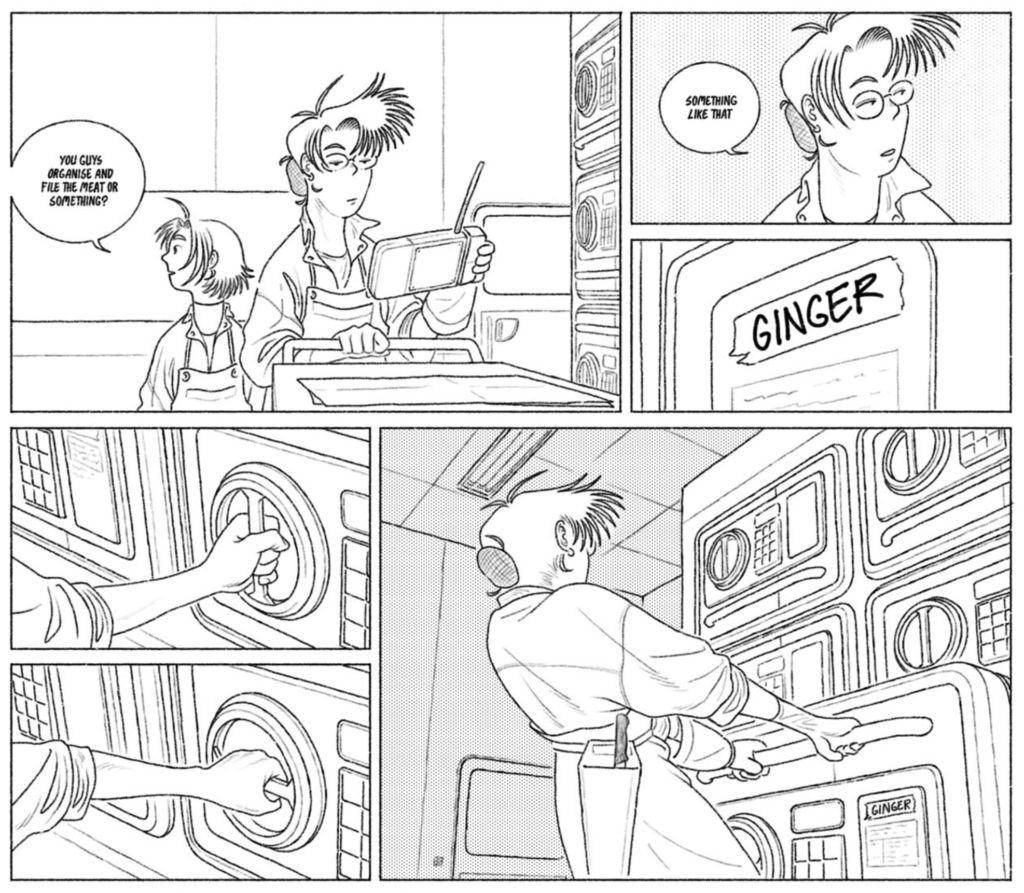
The answer, it turns out, is to cut. Fleshers are tasked with cutting open and cutting out the "superficial mutations" — ambiguously edible, possibly toxic — that the Farm's incubators actually "grow faster than anything you'd want to eat." Marrow has been engineered to be automatically and enthusiastically reproductive, but the engineered and incubated meat-forms also have "a habit of also growing things they aren't supposed to" — tumors that reveal features like eyes and teeth when they're cut open. In designing a mode of production without the agricultural "mess," the Farm has mainly exchanged one complication for another: "genetically these things are a mess," and fleshers do the cleaning-up.84 Cutting out the mutations ensures that the flesh remains meat, and the meat stays "healthy."
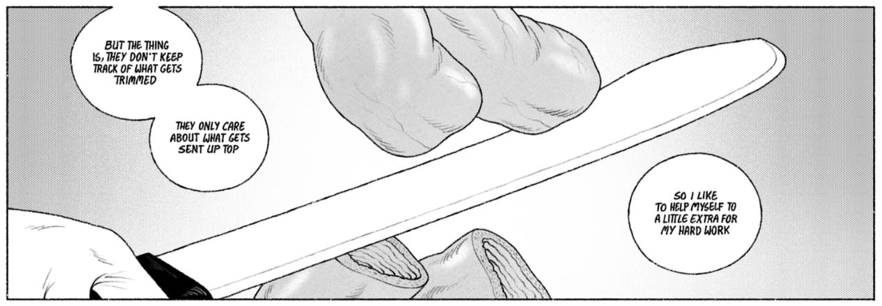
The flesher's job of janitorial lumpectomies comes with two unsanctioned perks, the first being access to marrow's "offcuts." Still a smuggler at heart, Diz helps herself to "a little extra" (Fig 7) whenever she makes a cut, sending the off-cuts to friends and family like a meat-based remittance. The second perk is the unofficial tradition among all the fleshers, a morbid lottery in which everyone gets a free round of drinks whenever something weird is found growing inside a tumor — paid for by whoever is "unlucky enough" to discover it.85
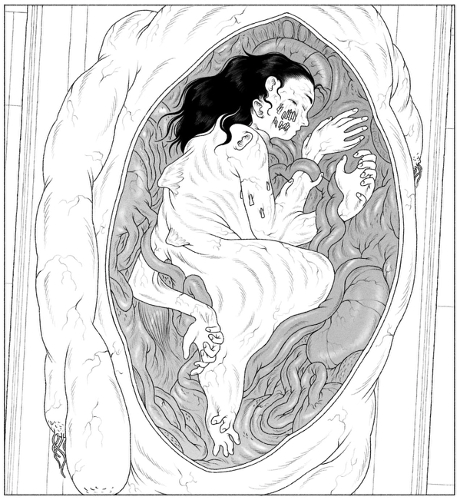
Up to a point, these excesses on the part of both marrow and fleshers have been incorporated as routine parts of the process. A lack of oversight is built into this mode of production, which means that a more indulgent margin of error can be tolerated in exchange for the low overhead (shitty pay) and real meat getting sent up to wealthy "topsiders."86 But one particularly "ambitious" meat-maker has earned a nickname — Ginger — for consistently growing far "too much too quick, like she's trying to figure something out."87 Morbidly curious, Natsu dares her friend to let something grow awhile, given that the abnormal level of mutations has Ginger slated for disposal anyway. When the two return to see what the incubator has made in their absence, Diz cuts into Ginger's swollen, placental flesh. What they find is a recognizable and whole "fucking person" (Fig 8).88
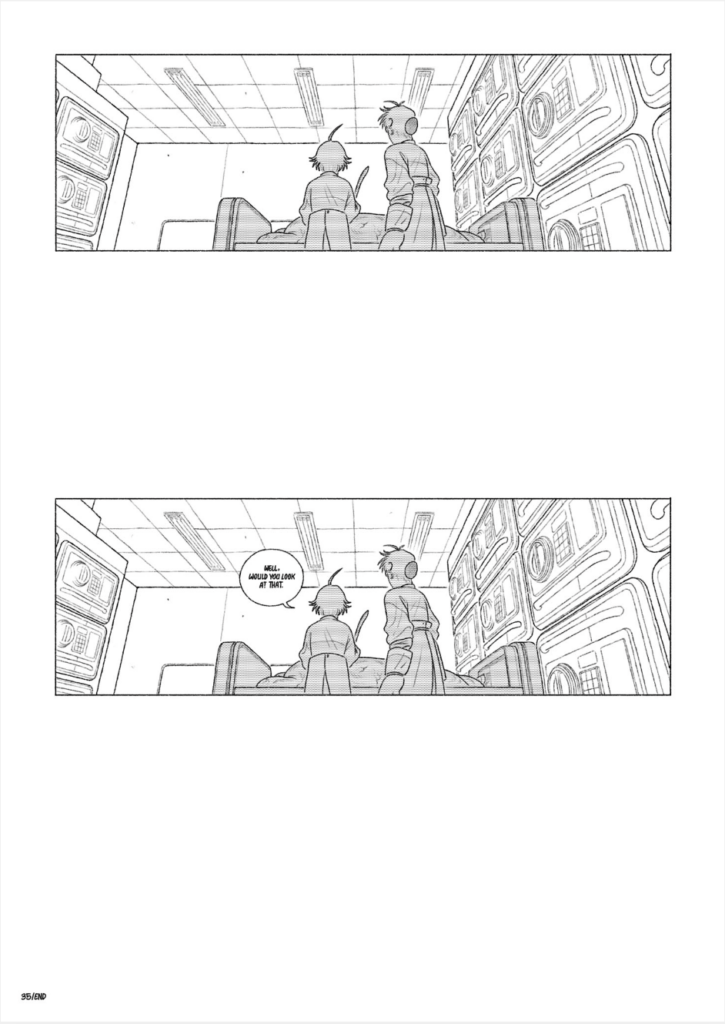
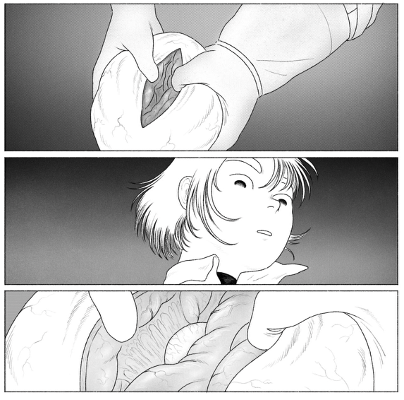
In the comic's tense final sequence, Natsu herself takes up the flesher's knife— not to kill the pseudo-fetal thing incubating inside the marrow, but to test its personhood via live dissection."If this really is more than just another tumor," she tells Diz, "Then her insides ... should look like ours too, right??"89 A sequence of intimate close-up panels shows us Natsu making the cut into this pseudo-fetal body, but we are never shown what the two women, peering in, see themselves. MARROW's very last panel (Fig 9) gives us a distinctly withholding view of both women's backs, and a flat declaration from Natsu: "Well, would you look at that."
From the start, the comic's premise establishes marrow's lively excess as something intentionally built into its mode of production. Ginger is, after all, not just a "meaty little troublemaker" but a "cultured teratomatous organism" — an engineered life-form that draws on the subtype of germ cell tumors called teratoma. Teratomas mainly originate in the reproductive cells of the ovaries, testes, and tailbone, which are capable of producing different tissue types; as a result, teratomas have a reputation for growing teeth, hair, bone, fat, and/or muscle. Thus, while the job of fleshers is to remove unwanted tumors and keep the marrow "healthy," all of The Farm's marrow production is premised on tumorous — which is to say abnormal, pluripotent, and uncontrollable — reproductive growth. Marrow is a commodity designed to reproduce itself so quickly and so abundantly that its frequent "mutations" — recognizable tumors with eyes and teeth — are a welcome trade-off to the messier, more labor-intensive methods. Its vitality is both a bug and a feature: an obscene truth that needs to be managed, on one hand, and on the other, a labor-saving trick of automatization, reducing animal husbandry's reproductive cycles to non-intensive, largely unsupervised work. The work left to fleshers is something similar to janitorial work, or proofreading, or even censorship. Cutting out the product's unseemly errors helps to manage the euphemistic fiction that "marrow" is merely meat — that it's not alive in any way that matters, only in the ways that generate surplus value.
The idea of eating neoplastic (tumorous) tissue cultures is thus not the only source of visceral discomfort in MARROW's premise. The economic potential of abnormally prolific cell cultures has its most famous exemplar in the story of Henrietta Lacks, a Black cancer patient whose cervical tumor was repurposed and reproduced without her consent in 1951, to enormous and enduring profit.90 In Life as Surplus, the scholar Melinda Cooper argues that neoliberal economic theory and modern biotechnology were born together in the 1980s, tightly entwined in their principles of speculation and de-regulation.91 The concept of life in itself has had to stretch to the extremes, with "new ways of theorizing life ... never far removed from a concern with new ways of mobilizing life as a technological resource," with the invention of recombinant DNA (aka genetic engineering) opening chimerical possibilities beyond the previous limits of sexual compatibility and breeding. Cooper writes that this technique "lends itself to the specific demands of post-Fordist production — flexibility and speed of change — to a degree that was impossible in traditional plant breeding."92
One way of reading MARROW, then, is as a comic asking what kind of relationship one can have to the improvisational, expressive life of flesh when its unruly promise has already become an investment of the bioeconomy. How, especially, might an artist square the simultaneous associations of viscera "always in surplus of itself" with capital's delirium, on the one hand, and somatic revelation, on the other? Hong puts this question in the genre dressings of a workplace horror-comedy, so that the laconic, understated ending arrives as something of a punchline. But it is crucially unclear how to take the gag — this suspenseful invitation to look at "that" which is blocked from view. Should we read this in a lineage of science-fiction dystopia (one more revelation that future-meat is human flesh), or in a lineage with Susan Stryker's famous monologue proclaiming her unnatural re/birth (revelatory science-fiction of a different kind), "My Words to Victor Frankenstein Above the Village of Chamounix"?93 The comic's affectively inscrutable ending makes it a considerable displacement from the alarm and rage, respectively, of these two readings.
On a formal level, MARROW invests in the expanded white space and constrained views associated with the omissions at the story's center. An interval of blank pages is suspended between page 22, when the two women decide to let Ginger grow, and page 26, when they return to cut her open. In the comic's final page (Fig 9), empty space swells between two narrow panels. Whatever viscera does or reveals in these swollen gutters, the comic makes a point of rendering it in blanks. Textually, too, marrow's revelatory truth is almost always cut off by a dash or ellipses; the disclosure is relentlessly clipped, blanked, and visually constrained — a verbal version of the flesher's cut. Her knife, we are reminded, is at once a tool to uncover via penetration (cutting flesh open) and a tool to censor via pruning: "cut 'em out to keep 'em healthy."94 That the ending blocks — and emphatically adds blank space to — our view into Ginger-the-girl's insides suggests a degree of restraint, or even modesty, against the ideals of visceral excess and exposure.
Instead, MARROW's visual style aligns with the neat, surgical manner of its setting. The linework is consistent, light, and meticulous, with little variation in weight and a slightly roughened texture only visible at close examination. Hong's approach resembles the ligne claire ("clear line") style of midcentury European cartooning, an "unerring evenness of line" that avoids "frayed lines, exploded forms, and expressionistic rendering" in favor of pristine, diagrammatic, and almost-shadowless images.95 Its unvaried treatment of body and environment, Charles Hatfield argues, betrays a fascination with "blurring the distinction between organic and inorganic form."96 In MARROW, the only form given three-dimensional modeling is the meat itself, where screentone has been applied and then gently abraded with white (a technique common to manga but not to the European comics associated with ligne claire). While everything else — even the body incubating inside the marrow — is primarily defined by graphic contour lines, viscera gets a velvety and lifelike modeled finish. The unnerving visual difference makes sliced-off and sliced-open flesh a singular exception to the ligne claire equation of living and unliving forms. The climactic panel depicting Ginger's cleaved-open inside (Fig 8) jumbles opening/object and figure/ground, recalling the translucent Risograph-ed red of Jo's "bleeding cut." This time, though, it's not flatness or screen that's in play but sensuous, swollen background against which the startling figure of a sleeping girl both emerges and recedes.
"Whatever's in here wasn't made, it happened," Diz insists to Natsu, just before they find the girl inside the flesh.97 "It's just a mutation, no different from a tumor." In an author's note appended at the end of the comic, Hong curiously echoes this disclaimer, explaining that she "originally came up with this plot as a throw away story for an exercise in aimless storytelling":
The idea was to take a simple premise and draw a comic, page by page, with no planning to see what kind of narrative would emerge. Before I knew it, I'd put more work into this little experiment than I'd ever intended and ended up making something weirdly revealing and meaningful for me.98
This authorial narration of the comic's making returns viscera to the figure of the unconscious, but not an unconscious of directly purgative irruption; both MARROW (the comic) and marrow (the meat-maker) require the extended work/indulgence of another to make a "little experiment" bear the surprise of "something weirdly revealing and meaningful." What should we call this "whole fucking person" that Ginger has made, or reproduced, or perhaps become: offspring, tumor, meat, or art?
MARROW suspends Ginger on the boundary between intention and error, creation and reproduction, much like Binky Brown suspends the artist-specimen between work, torture, and indulgence. Unlike Green's cringing avatar, who circuitously bluffs his way from mortified to grandiose, she is already understood to be "ambitious" from the beginning; Diz suspects, even if she does not believe, that Ginger's wasteful overproductivity is marrow "trying to figure something out."99 By the comic's end, Ginger has secreted herself across this line from unliving, unthinking meat toward "something like us" — from something that merely happened into something that was made.100 Her transgression of the line cannot destroy its arbitration of fleshly value (meat, person, mutation), but it does "see double," to use Lindon Barrett's phrase, grasping the boundary as a site "not only of separation but also of influential ... often surreptitious traffic and exchange," where human bodies can be cut and cultured into profitable flesh, and where the reverse can happen, too.101 Being trapped within a negative relationship to value, at least for the marrow nicknamed Ginger, does not subsume the meanings of its "unintended" forms, but neither does the new form bring about an exterior position of freedom. The incubator, which is her productive matrix and her enclosing morgue, is also responsible for the life support that makes her almost impossible to kill. If she were to "rise up from the operating tables of our rebirth," as Stryker puts it, this would also mean a new kind of exposure, vulnerability, and separation from the supportive restraints of her former (non) life.102 What supports might this new bodily form require, now that its egg has cracked?
I conclude with this reading of MARROW as a way of returning to the tropes of bodily obscenity, transgression, and death from the vantage point of social reproduction. But this is not to discard obscenity's eroticism: Hong's velvet renderings of viscera land somewhere between highly technical medical illustration and covert pornography (Fig 10), discomfiting in its inscrutable (yet unmistakably explicit) treatment of surplus flesh. Here, unlike the testicular balloon in Green's frontispiece, cartoon viscera's identity as a libidinous "alternative" to obedience does not enact the presumed immediacy of affective force (since Ginger's fleshy re/productions betray thought, not exactly feeling), nor a direct opposition to the parental censor (since the censor's knife not only represses but delivers her, in nested C-section). Instead, the enigmatic, quickening reappearance of Ginger's "tumors" emphasizes their undecidable relationship to The Farm's productive process: waste ("mutation"), byproduct ("offcut"), or sign of life ("girl")?103
Marrow's compulsion to repeat — reproducing monstrous growths until it achieves the form of a girl — is both cryptic and unmistakably "deliberate," the roundabout confirmation of an autonomous, thinking Other that cannot be directly observed.104 As a "cultured teratomatous organism," Ginger has implicitly been designed for the (re)production of monstrous and abnormal flesh (teras- from the Greek for monster). And yet she also has her own designs, her own way of interpreting and reformulating and quietly "trying to figure something out."105 Aligned after all with Susan Stryker's transsexual biomedical subject — violently assisted in birthing herself by the surgeon/flesher's scalpel — Ginger articulates "something more, and something other, than the creatures our makers intended."106
She is no less an economic figure, in the end, but her "ambitious" errors make her a flagrantly off-model minority who at once embodies and exceeds the bioeconomic value of stretching life to new extremes. As the unforeseen return on cartoon viscera's investment, Ginger's "something more, and something other" also leaves the reader with a problem that Jo's Bleeding Cut did not — namely, of imagining a freedom after or outside the cut. How will she live; what would that require; what could come from this? MARROW cuts off its "little experiment"in subjunctive suspense ("Well, would you look at that."), followed by the swollen gutter's pregnant pause.107 Hong leaves us to it.
Tony Wei Ling is a comics critic and a managing editor for the online literary magazine Nat. Brut.
Banner Image by Sloane Hong
References
- Hillary Chute, Graphic Women (Columbia University Press, 2010), 17-18. [⤒]
- See Brian Cremins, "Bodies, Transfigurations, and Bloodlust in Edie Fake's Graphic Novel Gaylord Phoenix," Journal of Medical Humanities 34 (2013): 301-313; and Keith Friedlander, "Beyond Alternative: Michael DeForge and the New Grotesque," Journal of Graphic Novels and Comics 11, no. 5-6 (2020): 538-53. [⤒]
- In Hortense Spillers's conceptual account of the flesh as the divided, de-personalized, ungendered, and quantifiable matter to which captive African people were reduced, the "hieroglyphics of the flesh" survive long after the captive has been "liberated" — a marking that makes visible "a gathering of social realities as well as a metaphor for value." Rather than any personal interior, the "profitable 'atomizing'" of enslaved flesh brings about the kind of body that "bears in person the marks of a cultural text whose inside has been turned outside." Hortense Spillers, "Mama's Baby, Papa's Maybe: An American Grammar Book," Diacritics 17, no. 2 (1987), 67-68.[⤒]
- Ramzi Fawaz, "Stripped to the Bone: Sequencing Queerness in the Comic Strip Work of Joe Brainard and David Wojnarowicz," ASAP/Journal 2, no. 2 (May 2017), 363. [⤒]
- Britain's Picture Post (1952), quoted in John Lent, "The Comic Book Debates internationally," in Comics Studies Reader, ed. Jeet Heer (University Press of Mississippi, 2008), 73. [⤒]
- Fawaz, "Stripped to the Bone," 336, 354.[⤒]
- Fawaz, "Stripped to the Bone," 354, 336; David Wojnarowicz, James Romberger, Marguerite Van Cook, Seven Miles a Second (DC Comics, 1996).[⤒]
- Fawaz, "Stripped to the Bone," 336.[⤒]
- Anna Kornbluh, Immediacy, or The Style of Too Late Capitalism (Verso Books, 2024), 110.[⤒]
- Rebecca Clark, American Graphic: Disgust and Data in Contemporary Literature (Stanford University Press, 2023), 2-3.[⤒]
- Linda Williams popularized this term to describe movies that attract and repel us with "gratuitous," even "gross" body spectacles, gripping the viewer's body in an "almost involuntary mimicry" of quivering flesh. Williams, "Film Bodies: Gender, Genre, and Excess," Film Quarterly 44, no. 4 (1991), 4.[⤒]
- Eugenie Brinkema, The Forms of the Affects (Duke University Press, 2014), xiii.[⤒]
- Brinkema, The Forms of the Affects, xiv.[⤒]
- Eugenie Brinkema, Life-Destroying Diagrams (Duke University Press, 2021), 4.[⤒]
- Sharon Snyder and David Mitchell, "Body Genres: An Anatomy of Disability in Film," in The Problem Body: Projecting Disability in Film, eds. Sally Chivers and Nicole Markotic (Ohio State University Press, 2010), 181-182.[⤒]
- Brinkema, Life-Destroying Diagrams, 4. [⤒]
- For some recent scholarship on comics and the corporeal, see Eszter Szép, Comics and the Body: Drawing, Reading, and Vulnerability (Ohio University Press, 2020); Graphic Embodiments, eds. Lisa Debora and Jodi Cressman (Leuven University Press, 2021); Elisabeth El Refaie, Visual Metaphor and Embodiment in Graphic Illness Narratives (Oxford University Press, 2019); Rebecca Clark, American Graphic (Stanford University Press, 2023); Hillary Chute, Graphic Women: Life Narrative and Contemporary Comics (Columbia University Press, 2010); Juliet McMullen, Sharon Rushing, Mark Sueyoshi, and Jaroslava Salman, "Reanimating the Body: Comics Creation as an Embodiment of Life with Cancer," Culture, Medicine, and Psychiatry 45 (2021): 775-94; G. Thomas Couser, "Is There a Body in this Text? Embodiment in Graphic Somatography," Auto/Biography Studies 33, no. 2 (2018): 347-73. [⤒]
- See Qiana Whitted, EC Comics: Race, Shock, and Social Protest (Rutgers University Press, 2019); David Hadju, The Ten Cent Plague: The Great Comic-Book Scare and How It Changed America (Farrar, Straus and Giroux, 2008); Amy Nyberg, Seal of Approval: The History of the Comics Code (University of Mississippi, 1998). [⤒]
- During the 1954 hearings, a now-infamous courtroom exchange over the Crime Suspenstories cover made the front page of the New York Times. Prompted to defend the cover's "good taste," EC's publisher William Gaines half-joked that a cover in poor taste would have "the neck... show with the blood dripping from it," to which counsel replied, "You've got blood dripping from the mouth." Peter Kihss, "No Harm in Horror, Comics Issuer Says: Comics Publisher Sees No Harm In Horror, Discounts," New York Times, April 22, 1954, 1. See Al Feldstein and Joe Orlando, "Judgment Day!" Weird Fantasy #18 (EC Comics, March-April 1953). For a discussion of this panel's censorship, see Daniel Yezbick, "'No Sweat!': EC Comics, Cold War Censorship, and the Troublesome Colors of 'Judgment Day!'," in The Blacker the Ink: Constructions of Black Identity in Comics and Graphic Novels, ed. Frances Gateward and John Jennings (Rutgers University Press, 2015).[⤒]
- Nicholas Sammond has written about MAD's pulpy cartoon grotesques as a "graphic abjection" inseparable from the postwar psychology of "adjustment, containment, and conformity." He offers the example of the "happily putrefying" face of MAD's May 1954 issue — a cover girl whose surface fails to keep her flesh from breaking out in more than one sense. Nicholas Sammond, "EC Comics and the Vernacular Abject," in Abjection Incorporated: Mediating the Politics of Pleasure and Violence, ed. Nicholas Hammond and Maggie Hennefeld (Duke University Press, 2020), 230.[⤒]
- Aline Kominsky-Crumb, "Aline Kominsky-Crumb," in Dangerous Drawings: Interviews with Comix and Graphix Artists, ed. Andrea Juno (Juno Books, 1997), 168. See also Chute, Graphic Women, 57-8. [⤒]
- Scott McCloud, Understanding Comics: An Invisible Art (Tundra Books, 1993) 66-68. Emphasis in original.[⤒]
- Will Elder, "A Conversation with Willy," interview by Keith E. Tubbs / Mad Doctor, MAD Mumblings, 2005, archived at Internet Archive; Will Elder, "The Will Elder Interview," interview by Gary Groth, The Comics Journal 243 (2003): 92. [⤒]
- Bill Schelly, Harvey Kurtzman: The Man Who Created MAD and Revolutionized Humor in America (Fantagraphics, 2015), 226. [⤒]
- Elder, "A Conversation with Willy." [⤒]
- Schelly, Harvey Kurtzman, 261. [⤒]
- W.J.T. Mitchell and Art Spiegelman, "Public Conversation: What the %$#! Happened to Comics?" Critical Inquiry 40, no. 3 (2014), 24, 21.[⤒]
- Christopher Pizzino, Arresting Development: Comics at the Boundaries of Literature (University of Texas Press, 2016), 123. [⤒]
- Mitchell and Spiegelman, "Public Conversation," 22. [⤒]
- This quotation has been attributed to both Jack Kirby and Charles Schulz; as it turns out, both of them said it. See Heidi MacDonald, "Did Jack Kirby really say, 'Comics will break your heart, kid'? - UPDATED," The Beat, December 21, 2017; SF Weekly Staff, "Still Drawing After All These Years," SF Weekly, July 24, 1996, archived at Internet Archive. For a discussion of this quotation's circulation in critical discourse, see Marc Singer, Breaking the Frames (University of Texas Press, 2018), 22. [⤒]
- Sigmund Freud, "Repression," The Standard Edition of the Complete Psychological Works of Sigmund Freud, vol. 14, On the History of the Psycho-Analytic Movement, Papers on Metapsychology and Other Works (Hogarth Press, 1957), 154. [⤒]
- Freud's 1895 writings on hysteria used a pimple-popping analogy for cathartic psychotherapy, though the cathartic method would soon be dislodged from the center of treatment, retained as only one important element of therapy. See Jean Laplanche and Jean-Bertrand Pontalis, "Cathartic Method (or Therapy)," in The Language of Psychoanalysis, trans. Donald Nicholson-Smith (Karnac Books, 1988), 60. [⤒]
- Jacques Lacan, The Seminar of Jacques Lacan: The Other Side of Psychoanalysis, Book XVII, ed. Jacques-Alain Miller, trans. Russel Grigg (W.W. Norton & Company, 2007), 169. [⤒]
- See also Jordan Carroll, Reading the Obscene: Transgressive Editors and the Class Politics of US Literature (Stanford University Press, 2021), 5. [⤒]
- Michael Green and Kimberly Myers, "Graphic Medicine: Use of Comics in Medical Education and Patient Care," BMJ 340 (2010): 574. [⤒]
- MK Czerwiec, "From the Trenches: Graphic Medicine," The Comics Journal 305 (2020):12. [⤒]
- Sathyaraj Venkatesan and Sweetha Saji, "Drawing the Mind: Aesthetics of Representing Mental Illness in Select Graphic Memoirs," Health 25, no. 1 (2021): 47. [⤒]
- Justin Green, Binky Brown Sampler (Last Gasp, 1972, 1995). [⤒]
- Citing Binky Brown as the first autobiographical comic is generally acknowledged to be a historical distortion, though this has not interfered with its continued position in the same role. Art Spiegelman, "Symptoms of Disorder / Signs of Genius," in Binky Brown Sampler, Justin Green (Last Gasp), 4-8. See also: Andrew Kunka, "Cranky Bosses, Rebellious Characters, and Suicidal Artists: Scribbly, Inkie, and Pre-Underground Autobiographical Comics," in Comics Studies Here and Now, eds. Frederick Luis Aldama (Routledge, 2018), 44-56. [⤒]
- See Ian Williams, "Mad World Building: Comics and OCD," in Routledge Handbook of Health and Media, eds. Lester Friedman and Therese Jones (Routledge, 2022), 327; Williams, "Graphic Medicine: Comics as Medical Narrative," Medical Humanities 38, no 1 (2012): 22.[⤒]
- Spiegelman, "Symptoms of Disorder / Signs of Genius," 5. [⤒]
- Spiegelman, "Symptoms of Disorder / Signs of Genius," 4. [⤒]
- Spiegelman, "Symptoms of Disorder / Signs of Genius," 4. [⤒]
- Charles Hatfield, Alternative Comics: An Emerging Literature (University Press of Mississippi, 2005), 131-8; Chute, Graphic Women, 18. [⤒]
- Spiegelman, "Symptoms of Disorder / Signs of Genius," 4. [⤒]
- See Michael North, Machine-Age Comedy (Oxford University Press, 2009), 91-2. [⤒]
- Sianne Ngai, Theory of the Gimmick: Aesthetic Judgment and Capitalist Form (Harvard University Press, 2020), 1. [⤒]
- Ngai, Theory of the Gimmick, 1. [⤒]
- In her 2019 history of EC Comics, Qiana Whitted makes a point of the Crypt-Keeper's semi-paratextual instruction to "read all the captions in E-C magazines as well as the balloons." Whitted, EC Comics, 25. [⤒]
- Green, Binky Brown Sampler, 10. [⤒]
- Green, Binky Brown Sampler, 10. [⤒]
- Green, Binky Brown Sampler, 28. [⤒]
- This is one of what Charles Hatfield calls Green's "extravagant visual metaphors" — extravagant relaying this sense of exorbitant spending, but also costly/showy investment. Hatfield, Alternative Comics, 125-6. [⤒]
- Green ironically characterized this work as a failed exorcism in connection to his cousin William Friedkin, who directed The Exorcist one year later. See Justin Green, "Justin Green On 'Binky Brown,'" interview by Shaun Manning, Comic Book Resources, last modified January 22, 2010, archived at Internet Archive. [⤒]
- Phoebe Gloeckner, Justin Green, Aline Kominsky-Crumb, Carol Tyler, Deborah Nelson (moderator), "Panel: Comics and Autobiography," Critical Inquiry 40, no. 3 (Spring 2014): 86. [⤒]
- Manning, "Justin Green On 'Binky Brown.'" [⤒]
- Manning, "Justin Green On 'Binky Brown.'"[⤒]
- Ian Williams, "Mad World Building: Comics and OCD," in Routledge Handbook of Health and Media, eds. Lester Friedman and Therese Jones (Routledge, 2022), 22.[⤒]
- Hellen Jo, A Bleeding Cut, publisher's image, https://tinysplendor.com/catalog/a-bleeding-cut. [⤒]
- Kelly Chen, "Make Your Own Mini-Zine," Institute of Contemporary Art, Boston, May 28, 2020. [⤒]
- Mimi Thi Nguyen, "Minor Threats: On Being in the Archive," Radical History Review 122 (May 2015): 12. [⤒]
- Hellen Jo, Deep Cut, cover image for Surface Relations: Queer Forms of Asian American Inscrutability, by Vivian L. Huang (Duke University Press, 2022). [⤒]
- Vivian Huang, Surface Relations: Queer Forms of Asian American Inscrutability (Duke University Press, 2022), 4, 78. [⤒]
- Huang, Surface Relations, 89. [⤒]
- Huang, Surface Relations, 76. [⤒]
- Huang, Surface Relations, 89.[⤒]
- See Colleen Lye, America's Asia: Racial Form and American Literature, 1843-1945 (Princeton University Press, 2005); Eric Hayot, The Hypothetical Mandarin: Sympathy, Modernity, and Chinese Pain (Oxford University Press, 2009); Lisa Lowe, The Intimacy of Four Continents (Duke University Press, 2015), Iyko Day, Alien Capital: Asian Racialization and the Logic of Settler Colonial Capitalism (Duke University Press, 2016). [⤒]
- Colleen Lye, America's Asia, 57; Eric Hayot, "Chinese Bodies, Chinese Futures," Representations 99 (2007): 102-3. [⤒]
- Lye, America's Asia, 94-5; Hayot, "Chinese Bodies, Chinese Futures," 122. [⤒]
- Michel Foucault, The Birth of Biopolitics: Lectures at the Collège de France, 1978-1979, trans. Graham Burchell, ed. Michel Senellart (Palgrave MacMillan, 2008), 226. Quoted in Nadal, "How Neoliberalism Remade the Model Minority Myth," Representations 163 (2023), 83. [⤒]
- Hayot, "Chinese Bodies, Chinese Futures," 123. [⤒]
- For a conceptual account of flesh marked with/as value, see Hortense Spillers, "Mama's Baby, Papa's Maybe: An American Grammar Book," Diacritics 17, no. 2 (1987): 67-8. [⤒]
- For discussion of self-shattering's racial fantasies, see Amber Musser, Sensational Flesh: Race, Power, and Masochism (New York University Press, 2014), 12-20; Kadji Amin, Disturbing Attachments: Genet, Modern Pederasty, and Queer History (Duke University Press, 2017), 97-8.[⤒]
- See Dave Beech, Art and Value: Art's Economic Exceptionalism in Classical, Neoclassical, and Marxist Economics (London: Brill, 2015); Sarah Brouillette, "On Art and 'Real Subsumption,'" Mediation 29, no. 2 (Spring 2016): 169-176. [⤒]
- Maggie Gray, "The Freedom of the Press: Comics, Labor, and Value in the Birmingham Arts Lab," in Critical Directions in Comics Studies, ed. Thomas Giddens (University Press of Mississippi, 2020), 107-133. [⤒]
- Gray, "Comics, Labor, and Value," 129. [⤒]
- Gray, "Comics, Labor, and Value," 126.[⤒]
- Mimi Thi Nguyen, "Zine," in Keywords for Comics Studies, eds. Ramzi Fawaz, Shelley Streeby, and Deborah Elizabeth Whaley (New York University Press, 2021), 233-4. [⤒]
- Brouillette, "On Art and 'Real Subsumption,'" 175.[⤒]
- Hayot, "Chinese Bodies, Chinese Futures," 123. [⤒]
- Sammond, "A Matter of Fluids," 238.[⤒]
- Sloane Hong, MARROW(ShortBox Comics Fair, 2023), 10. [⤒]
- Hong, MARROW, 11. [⤒]
- Hong, MARROW, 11-2. [⤒]
- Hong, MARROW, 20.[⤒]
- Hong, MARROW, 10. [⤒]
- Hong, MARROW, 20, emphasis added. [⤒]
- Hong, MARROW, 31.[⤒]
- Hong, MARROW, 33. [⤒]
- See Rebecca Skloot, The Immortal Life of Henrietta Lacks (Crown, 2010); Brendan Lucey, Walter Nelson-Rees, and Grover Hutchins, "Henrietta Lacks, HeLa Cells, and Cell Culture Contamination," Archives of Pathology and Laboratory Medicine 133, no. 9: 1463-67. [⤒]
- Melinda Cooper, Life as Surplus: Biotechnology and Capitalism in the Neoliberal Era (University of Washington Press, 2008). [⤒]
- Cooper, Life as Surplus, 33. [⤒]
- Susan Stryker, "My Words to Victor Frankenstein Above the Village of Chamounix," in The Transgender Studies Reader, eds. Susan Stryker and Stephen Whittle (Routledge, 2006), 244-256. [⤒]
- Hong, MARROW, 13. [⤒]
- Charles Hatfield, Alternative Comics: An Emerging Literature (University Press of Mississippi, 2005), 60-1. [⤒]
- Hatfield, Alternative Comics, 60. [⤒]
- Hong, MARROW, 29. [⤒]
- Hong, MARROW, 39.[⤒]
- Hong, MARROW, 20. As Elizabeth Wilson suggests, "the gut is an organ of mind: it ruminates, deliberates, comprehends." Elizabeth Wilson, Gut Feminism (Duke University Press, 2015), 5.[⤒]
- Hong, MARROW, 32. [⤒]
- Lindon Barrett, Blackness and Value: Seeing Double (Cambridge University Press, 1999), 17. [⤒]
- Stryker, "My Words to Victor Frankenstein," 248. [⤒]
- Hong, MARROW, 3, 28, 33. Ginger's emergence through an overproduction of unsavory "offcuts" also evokes Spiegelman's reference to the "unwanted byproduct of a printing process" origin story of the comic book. See Mitchell and Spiegelman, "Public Conversation," 21.[⤒]
- Hong, MARROW, 21. The comic's topological metaphor for class can also be read alongside the early topological model in Freud's writing: "They only care about what gets sent up top," Diz says in defense of off-cuts (13). [⤒]
- Hong, MARROW, 20. [⤒]
- Stryker, "My Words to Victor Frankenstein," 248.[⤒]
- Hong, MARROW, 35, 39. [⤒]
Related reading
 Manifest Diversity and the Empire of Finance
Susan Sontag and the Americanization of the Nouveau Roman
Manifest Diversity and the Empire of Finance
Susan Sontag and the Americanization of the Nouveau Roman
 The Programming Era: The Art of Conversation Design from ELIZA to Alexa
 “The Trouble Spot”: Racialized Paranoia and the Vision of the State in The Spook Who Sat by the Door
 Toward a Trans Fag Phenomenology: the Orientation(s) of Desire and the Afterlives of Lou Sullivan
 Big Color Analytics: Privatization, Precarity, Pantone
Seeing Past Consumption: Race and Species in the Slaughterhouse
The Blues Brothers, Tammy Wynette, and the Long Denouement of the 1960s
Big Color Analytics: Privatization, Precarity, Pantone
Seeing Past Consumption: Race and Species in the Slaughterhouse
The Blues Brothers, Tammy Wynette, and the Long Denouement of the 1960s
 Side Hustle: College Sports and the Future of Academic Labor