It must be underscored how unpopular it is on the left today to countenance the notion that transition expresses not the truth of an identity but the force of a desire. This would require understanding transness as a matter not of who one is, but of what one wants.
—Andrea Long Chu, "On Liking Women"
Oh, God. I am so happy. My life as a gay man has been so fulfilling, so perfect, everything I could have hoped for. The beauty of a man loving a man just takes away my breath.
—Lou Sullivan, We Both Laughed in Pleasure
On Wanting Men
In the fourth box of Lou Sullivan's archival materials at the San Francisco GLBT Historical Society, the penultimate folder label reads — in neatly penciled block letters — "The Small Club." When I drew the folder out and flipped it open, I was seated alongside two other researchers, one listening to tapes of 1990s queer punk bands on borrowed headphones. A hefty envelope sat right on top. Skimming through the archives for days on end had worn me down: the lack of sunlight in the basement, the eye and joint strain, the emotional weight of reading through untimely queer death. Whatever numbness I'd settled into, however, cracked when I emptied the envelope contents onto the table. Fifteen dick pics (dick Polaroids?) of guys who considered themselves to be "hung like hamsters" beckoned to me across forty years, spread over horny letters and mailing list ads. 1 The person beside me said, "oh!" in shared delight. I perused the photographs one by one, appreciating that Lou had chosen to keep them and wondering whether I could recognize a given penis from descriptions elsewhere in his journals. The first picture showed a man who generously measured an inch erect. I found myself feeling an erotic fondness for this cisgender man whose endowment resembled those of transgender men like Sullivan — or like me. Per the late José Esteban Muñoz, these photographs bring forward "a moment that is behind us, its memory, its ghosts" regarding the "political and erotic lives" shared between cis and trans gay men during the 1980s. Their materiality stands as "testimony to a queer lifeworld in which the transformative potential of queer sex ... permits us to conceptualize new worlds and realities that are not irrevocably constrained by the HIV/AIDS pandemic and institutionalized state homophobia," as well as institutionalized state transphobia. 2
In this article I return to the figure of Sullivan as he, and his often-hagiographic afterlives, still regularly stands in for the material/political experiences of gay and-or queer trans men in contemporary gender discourses.3 Starting from such a familiar site — from a man who is, in fact, still many people's only landmark exemplar for what it means to be trans and gay at the same time; a man whose dedicated activism is partly responsible for making broader access to medical transition even possible for non-straight trans men nearly in my lifetime — allows me to take up his story(s) as a way to effectively reorientate, expand, and complicate our current understandings of trans faggotry. I pose a familiar question: what are we talking about when we talk about Lou Sullivan? How do the many constructions of "Lou Sullivan" intersect with, diverge from, and complicate one another — and to what uses are these imaginaries being put? How do these ghosts in the archive model or reflect our understandings of what it means, during his lifetime as well as our own, to be and ultimately to think as a trans faggot? By thinking deeply about and re-orientating how we remember Sullivan — a man regularly footnoted as the singular trans faggot and as such flattened and reduced even as he's referenced — this article aims to open critical discursive space for trans faggotry itself beyond those footnotes.
The material lives of trans gay men are, for the most part, sites of epistemic erasure in institutional gender studies and pop cultural representations of trans men/mascs alike.4 Most scholarship on transgender men grounds itself in "female masculinity(s)" proximal to lesbian life-worlds, as well as butch and otherwise gender-nonconforming queer women's cultures.5 Whenever trans men aligned instead with gay male cultures appear in this work, their presence is marked through asides or footnotes — and often through a reference to Lou Sullivan. The presumption that every trans masc begins his journey in lesbian women's spaces (and conversely that every trans fem begins hers in gay men's spaces) does not reflect lived reality. Furthermore, it contains a mild but insidious binary gender essentialism.6 Within queer studies, the gender trouble reverses; while many texts theorize and critique queer masculinities across the globe, they rarely encompass or include those of trans men. However, critical perspectives drawn from these borderlands where gender and sexuality intersect provide an alternative entry point, ultimately guiding our inquiries and imaginations toward other horizons. Or, said another way: this article aims to illustrate some of the affective difficulties of determining — and then fighting for the material right to transition toward — an interrelated trans and queer gender(ed) sexual self, in a world structured to violently suppress both gay male and transgender desires.
As for myself, I encountered Lou Sullivan in three different ways at three different times. This trio of locations — the academic institution, the digital public sphere, and the material-historical archive — scaffold the article's analysis of how "Saint Lou" circulates as a subject of trans history and as an object of trans desire. This article first takes up the circulation of Sullivan's afterlives to open discursive space wherein the nuanced and complex gender-stories of trans fags can begin to emerge, and then grounds us in that space using the felt experiences of trans faggotry modeled within his archival materials. Operating from that re-orientated position, I conclude by delineating some possibilities for how thinking with the model of trans faggotry derived from these affectively-rich materials, archival and ephemeral alike — rather than simply gesturing toward the trans gay/queer man's presence at the margins of trans and gender theories then discarding him. In so doing, I move toward the horizon of an alternative trans phenomenology, one that centers and derives its orientating gravity from a powerful, doubled wanting: specifically, the felt desire to love/be/fuck men. 7 Or, in the words of Larry Mitchell, the felt desire to align ourselves culturally, erotically, and in shared political resistance with "the faggots and their friends."8
Saint = Lou9
I began with an instance of sensual connection between myself, the stranger in the photograph, and Lou's ghostly presence to underscore the necessity of what Muñoz refers to as queer utopian memory for exploring trans gay/queer masculinities past in the interest of apprehending a livable present and a possible future. As he argues, "our remembrances and their ritualized tellings — through film, video, performance, writing, and visual culture — [have] world-making potentialities, ... and the longing that structures them ... helps us carve out a space for actual, living sexual citizenship."10 Sullivan proposed his own AIDS Memorial Quilt entry to read:
In lifelong affinity with homosexual men ...
Louis Graydon Sullivan
a female-to-male transsexual 6/16/51 - ______ (Milwaukee/San Francisco)
... and now in death11
When engaging with the historical records of an iconic gay transgender man like Sullivan, I aim to avoid flat nostalgia while also embracing the queer utopian longing he represents, wherein his trans experience inextricably enmeshes with his experience as a gay man. Or, to be specific, I embrace his experiences as a faggot with all the political and sexual dimensions that epithet contains.
These archival intimacies also arise from my own longing as a "trans homo ... gasp!" to theorize the otherwise-underrepresented experience of (trans) genders that cannot be neatly separated from (trans) sexualities. 12 As Cameron Awkward-Rich argues in his metacritical project on contemporary trans studies The Terrible We, "it is vital that we think critically about the effects of the stories about trans that undergirded trans studies' often para-institutional emergence."13 Though scholars often gesture toward people who are generally excluded from the practice of institutional trans studies, these inclusionary attempts simultaneously feel like a warding-off.14 The material experience of being transgender and gay is an experience of compounding marginalization and exclusion. It is an experience based partly in transphobia and partly in the formations of homophobia directed toward faggots, as well as the nasty intersections where those sometimes cross and-or cannot be separated from underlying structures of misogyny and transmisogyny, which are then further compounded by factors such as race, class, citizenship, and ability. Though my archive of trans[masculinity] diverges from Awkward-Rich's in some respects, I aim to think "with and against my own formative and terrible we, white(ned) transmasculinity" and I draw from his insights into trans life and culture.15
Harkening back to Judith Butler's investigation of how "non-normative sexual practices call into question the stability of gender as a category of analysis," the queer phenomenology of trans fags similarly disrupts the bioessentialism and strictly dualistic hierarchies of gendered power foundational to trans-exclusionary, conservative, and/or reactionary "radical" feminisms' construction of gender itself. 16 Trans fag knowledge-practices offer another method for orientating us toward coalitional feminisms that disrupt flat conflations of gender and sex while also troubling the urge to discard eros, sexuality, and their influences on how gender(s) take shape. As for the utility of tracing "orientation" and felt experience as a method for producing and grounding trans-queer knowledge, Lucas Cassidy Crawford has argued that "transsexuality is a matter of affect at least as much as it is a matter of certain procedures of gender transition."17 Furthermore, as Awkward-Rich elaborates, the set of feelings that have become legible as transness — "gendered unease, restlessness, suicidality" — are then assumed to "necessitate a particular set of narrative movements (self-discovery, coming out, transition) for the health and persistence of the trans protagonist/subject within the terms of the liberal-imperial state."18
But what if the story of gender began instead with feelings of desire? How might a project of recontextualizing and interweaving the insights of gay/queer scholarship with trans scholarship allow us to move toward more expansive understandings of gender itself? The gender(ing) practices of faggotry develop through horny kinship with other gay men, cis and trans, around iterations of queer "sex in public."19 The transgender fag also, often at great personal cost, "undermines [the] normative sexual, gender, and racial standards" in exclusionary gay male spaces, assimilationist trans politics, and conservative American national culture.20 This desirous formation of queer masculinity is, of course, neither a "new" development in trans lifeworlds nor an impossible one, though the cyclical erasure of models for and understandings of queer trans(sexuality) often makes it a difficult position for a budding trans man to locate himself within.21 The possibility of life as a trans fag therefore often becomes legible to those experiencing the doubling desire for queer masculinity through the stories, memories, and archives that have survived despite various processes of forcible erasure. These material and ephemeral archives offer models for survival by showing what queer-trans futures others were able to forge in the past—including, for our purposes, the archives of "Saint Lou" Sullivan himself.
Going in search of histories and memories of Sullivan as a method for both modeling and capacitating understandings of trans faggotry, I begin with the inaugural issue of the 1996 TransFag Rag, aptly titled "Transfagsex," which has a box at the bottom right corner reading:
TransFagRag is dedicated to the memory of LOU SULLIVAN (1951-1991), friend and mentor to those of us who knew him, and inspiration to transfags everywhere.22
The editor introduces the zine as a project born from the first International FTM Conference in August 1995, where he'd been pleasantly surprised by the sheer number of gay or bisexual FTMs/MtMs in attendance, as in the 1980s, when mainstream institutions flatly denied their existence, "the only gay FTMs I had known in all of North America were Lou Sullivan . . . and one other person in Toronto."23 Tracing the popular iconography of Lou Sullivan, I encountered many iterations of this story. Whether referred to as "the first female-to-male (FTM) transsexual to identify publicly as a gay man," as a "founding father of the FTM trans community . . . [whose work] gay trans men in particular will really appreciate," or as "a fellow trans person as well as an historian of LGBTQ+ experience and a theorist of gender ... [whose journals] offer one of the most complete, and most compelling, records of a trans life ever to have been produced," his significance in contemporary trans history is undeniable.24 Sullivan remains both near and far from us, located as we are in the now. Through this archive-diving process I've become hauntologically-oriented toward "certain structures of feeling" that resonate from the stories, images, and queerly utopian memories surrounding Sullivan and his desires for queer masculinity: how he "sought gay love, gay sex, and gay pleasure" throughout his life.25
When it comes to relocating the intimate histories beneath a hagiographic representation, hauntology as an affect-oriented method provides a mechanism for situating the "lived experience and ground-level history" of queer (and trans) sexuality within broader cultural memory.26 As Muñoz argues, the "double ontology of ghosts and ghostliness, the manner in which ghosts exist inside and out and traverse categorical distinctions" must become central to queer scholarship that aims to hold "communal mourning, group psychologies, and ... a politics that 'carries' our dead with us into battles for the present and future."27 Such an approach allows queer ways of knowing entrance onto the field of institutional knowledge production, and also gestures to the "structures of feeling that link queers across different identity markers," including HIV antibody status and generational lines—or, cis and trans gender formations. Therefore, this affective method for apprehending the surplus of "haunting and haunted cultural work" surrounding the figure of Lou Sullivan allows for the creation of an aesthetic/critical archive that expressly attends to lived experience and the ephemeral resonances felt between scholar, subject, and archive. This archive is, after all, also an archive of desirous feelings "remember[ing] and long[ing] for a moment outside of this current state of siege" against queer, trans, and sexual liberation.28 Furthermore, the publication of We Both Laughed in Pleasure: The Selected Diaries of Lou Sullivan 1961-1991 edited by Ellis Martin and Zach Ozma has led to an "outpouring of Sullivan-related content via songs, illustrations, memes, and other media," which Ozma described in an interview as "the Lou Sullivan cultural production boom."29 Sullivan thereby carries on as an object of attachment, another gay saint who circulates across disparate cultural spaces. These afterlife resonances, his ghostly presence and haunting absence, set Sullivan apart as a model for thinking about trans fag orientations.
My own desire for queer kinship with other men led me to Lou more than fifteen years ago, when his iconography circulated through my online counterpublics. What I remember most about those earliest encounters was the focus on his activism, his HIV diagnosis, and his death. Perhaps I came across a pixelated photo of Sullivan in a LiveJournal entry while scrolling through BDSM blogs, queer erotic fanfiction, and gay porn feeds. Upon seeing the story of Steve Dain in the paper, Sullivan wrote in his journals, "just the thought there was someone else like me!" I must have felt the same, though I've managed my own archives less studiously than Sullivan.30 I was searching for present intensities and utopian histories, for "kinship between interconnected but temporally separate queers."31 The burgeoning fields of trans scholarship and memoir were then largely centered on stories about entering onto "straight" masculinity and a field of privilege otherwise denied women, wrestling with the fear of betraying lesbian feminist politics. However, I wasn't a lesbian and I wouldn't be transitioning into that version of masculinity. I was searching for an erotohistoriography capacious enough to hold trans men who were, unabashedly, faggots.32 I was also searching for theories of gender and sexuality and models of feminist praxis that did not assume or require an essential femaleness I had never felt (despite my love for male effeminacy and the femininity embodied by the cis and trans women in my life, some of whom were also drag queens). Learning about Sullivan created a ripple in my consciousness, but there was little material on him accessible to me, and so I moved on.
I return now to "Saint Lou" and his archives in my later thirties: after top surgery and nearly a decade of testosterone, after innumerable gay encounters and relationships, and after the publication of a Sullivan biography and his edited journals. As Martin and Ozma argue, his iconography now carries an engagement with "his carnal pleasures" and provides a model for crafting "new erotics, new moments of satisfaction, sense of self, and strong feeling." They continue,
Lou's diaries offer one way to fold a transmasculine body into the erotic utopic imaginary of gay sexual life ... [and] disavow the view that AIDS ended public sex culture ... enacting in real-time and texture the practices of a trans-and-gay-and-poz life beyond the imagination of both experts and the public in his time.33
While engaging with the "force fields of affect and political desire" that surround remembrances of this trans gay man, I am guided by a core question: what might we learn from the crackling intensities of Sullivan's trans/queer life which, though cut short, continues to be transmitted by his(stories)?34 What gets left out and what gets reanimated by desiring Lou, mediated as these narratives always are by, as Julian B. Carter puts it, "how bodies both are and are not archives and how archives do and do not have room for our bodies in them."35 I am also partly motivated to return to stories of Sullivan as a corrective against the other kinds of stories that circulate around him — the transphobic, homophobic, serophobic and-or ableist stories I've otherwise left aside from the project at hand here, but that nonetheless shape the popular memory of Sullivan as a contemporary historical figure and the reception of and capacity for understanding gay trans men now.
As a figure within institutional scholarship, Sullivan has primarily circulated in the form of gesture: acknowledging that men who are both trans and gay have existed but are not subjects in the work at hand. During his lifetime, Sullivan's interactions with institutional knowledge-production were contentious. His bodily presentation as a white, and eventually passing, transhomosexual man allowed him access to base-tier secretarial jobs and therefore a level of financial stability many of his trans peers, particularly trans peers of color, were unable to access.36 However, he was by no means able to enter the spaces of the professional class on equal footing — the same class of "gender professionals" who repeatedly denied him medical transition due to his sexuality over the years. He never held an advanced degree, and he never received training as a gender scholar or historian, let alone any psychological or medical schooling. Instead, he pursued his activism from outside the academic and medical spheres — using the funds provided by his secretarial job to seek access to transition care for himself and others in similar constraints, as well as to reinvest in his community through organizing and education. He founded a press to print resources for FTMs, lobbied "gender professionals" to recognize the existence of all non-straight trans people, completed an imaginative biography of Jack Garland, and presented panels on gender/sexuality as an independent researcher. 37 Agitating for access to medical care for his communities as an FTM and an HIV+ gay man, Sullivan became a citational standard for scholars and doctors aiming to correct those pathways.
Though the Sullivan industry seems to be thriving, his circulation in academic spaces stands out because he remains, in some real sense, alone. This double-bind of hagiography and erasure is what draws me to Sullivan as a model for the project of orientating trans faggotry itself, an otherwise overwhelming task. The decontextualized, instrumentalized circulation of Sullivan in most scholarly contexts demonstrates the "material conditions of precarity under which trans knowledge workers work" in neoliberal institutions hostile to their presence as knowledge producers rather than objects.38 Other and rarer scholarship, however, models how academics might orient themselves alongside Sullivan as a fellow knowledge-worker despite his lack of official credentials. Two pieces separated by twenty years offer alternative approaches for understanding Sullivan, and for how we might begin to think with rather than about him—first and foremost by taking him at his word that his experiences as a man who is both transgender and a faggot are markedly differentiated from the presumptive norm: Susan Stryker's "Portrait of a Transfag Drag Hag as a Young Man: The Activist Career of Lou Sullivan" (1999) and Francisco J. González's "Writing Gender with Sexuality: Reflections on the Diaries of Lou Sullivan" (2019). These paired works, which also draw on their authors' affective experiences of transness and queerness as it informs their critiques, forge an alternate path in trans-queer theory capacious enough for holding genders that are explicitly and irreducibly orientated through sexualities—a path which this article builds upon.
By insisting on the importance of Sullivan's dual perspective on gender/sexuality, as someone who herself occupied both supposedly-contentious epistemological arenas simultaneously, Stryker models thinking with the transfag rather than treating him as "merely the object of discourse, the subject spoken about, deliberated over, and acted upon."39 As one of the few openly trans academics working in gender/sexuality studies at the time, and as a lesbian herself, Stryker approaches Sullivan from a place of kinship. She narrates his early identifications with drag queens as "a reflection of his own situation as a masculine subject who presented a feminine image to the world" and connects his "butch drag" pre-transition explicitly to his later bathhouse and S/M bar excursions.40 She explores Sullivan's nuanced self-theorizing as a trans and gay subject during a time when "feminism and gay liberation supposedly obviated" what cis activists framed as "passing" as the "opposite" sex to enact same-sex desire or for economic reasons "and made transgender practices seem politically suspect."41 Her article remains one of the few early pieces of scholarship on Sullivan that understood and encompassed the ways in which his existence as a fag was inextricable from his maleness, rather than being just a secondary personality characteristic.
Similarly, González employs the edited diaries as a comprehensive account of gender formation shaped by — rather than disarticulated from — the erotic attachments of sexuality. González suggests that while scholars and activists have productively disrupted essentialist conflations of gender identity, anatomical morphology, sexual identity, sexual behavior, and gender performance in the process "erotics, desire, and bodily pleasure" somehow became invisible within social constructionism.42 The result is an oversimplified, two-dimensional understanding of gender and therefore gendered oppression; I — as well as other fags, cis and trans alike — slog through this set of normalized misapprehensions daily. By pointing to particular moments, such as Lou's experience of "the unrequited love of a gay man for a straight roommate, as a gay man," González states that:
Gender must have something to do with bodies. Having disarticulated gender from anatomical sex and heterosexuality in a fruitful deconstruction of normativity, perhaps we are now in a position to re-find a place for sexuality as a driving organizing principle in gender's construction. Not through a false equivalence between sexual orientation and a way of doing gender, nor through reading gender as sexual behavior, but by bringing back into play the body and its psychically disruptive ecstasies.43
He ultimately argues that Sullivan's enlivening erotic fantasies "braid together social position, personal gender performance, and sexual desire" such that no single thread "can be isolated without disrupting the others."44 Via his interpretation of Sullivan's diaries, González models a trans fag psychoanalytic method that echoes the concept of desirous gender formation this article explores, though grounded instead in a psychological discipline.
While Sullivan's continued academic circulation is animated by desires for visibility and authorization in fields that otherwise dehumanize trans peoples, the uses to which he's put and sometimes even the ways he's written about can be destructively flattening. My own orientating desires as a gay trans scholar crafting another Sullivan archive — a longing for the sustenance of kinship as well as for an institution that does not aim to destroy me — resonate instead with Stryker and González's approaches. What uses, then, has Lou Sullivan been put toward outside academia in the gay and trans subcultures where he once made his life? In these spaces his circulation most closely resembles hagiography, though perhaps in the manner of Saint Sebastian, given that his iconography carries inspiration, longing, kinship, lust, recognition, and mourning. Lou's ghostly presence circulates through communities of men and mascs who are trans, queer, gay, and-or some combination. Two shorts from trans history YouTube channels alongside posts on Twitter and Tumblr serve as models for how people continue to desire kinship with "Lou" as they explore what it means to be trans, HIV+, a fag, or all the above. The videos, "Trans Oral History: Meeting Lou Sullivan" hosted/narrated/presented by Bet Powers on transhistory (2011) and "Lou Sullivan" directed by Rhys Ernst on We've Been Around (2016), approach from a position of historical memory intended to inform and bolster contemporary trans communities.
Powers describes coming across the Information for the Female-to-Male Crossdresser and Transsexual pamphlet, discovering Sullivan's phone number at the back, and ringing him up for a meeting. Though Powers dressed as tough as possible in leather for the meeting (Fig. 1), he promptly discovered that Lou was small, skinny, and extremely faggy.
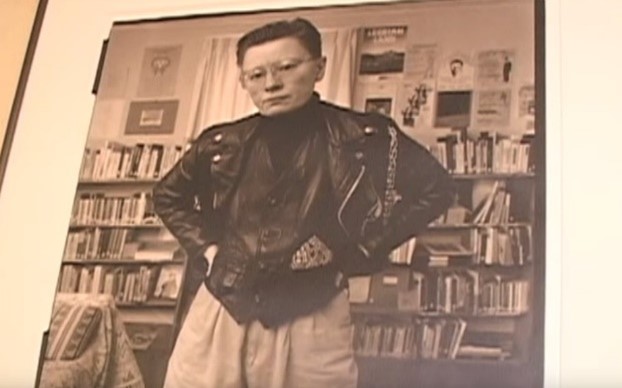
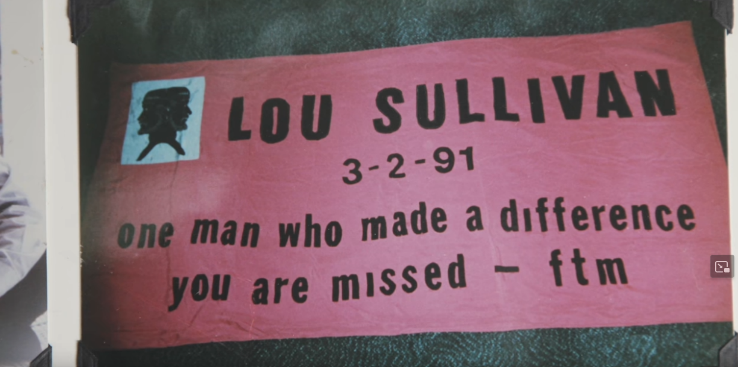
Powers says, "I wasn't prepared at all, you know, because he was totally gay, and I didn't have a concept that FTMs could be gay. [As a heterosexual,] I was a bit uncomfortable. I thought, this is like me but it's not like me." He then describes the way Lou broke down his barriers and had an intimate conversation about their lives — interrupted by his AZT dosage, marking the moment at which Powers understood that he "wasn't going to have him for very long." This kinship formed between straight and gay trans men, each seeking communities of trans experience though their approaches to masculinity and gender itself are often markedly different, carries on into the present. Their meeting also further models the myriad unique ways men, mascs, maleness, and masculinity stand as fraught objects of desire in trans life. The next film is a short directed by Rhys Ernst with voice-over by Elliot Montague. He narrates Lou's struggle to access medical transition as a man who desired men over archival footage of San Francisco, photographs of Lou, and recordings of him explaining his transition journey, queerness, and HIV+ status. Montague's vocal tone is firm and skirts the edges of anger: mourning militancy felt for those we've lost. The narrative is explicitly framed as proof that "we've been around" as trans/queer people throughout history. It is a legitimating project, one that employs visual rhetoric to stake out a claim for transfag historical memory in which Lou remains a mobilizing presence (Fig. 2).
While the posts on Twitter and Tumblr aren't uninterested in creating reference points for historical memory, they foreground a more intimate perspective: what the individual resonates with, feels electrified by, and wishes to circulate. 45 From my earliest encounters with Sullivan as an activist figure online, as noted previously, I witnessed an evolution in his circulation after the journals' publication, which shifted from a more sanitized iconography to one which also embraced his raw, sexual being. One subsection of these posts is pure horny kinship, ranging from a young white trans man's Pride selfie bare-chested in leathers holding a sign that reads "Lou Sullivan Fought for Us," to a late-twenties Black trans queer whose display name is pleasure-seeking poof tweeting, "No more transmasc discourse. Time to simply live in the spirit of Lou Sullivan (gay slut)." Editors Martin and Ozma note that they aimed to "prioritize the intangibles of Sullivan's San Francisco, tracing his worldly pleasures and ephemeral expression of identity" while countering flattened portrayals of trans life and illuminating the "personal, lascivious, quotidian, poetic, and romantic aspects" of his archive.46 Charlie Markbreiter writes that the journals are "perfect for a Trans Literature burdened by the pressure to produce respectable texts whose protagonists ... aren't allowed to be complex freaks" as they explore the "very transsexual clump of wants" around desiring "to protect your bro, fuck him, and possess his body."47 In their TSQ article, Martin and Ozma include a SCRUFF profile suggesting men "come over and read the horniest bits of We Both Laughed in Pleasure out loud," demonstrating how Lou still facilitates gay desire. 48 The reintegration of his gayness not as an identity category, or as legitimated by an HIV diagnosis, but as an orientation toward the queer erotic emphasizes our potential "connectivity and collectivism."49 Lou circulates between the subcultural and institutional worlds wherever trans fags meet, as room is increasingly made for the centrality of queer desire in his, and our, formulations of gender.
At the same time, however, all these figurations of Lou Sullivan are necessarily partial. That trouble remains at the heart of any affective orientation: though our desires might point us toward one another, or toward these enlivening queer historical memories, we can never achieve perfect togetherness or identification. If the above stories about Lou Sullivan spark certain ways of knowing him — or knowing about him — then still others might produce different pathways, different ways of understanding and thinking with this iconic figure who was once simply another man. His biography and edited journals are condensations derived by individuals from an expansive archive. Furthermore, the archival materials are already-mediated, given that Lou was aware of and purposeful with the records he was amassing. It was in those stuffed banker's boxes I once again encountered Lou in perhaps the fullest way one can still meet the dead — one which isn't otherwise easily accessible for circulation beyond the physical archive, as opposed to the stories laid out so far. However, across the two weeks I spent touching pages he'd written, photographing clippings of his beard hairs and concert tickets taped to yellowing paper, and silently weeping over blank pages, I resonated with many other possible "Lou(s)." These versions further extend the prior models for thinking about and with trans fag orientations by attending to additional, nuanced, and sometimes even troubling structures of feeling.
Haunt(ing) Archives
What gets left aside from the hagiography of Lou Sullivan are, put simply, the ugly feelings and vulnerabilities that haunted his orientations toward gay masculinity. However, it is these trans maladjustments — or, "bad" trans feelings — that animate the material and affective textures of trans fag life. As trans people are forced to defend our existence against systemic transphobias, external actors often pressure us to (re)orientate our stories of gender along more easily defensible lines to access transition and other survival needs. This reorientation can be direct, such as Sullivan purposefully sanitizing his explanations of his maleness and gayness in his letters, organizing, and even public interviews with gender professionals as a means of legitimizing queer FTM existence to parties otherwise ignorant of — or outright hostile to — its realities. However, it can also be more indirect or implicit. Consider how trans life stories in the public sphere must adhere to linear, simplified narrative trajectories that uplift straightforwardly "good" trans feelings, as Awkward-Rich has argued. The gravitational pressure to be aware of how one's transness appears to others stifles actual felt interiorities, as well as one's ability to theorize and communicate complex desires for gender itself. While the previous iterations of Lou Sullivan's iconography discussed in this article are externally oriented, presented for public audiences, his archival remains are internally oriented, faced intimately toward his private self. These intimate archives are where a fuller self remains — its ugly feelings, nonlinear trajectories, uncertainties, and struggles left intact.
Trans theorist Talia Bettcher has provided an account for thinking about trans gender(s) that avoids both the pathologizing "born in the wrong body" narrative of medical correction and the trans theory of gender outlaws that suggests trans people must break the gender binary merely by existing.50 Against these strategic essentialisms, Bettcher argues that we should recognize a "multiplicity of trans worlds [exist] in relation to a multiplicity of dominant ones."51 For example, consider trans worlds in which a woman who is trans is a paradigmatic woman and whose being is not defined by hegemonic modes of gender/sexuality. However, when she enters onto the dominant social world she may be captured by systems of power as a partial-woman, or even as a man, whose self remains at risk. Attending to the combination of interior/exterior sense — to how the mundanities of trans life intersect with violence and misrecognition — also allows for a nuanced approach toward trans fag phenomenology. As suggested by Awkward-Rich, rather than "trying to offer feeling bad as a good," this attendance to the ongoing complexities of trans fag orientations joins the project of refusing to excise maladjustment, given how the "inevitable failure of affirmation, love, and legibility to fulfill their promises have made it increasingly difficult for individuals to bear their bad feelings."52
The lived textures of a trans fag world of sense include many sites of maladjustment and "bad feelings." In Sullivan's case, his ideal imaginary of queer masculinity was often shaped by whiteness, and the materialization of his own white transsexual man's body occurred in a gay community already stratified along racial lines — though his intimate relationships were not exclusively with other white men. His provocative erotic fantasies attached variously to scenes of subjection, domination, masculine authority, and ageplay. Meanwhile, his feelings around t4t (trans-for-trans) relationships were more complicated than they appeared on the surface, including his lack of sexual interest in other trans men. Lastly, the material realities of desiring/cruising/fucking as a man who made sense of his physical embodiment through the lens of disability often conflicted with ableist cis gay men's aesthetics and desires.
These practical affects and textures, gleaned from archival materials, expand the models for trans fag phenomenology and the desirous formation of gender to include experiences of projection, perversion, and pain. 53 Because transphobic discourses often argue that "gender" constitutes an essential and binary sex-based identity being offensively pantomimed, and that transition is motivated by a desire to deceive or trick cisgender people with one's body, producing knowledge around the ways trans orientation(s) become legible through attachments like desire and projection feels dangerous. This is doubly the case for the queer trans person — whether fag- and/or dyke-orientated — whose relations with other queers are then construed as either corrective rape "straightening" the bent sexuality of cisgender fags and dykes, or as an attempt to appropriate the cultures of lesbian women and gay men. However, within a trans fag phenomenology, how we are orientated sexually becomes as Ahmed has argued "not only a matter of 'which' objects we are orientated toward, but also how we extend our bodies into the world," and how this involves "differences in one's very relation[s] — that is, in how one 'faces' the world or is directed toward it."54 These different and significant ways of directing desire create orientations toward, and through, queer(ed) genders.
Firstly, Sullivan became orientated toward male femininity, toward his longing to be a fag as well as for the kind of fag he would eventually become, through projection onto and through media materials. These projections arose within what we might contemporarily recognize as musician fandom. Some of his earliest journal entries document his intense Beatlemania: how he modeled his haircut, wardrobe, and romantic fantasies after the boy band (his favorite member was Paul). He writes at one point, "Paul-Ringo-Paul-Ringo they keep bouncing around my head. They're so perfect. Model yourself on them & you'll have no worries ... I'm not crazy. This is a love so strong and real."55 These are the beginnings of his lifelong doubled desire for men, located before his understanding of his own masculinity. Desirous attachments to male musicians continue throughout his life. During a Bob Dylan phase, Sullivan's journals are written in a youthful imitation of streetwise language and he grows his hair long. He forms crushes on and attempts to cruise queer male musicians in his local scene; dates boys that share these musicians' aesthetics; and eventually comes to adore Lou Reed such that he takes on his name, even signing a coming-out letter: "My male name is Lou (as in Lou Reed)."56 He later became a fan of reggae music, writing letters to radio stations encouraging them to play the genre to build greater racial solidarity, but his early projections often modelled his visions of possible queer masculinity on those of other white men. However, these identifications with — and desires for — musicians were attached to white men whose public personas were softer, more effeminate and queerer, and often more in-community with artists of color than the normative "All-American" cisgender heterosexual male artists of the time. These alternative forms of masculinity offered Sullivan an object toward which he orientated both personally and sexually.57
Another aspect of his projection onto and through queer masculinity is located in his relationship to gay literature. Music fandom offered an aesthetic model for the masculinity he desired in himself and others, but the fiction and nonfiction of queer men, for example the Mexican-American writer John Rechy, shaped his erotic imaginaries around his blossoming faggotry through narrative. This literary education on queer masculinity, undertaken in solitude, as Awkward-Rich argues in his reconsideration of the affordances of trans asociality and withdrawal, offered Sullivan an "enduring, lyric model of the (trans) self": the man he'd later become.58 Sullivan's projections onto and identifications with the youngmen and drag queens of Rechy's City of the Night resonated as he began to understand his own orientations. However, these affective attachments come with their own senses of dislocation. As a young Sullivan writes:
I've wanted to go & leave everything & join that world. But where do I fit in. I felt so deprived & sad & lost. ... I don't know what I'm thinking, which way I'm going (thinking as I spoke, that what can become of a girl whose real desire & passion is with male homosexuals. That I want to be one. That I fancy him [Sullivan's boyfriend] to be one & I pretend I'm a man when we make love).59
Recognition and desire first felt through literature directed him toward his erotic, social, and cultural formations of queer masculinity.
But Sullivan also recognized his own bodily shortcomings in the face of this desire. This is a common experience for a young trans person, one both familiar to me and repeated with minor variations frequently by others across the whole spectrum of transness: the sense that one is living a half-life, a partial-life that is severed from the self by the awareness of one's fundamental and often agonizing difference. Before we are capable of pursuing — or even able to begin imagining — the other possible futures transness offers us, the life being survived isn't an untroubled cisgender life: it is a closeted transgender life. Projection becomes a method for sustaining trans self-knowledge on the inside in the face of material struggles on the outside, though the ways this functions in practice are far from uncomplicated.60 As with the processes of disidentification, projection serves as a lifeline for the construction and maintenance of being through observed performances, artistic affinities, and utopian imaginaries of a livable future that is not yet here.61
Secondly, though the edited Sullivan journals have recentered the significance of sex to his gay trans maleness, some of the messier particulars were elided. These include the "perverse" pathways Sullivan's active fantasy life traveled: from S/M and public sex, to daddy kink roleplay and watersports with the occasional foray into scat, to narrative fantasies about gang rapes of young male protagonists by male authority figures (sometimes with inventive settings, like post-apocalyptic societal collapse). 62 The richness of Sullivan's erotic life, complementary as his desires often were to those of the cisgender gay men he fucked, deserves to be understood in its wholeness and complexity. As I texted a friend while reading the sex fantasies folder, "Lou would've loved gay internet porn. The more things change, the more they stay the same." Sexuality studies research concerned with kink, fantasy, and power-play provides scaffolding for an audience whose initial, visceral response to these erotic practices might be to flinch away. Sexuality studies also provides useful reframings when it becomes necessary to push back against normative disgust regarding sexual edge-play practices. Though an extended meditation on the resurgence of anti-sex/anti-kink moral panics around "perverse" sexualities would necessitate another article entirely, I gesture toward Gayle Rubin and Pat Califia's bodies of work as starting points as well as to more recent scholarship on sexuality such as Avgi Saketopoulou's Sexuality Beyond Consent: Risk, Race, Traumatophilia or Joseph Fischel's Screw Consent.63
Holding these supposedly-perverse erotic desires as valuable orientating objects in a trans fag phenomenology, rather than excising them as embarrassing, unpalatable, or even damaging to trans/queer legitimacy, extends our horizons for self-satisfaction. Reparatively reading two particular instances from the Sullivan archives, one an illustrated narrative fantasy and the other a mutually fulfilling hookup with another gay man, demonstrates the ways these kinky imaginaries serve the aims of a desirous gender formation. The collected texts located in the "sexual fantasies" archival folder are partial, and were scribbled during Lou's workdays on the backs of accounting spreadsheets or loose notebook paper. One common theme is young men receiving erotic punishments, humiliations, trainings, and inductions into queer sex practices, often through public use, with a recurrent focus on the desirable features of assholes whether pristine, dirty, virginal, or well-fucked. In the brief example shown here, penetration is enacted on the young man as anal training (Fig. 3). Lou has helpfully illustrated the resultant gape and the fantasy figure's large testicles. Almost every one of the fragmentary narratives collected in this folder is dedicated to stories of nonconsensual but ultimately pleasurable — or, at least, overwhelming — sexuality, where the pressure of being responsible for one's deepest, most shameful gay desires has been removed at the behest of a dominating, experienced older man. Furthermore, in these fantasies, the physical flesh and what is done to it — including the erotic utility and capacity of the asshole, and the regularity of cock and ball torture — gestures toward the ways many trans fags grapple with and eroticize our own unfitting bodies.
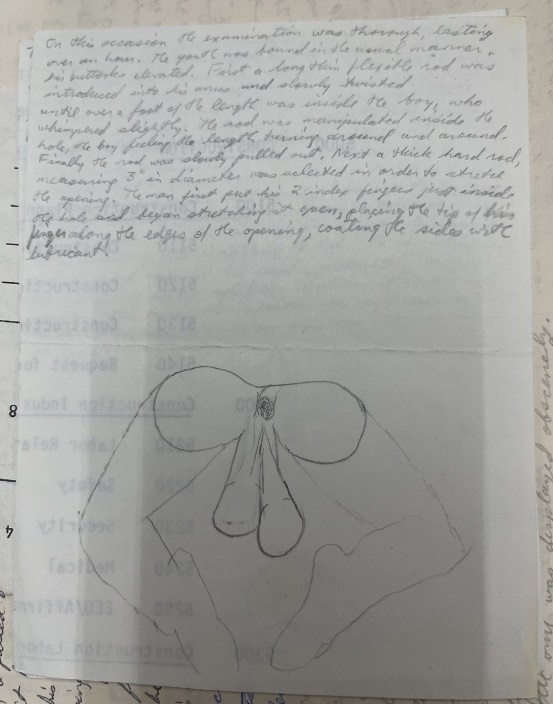
Though Sullivan in his fantasies could be described as a verse switch, in practice he predominantly bottomed for other men and held deeply conflicted feelings about possessing a vagina — an "extra" hole — while having a testosterone-grown micropenis but not the testicles that marked the desirability of cis gay male bodies in his erotic imaginary.64 As he self-deprecatingly jokes while developing his mailing list profile, "How about this ad? Sensual 35-year-old with child-sized pee pee seeks fun guys."65 Conversely, he journals his repeat encounters with cis gay man "Cory (I guess that's what he wants me to call him)," with whom he "[gets] into the daddy . . .fantasy, which also turns me on" — and who in the process praises his "'fuckhole' and even said my 'juicy pussy'... I'm tellin' ya, I still don't know how much he's figured out."66 In each of these journaled encounters, some of which feature lightly humorous attempts at watersports and scat-play, the pair explore the erotics of Sullivan's material body (tiny dick and all) as it appeals to Cory, and the appeal of Cory's maturely masc body for Sullivan in turn. These entries are notably some of the most engaged, passionate, and hopeful that occur after Sullivan's diagnosis with HIV. At the same time, they are interspersed with entries where he recorded his fears that the disease on top of his "impotent masculinity" rendered him doubly undesirable, which "sparks all the disgust I feel for my body - my second hole, my scars."67 Overall, the role of sexual fantasy for the psychic lives of trans fags is partly about dislocation and projection, but it is also about locating myriad ways to eroticize our own real bodies on the same terms under which they are affected by, and thereby affect, the sexual worlds we enter onto.
However, Sullivan's relations to the erotic capacities of his body as a trans body are complicated. Martin and Ozma gesture toward this unresolvable complexity in their statement that "Lou has gay sex that isn't enhanced or affected by a contemporary understanding or awareness [of transness]" with multiple queer cisgender men, some of whom he shows his full body to and some of whom he does not at various stages of his transition.68 Sullivan's two long-term romantic relationships both formed with cisgender men whose sexualities intersected in conflicting ways with his maleness and changing body; the first boyfriend resisted his hormones and top surgery, and the second his bottom surgery. His cruising life on the street and through mailing lists allowed him to have many other erotic encounters with men who either didn't know he was trans or simply didn't care. But the orientation(s) of his erotic desire with regards to other trans people reveal some of the internal conflicts that can arise in trans fag phenomenology.
After all, even as a trans fag avows the importance and centrality of t4t relations, his erotic desires for cisgender men can run parallel, or sometimes counter to, those staunchly-held positions. Sometimes dysphoria activates in response to other trans bodies that resemble one's own, or resemble the body one wishes to craft; this is an experiential reality that nonetheless provokes further "bad feelings," such as guilt and shame. While Sullivan was passionately driven by a sense of mutual community with other FTMs, his sexual encounters ran largely toward cis and gender-nonconforming fellow fags but also on rarer occasions trans fems, MTFs, and male-identifying feminine crossdressers whom he felt resonated with and held mutual empathy for him as a gay transsexual.69 In one correspondence exchange with "Peter," who asks Lou explicitly about his feelings for other trans men, he writes, "my relationships w/ other F-Ms are strictly on a peer counseling, platonic basis."70 The mailing lists Lou participated in reflect this, as he sought out intimate relations with others whose aesthetics he perceived as related to his own (e.g., male effeminacy) though he once tried for sexual intimacy with a woman who was trans and had undergone bottom surgery.
In this way, a trans fag orientation toward gender as an erotic object also opens vistas onto more flexible understandings of gayness that reject inherently bi- and transphobic "gold-star" valuations and other strictly-policed gender boundaries.71 Sullivan had no doubts about his queer masculinity; nonetheless, he did not restrict himself from sharing erotic experiences with cis and trans women, even if he ultimately found these experiences unsatisfying. Negotiations with sexual desire and what trans male embodiments can signify are complex, and in their complexity resonate with Bettcher's trans worlds of sense encountering the pressures of dominant worlds of sense. The gender that forms through Sullivan's erotic practices is one that "feels" best when recognized as just another undifferentiated cisgender fag. He does not "feel good" when approached as a provisional, conditional, or incomplete man — or, when approached as trans first and foremost — though he nonetheless maintains a powerful commitment toward trans solidarity and liberation while caught in the teeth of intersecting transphobic and homophobic systems.
Thirdly, any trans fag phenomenology remains partial unless space is made for experiences of pain. Whether due to sexual rejection, bodily dysphoria, violent homophobia, and/or the overwhelming pressure of transphobia and trans exclusion, these bad feelings are the counterpoint of gender's desirous formation. The same queer desire that orientates us away from the norms of the dominant world also carries alongside it the dispossession and unhappiness enacted against the nonnormative. I do not intend to suggest that these "bad feelings" form an entirely, or wholly, negative aspect of trans fag phenomenology. Rather, in the vein of Awkward-Rich, I resist retreating from the "potentially disqualifying 'lumping' together of gender nonconformity and disability in general, madness in particular" that leads to the restriction of possible trans/queer lifeworlds.72 It would be disingenuous to theorize the ways Sullivan mediated his body as a disabled male body without attending to the materiality of lived pain that exceeds the possibilities of social accommodation.
Attending to matters of pain and debility is necessary, given that Sullivan identified himself as disabled with regards to his chest and his penis, as well as his later HIV+ status. He found community in groups for similarly disabled (cis/gnc) men who were "cruising impaired" within normative, abled gay sexual culture due to other disabilities, as well as groups for those considered "small endowed" and their admirers.73 The last three file folders of Sullivan's journals trace through his nearly five years living as a person with HIV/AIDS. There are additional folders containing his treatment notes, both for his genital surgeries and the progression of his HIV. In Awkward-Rich's tracery of Jack "Bee" Garland's "disability drag," they mention the affect-oriented biography Sullivan wrote of Garland while he was otherwise "haunted by the sense of being utterly alone, the only one of his kind."74 But Awkward-Rich does not attend to Sullivan himself as a man who theorized his trans male body as being disabled, nor his life with HIV as one of increasing debilitation supported by communal care. These, too, are vitally important ways of thinking with the transfag and the centrality of his gayness: his body, his lived materiality, in relation to the gender he doubly desires.
Experiences of trans fag pain that are unresolvable but nonetheless orientating are also significant to the formation of culture, community, and desire. Sullivan dedicated himself to activist group organizing and information dissemination among trans communities as a response to his own pain, and his drive to alleviate as much of this pain as possible for others. The Sullivan archive collects every version of his pamphlet-cum-book on transition for trans masc people, which by the third and final edition contains referential photographs for bottom surgeries that demystify the process for other trans men. I remark upon his openness about his surgeries and desire for a "passing" cock and balls because there has been a shift in popular trans discourses toward obscuring the materiality of our widely-varying bodies. These retreats into obscuration are justified as defenses against the prurient and violating gaze of cis, white, straight, patriarchal medical/psychiatric systems.75 However, while these refusals may sometimes serve as necessary resistance to violent documentation they also sometimes deny the trans body gazing at itself with knowledge and active desire. Embracing the full erotic potentialities of trans bodies — as well as the struggles to define and (re)create our unique physical contours — also resists dehumanizing forensic forms of documentation, particularly at a moment when transition itself is demonized from all directions. Furthermore, Sullivan had also collected all the materials he could find depicting trans men before and after genital surgeries, including a porno magazine featuring Annie Sprinkle as the first fuck for a straight trans man after phalloplasty. Contemporary, independent trans gay porn performers often serve a similar function for many trans fags, modeling how bodies with alternate genital configurations are desirable for their own sake rather than as a dehumanized fetish-object produced entirely through a cisgender erotic imaginary. The same can be said for erotic workers who are disabled; the same can be said for those who are both disabled and trans; and so on.
Of course, desire is always-already related to the social world where it forms. Queer scholars of color have developed numerous critical frameworks for analyzing the ways minoritized peoples experience intracommunity violation and exclusion around sexuality. For example, sociologist C. Winter Han argues that "erotic desires are not neutral or personal. Rather, they are the result of the development of an 'erotic habitus,' where some traits, and some people, are believed to be desirable and other traits, and other people, as undesirable."76 Han argues that as white (cisgender) masculinity becomes normalized as the desirable status, reflecting broader racial hierarchies in a white supremacist public culture, it marks "the concerns of gay white men" as "the de facto concerns for all gay people" — while whiteness itself then "appears to be nothing in particular . . . [it is] everywhere but nowhere."77 Gender nonconformity and sexual deviancy are then displaced onto racialized bodies, while sexual rejection and sexual fetishization become two sides of the same coin — sexual racism — in how white gay men interact with gay men of color. As Han argues, the consequences of "being seen as 'not worth a fuck'" then extend to issues affecting the lives of men of color being perceived as not worthy of attention or resources in gay communities."78
However, Han also notes that there is another trouble with sexual racism that appears in justice-minded critiques, when those critiques imply that all interracial desire is inherently suspect or necessarily always fetishistic. Rather than breaking down whiteness as the desirable status in a hierarchal system, this rhetorical maneuver only reifies the supposed naturalness of (cis) white desirability by marking out any desire for men of color as always abnormal or suspect in turn.79 Though Han does not acknowledge the presence of trans men of color or white trans men in gay spaces, his analysis of the consequences of an erotic habitus which insidiously preferences the "normal" affluent white cis gay male is relevant in our understandings of (desiring) gay transness as well. While race and gender are far from analogous categories, there are nonetheless affinities across methods for analyzing minority experiences of gay sexuality in majoritarian gay spaces. These include the dual experience of exclusionary rejection and overt fetishization as well as retreats from trans bodies as desirable even in queer/trans worlds of sense, which only serve to reify transness as presumptively abnormal and "naturally" undesirable. These pressures of rejection and fetishization are then exponentially compounded for trans men of color in predominantly cisgender, white gay spaces. For white trans men such as Sullivan and myself, the work of participating in and holding together communities of solidarity also requires recognizing and laboring against racist standards of valuation as much as we labor against shared or related experiences of transphobia.
Within these gay, trans archives of feeling, pain sometimes arises from cruelly optimistic desires for gender. Sometimes, though, pain is also a result of desire hitting its mark. Lou Sullivan fashioned a possible future for himself and as many other FTMs/trans men or mascs as he could in his time, and his ghostly presence remains in the intermeshed formation of gender and sexuality that oriented me toward his archives. He circulates through the stories told about him, the gender theories built from his extensive records and writings, even the photographs of his body both before and after surgical intervention and across his years as a poz gay man. Sullivan records similar bittersweet emotions in his own words:
Is it just too damn bad for us transsexuals? I'll forever be lacking, I'll always have to explain/excuse myself. Yet it's been worth all these years just to be in this bar, here, now, with AIDS, & to be a man among men. To be included, however voyeuristically, however theoretically, in the society of men who can only openly proclaim their ardor for other men —
It may be the love that dare not speak its name but it is surely the love that endures, that persists against all condemnation, even through the threat of death, of "AIDS," a love that cannot die; to me, this is the only REAL love.80
I underlined the phrase "yet it's been worth all these years" in my personal copy of We Laughed in Pleasure. As I passed through each journal and the decades of Lou's recorded life and saw the overwhelming but minuscule remains spread before me in those boxes, I couldn't help but know that the ending was coming. The terminal entries crept closer as I grew tense with emotion. The final red hardback journal weighed more than I expected, and I regularly had to set it down and rotate my wrists. I read the cursive blue pen line, "Changes are occurring daily, so quickly that I can hardly keep up," dated 2/27/91, and then found only blank pages afterwards. The grief that overtook me as I held the unfinished journal — in which he had taped the McCartney ticket and fondly reflected on how he'd loved Paul his whole life — was immense. I had to leave the building and walk around the block — the same streets that Lou had walked — while I waited to stop crying. This too belongs in a trans fag phenomenology: the pain of losing the elders whose presence we desire, over and over again, even as we live on into the futures they made possible.
Proliferating Orientations, Perverse Genders
Having constructed this archive of the many afterlives of Lou Sullivan as a method of modeling and understanding trans faggotry, as well as its orientating objects of desire, I lastly propose some ways we might now begin to think from within this trans fag phenomenology. One shift in perspective it makes possible is an understanding of gender itself as a flexible and desirous formation — something created between the relational stickiness of bodies and the social world — rather than something rooted in bioessentialist gender-sex dualisms or in the trans/homophobic imaginaries that animate reactionary feminism and far-right conservatism. When apprehended fully as such, the gender(ed) experiences of gay/queer trans men disrupt otherwise strictly-enforced binaries between cis and trans, male and female. A trans fag orientation offers another way of apprehending the multitude of other genders and gendered power relations that proliferate throughout queer cultures, counterpublics, and lived experiences across differing geographic and temporal contexts.
What if, for example, operating from within a trans fag phenomenological orientation allows us to flip the presumptive cis-normative position and instead consider how cis gay men are similar to trans gay men? Our material perspective then points toward a shared desirous gender formation — that of faggotry — which serves to draw us all, together, away from the norms of hegemonic masculinity and toward other, queerer, less cis-normative masculinity(s): toward being, as well as aligning in solidarity with, the faggots and their friends. On this note, there is a final illustrative moment contained in the Sullivan archives. After reading a counseling book for gay men, Sullivan journaled to himself and his presumptive future audiences: "he says gays must learn to enjoy their bodies, because they've spent their youths trying to control their bodies ... it seems in so many ways I've gone through very much the same stages as all gay men have, only for different reasons, though not all THAT different."81 Furthermore, even in the '90s, Sullivan's contemporary Dr. Walter Bocking confirmed in a Transfag Rag interview that "gay and bisexual FTMs do exist ... and are in many respects similar to nontranssexual gay men."82 This practice of thinking-from-within a trans fag orientation also points me toward more recent objects of study, such as Manuel Betancourt's The Male Gazed: On Hunks, Heartthrobs, and What Pop Culture Taught Me About (Desiring) Men, a nonfiction project tracing Betancourt's own orientation toward queer masculinity as it evolved through his lifelong desires for other men. He narrates how complicated his own desire for effeminacy in himself and others has been, and how it is a gender(ed) identification he became orientated away from by the violent pressures of cisheteronormative masculinity... before being drawn back toward by his queerness, his burgeoning though suppressed faggotry, by the gravity of desire. In this way, within queer worlds of sense, strictly binary separations between cis and trans experiences of gender fall apart; they are instead revealed to be closer in kind than they might otherwise appear, as each of us ultimately transitions into, and becomes, a fag.
In these ways and others, gender itself appears differently when approached from a trans fag perspective: as an erotics formed between material bodies and the social world, orientated and shaped by the objects of longing and desire, as opposed to a discrete identity category cleanly separated from sexuality. Desire moves us; it provides a way of becoming orientated to the world, as well as a source of possible affinities and relational attachments. At the same time, desire also contains its own lack — for example, in the ways gay cis men sometimes don't or can't reciprocate the desires of gay trans men, whether for community or intimacy. Nevertheless, these desirous formations of gender always operate outside the oversimplified trans narratives often demanded by institutions as proof of legitimacy: narratives that require linear stories of individuated self-formation which aspire toward images of straight, cis normativity and disallow "bad feelings," incoherence, or uncertainty. But if we are drawn toward — and some of us then transition into— the minoritized gender-space of faggotry, then the field of possible nonhegemonic masculinities proliferates. Creating space for the inclusion of gay/queer trans men's material perspectives allows us to, as queer poet Ocean Vuong says, "invest in troubling he-ness" while also expanding and changing masculinity from the inside as an act of love for ourselves and other men: a practice trans fag phenomenology is fundamentally orientated towards.83
Lee Mandelo (he/him) is a USA Today Bestselling writer, scholar, and editor whose work focuses on queer/trans and speculative fiction. His recent books include the original anthology Amplitudes: Stories of Queer Futurity, the contemporary gay Southern gothic novel Summer Sons, and the novellas Feed Them Silence and The Woods All Black. Mandelo's short fiction, scholarship, and criticism can be read in publications including Reactor, Post45, Uncanny Magazine, and Capacious; he has also been a past nominee for various awards including the Lambda, Nebula, World Fantasy, Ignyte, and Otherwise. He holds a PhD in Gender Studies from the University of Kentucky and currently resides in Louisville. Further information, interviews, and sundry little posts about current media he's enjoying can be found at leemandelo.com or @leemandelo on socials.
Banner Image cc Lee Mandelo
References
- Lou Sullivan, We Both Laughed in Pleasure (Nightboat, 2019), 365. [⤒]
- José Esteban Muñoz, "Ghosts of Public Sex," in Cruising Utopia: The Then and There of Queer Futurity (New York University Press, 2019), 34-35. [⤒]
- The intimate and pressurized relationship between trans-queer histories and presents scaffolds my approach to the concept of hagiography. On the one hand, hagiography sometimes flattens and obfuscates a figure's complexities. On the other, when it concerns figures from marginalized backgrounds whose lives and experiences are often misrepresented and "demoniz[ed]" in acts of "cautionary spectacle" — such as those of faggots, and trans people — the practices of critical hagiography can shift, as described within David Halperin's work on Foucault, to "passionate and personal identification" with the "total political situation" evinced by these particular, individual figures and their afterlives. This approach can also ground efforts to theorize from the "compelling models" they offer to other scholars whose "stigmatized personal identity invites precisely such an [homophobic] onslaught even as it disarms his ability to withstand it" (Saint = Foucault, 6-8). The balance struck between these modes throughout this article is uneasy and threaded-through with the feelings that singular queer and trans figures such as Sullivan inspire among their contemporary descendants. [⤒]
- One psychologically dislocating aspect of this epistemic erasure is having to observe repetitions of the same patterns of dismissal and, often, hostility directed toward any insistently-visible, lived trans faggotry. First one encounters an insistence that the trans fag simply does not exist as a marked and material way of moving through cisheteropatriarchal hegemonic society; secondly comes an admission that perhaps he exists, but he is rare enough that his realities do not merit discussion or inclusion as distinct or worthy of scholarly consideration. Lastly, if his materiality cannot be ignored or dismissed, there will be a turn toward making explicit an otherwise implicit trans/homophobic belief-set that imagines him as a "straight woman," either mutilated or play-acting depending on the extent of his physical transition and/or alignment with transsexuality while simultaneously flattening and devaluing all queer men's experiences of gendered and sexual violence into an ontologically-tainted vision of manhood/masculinity, one which further contributes to homophobia, transphobia, and other forms of interrelated social violence, particularly for queer and/or trans men of color. [⤒]
- See J. Jack Halberstam's Female Masculinity (Duke University Press, 1998), which Cameron Awkward-Rich revealingly refers to as "a foundational work in the study of trans and (cis) lesbian masculinities" (Terrible We, 18), or their Trans*: A Quick and Quirky Account of Gender Variability (University of California Press, 2018);Henry Rubin's Self-Made Men (2003); and Jason Cromwell's Transmen & FTMS: Identities, Bodies, Genders & Sexualities (University of Illinois Press, 1999). [⤒]
- Consider, for example, the persistent association of trans masculinities with a "core femaleness" and trans femininities with a "core maleness," which also stems from an inability within many popular feminisms to conceive of marginalized genders outside of cisgender, white womanhood. This persistent association also undergirds much transmisogynistic violence. [⤒]
- This trans fag phenomenology functions along the lines of Sara Ahmed's queer phenomenology, in which she asks "what does it mean to be orientated . . . [and] what does it mean for sexuality to be lived as orientated?" by "putting queer studies in closer dialogue with phenomenology" to explore the concept of orientation. Her approach is, as she argues, perhaps "not 'properly' phenomenological" but in its queer failure allows for a "new way of thinking about . . . how bodies take shape through tending toward objects that are reachable," particularly thanks to how it argues that "consciousness is always directed 'toward' an object" and arises from bodily experience. A trans fag phenomenology, then, considers the objects and subjects, the "orientating devices," a trans gay/queer man might be directed toward as well as how his lived experiential body provides information and theorization through this piece. (Queer Phenomenology, Duke University Press, 1-3). [⤒]
- Larry Mitchell and Ned Asta, The Faggots & Their Friends Between Revolutions (Nightboat Books, 2019). [⤒]
- After David Halperin, Saint = Foucault: Towards a Gay Hagiography (Oxford University Press, 1995). [⤒]
- Muñoz, "Ghosts of Public Sex," 35. [⤒]
- Louis Graydon Sullivan Papers. Journal Entry, Dated 12/19/87. Box 1 of 7. [⤒]
- After Avi Ben-Zeev and Pete Bailey's anthology, Trans Homo...Gasp!: FTM and Cis Men on Sex and Love (Transgress Press, 2017). [⤒]
- Cameron Awkward-Rich, The Terrible We (Duke University Press, 2022), 14. [⤒]
- These gestures are often aimed toward poor Black trans women in particular, a motion I once again replicate here as a white trans man. This work on trans faggotry exists in conversation with current and desperately-needed future work on its sister orientation(s), those of trans dykes, whose experiences and lives are also orientated around a gender(ed) sexuality that serves as grounds for queer-trans communal flourishing — while sometimes also bridging racial and cultural differences — on the borderlands. [⤒]
- Awkward-Rich, The Terrible We, 25. Awkward-Rich employs the bracketing of [masculinity] because "the terms transmasculine and transfeminine — though often useful as descriptors and necessary to indicate the divergences of [their] histories and presents — are more or less self-defeating" because they simple reify the binary sex/gender system in a trans context. He continues by arguing that it's "imprecise to call prominent trans activist Lou Sullivan — whose deepest, earliest identifications tended to be with fags and drag queens — masculine. When we do, implicitly, we are saying he was masculine relative to his presumed womanhood and are, therefore, reenacting the founding violence of sex/gender (mis)assignment that trans attempts to problematize, evade, or undo" (26). Similarly, I add a space between "trans" and "masculine," signaling that the person in question occupies a masculinity — but not one inherently defined by the presumption of a "female" body, as he might more closely share social and political experiences with his otherwise-"male" drag queen sisters than with a butch-aligned, he/him lesbian. I encounter the majority of trans/homophobia in my daily life when being read as a "feminine man." Furthermore, alternating usage of the words men and mascs is intended to gesture toward the openness of variable, culturally-constituted forms of "maleness" trans and cis queers each occupy which are distinct across racial, ethnic, and geographic lines. [⤒]
- Judith Butler, Gender Trouble: Feminism and the Subversion of Identity (Routledge, 2007), xi. Secondly, see Ahmed's Queer Phenomenology for how "we come to find our way in a world" based on what objects, emotions, and attachments we become "orientated toward" through the "lived experience of inhabiting a body," always from within our own complexly mediated sociopolitical positions (1-3). [⤒]
- Lucas Cassidy Crawford, "Transgender without Organs," in Transgender Studies Reader 2, ed. Susan Stryker and Aren Z. Aizura (Routledge, 2013), 132. [⤒]
- Awkward-Rich, The Terrible We, 9-10. [⤒]
- See Berlant and Warner, "Sex in Public," Critical Inquiry 24, no. 2 (1998): 547-566. [⤒]
- Nguyen Tan Hoang, A View from the Bottom: Asian American Masculinity and Sexual Representation (Duke University Press, 2014), 2. When it comes to understandings of what capaciously-gendered categories like fag and bottom can hold, I draw from the works of other queer men, such as Nguyen Tan Hoang — closing the distance between trans theory and otherwise-underutilized scholarship exploring gay masculinity(s), which together can offer more robust pathways toward holding the gender(s) of trans queer men as well. His "reassessment of male effeminacy and its racialization" works to "challenge the strategy of remasculinization employed by Asian American and gay male critics as a defense against feminization," and "rewrites male effeminacy as socially and sexually enabling" (2). The embrace of bottomness as an identification that is queerly male but rejects hegemonic re-masculinization allows for the "cultivation of social and political alliances between gay men and other subjects similarly situated at the bottom of social hierarchies" (3-14). Such alliances should be inclusive, for example, of affinities with transgender male bottoms whose genital configuration is feminized — some of whom then, as men of color, doubly share the experiences of sexual racism Nguyen addresses. [⤒]
- See, for example, a recent essay by Dave V. Riser, "'Enough Rope': Transmasculine Erasure, Violence, and Reading Trans Horror" in Bloodletter Magazine (2025). [⤒]
- C. Julian Leonard, ed., TransFag Rag: Information & Networking for Gay/Bi Transmen (1996), at The Digital Transgender Archive. [⤒]
- Leonard, TransFagRag, 1. [⤒]
- Liz Highleyman, "Past Out: Who Was Lou Sullivan?," Seattle Gay News, 2008; "FTM Trans History: Lou Sullivan," TransGuys, Tumblr; Susan Stryker, "'My Own Interpretation of Happiness': An Introduction to the Journals of Lou Sullivan," in We Both Laughed in Pleasure (Nightboat, 2019), 7. [⤒]
- Munoz, "Ghosts of Public Sex," 42; Ellis Martin and Zach Ozma, "Lou Sullivan and the Future of Gay Sex," TSQ 7, no. 4 (2020): 599. [⤒]
- Munoz, "Ghosts of Public Sex," 42. [⤒]
- Munoz, "Ghosts of Public Sex," 46. [⤒]
- Ann Cvetkovich, An Archive of Feelings: Trauma, Sexuality, and Lesbian Public Cultures (Duke University Press, 2003); Munoz, "Ghosts of Public Sex," 47. [⤒]
- Megan Milks, "Overlooked No More: Lou Sullivan, Author and Transgender Activist," The New York Times, June 9, 2023. [⤒]
- Sullivan, We Both Laughed in Pleasure, 166. [⤒]
- Martin and Ozma, "Lou Sullivan and the Future of Gay Sex," 602. [⤒]
- Per Elizabeth Freeman, erotohistoriography is a mode of reparative criticism that "indexes how queer relations complexly exceed the present. It insists that various queer social practices, especially those involving enjoyable bodily sensations, produce form(s) of time consciousness, even historical consciousness, that can intervene upon the material damage done in the name of development" (2005, 59). [⤒]
- Martin and Ozma, "Lou Sullivan and the Future of Gay Sex," 599. [⤒]
- Munoz, "Ghosts of Public Sex," 35. [⤒]
- Julian B. Carter, "Sex Time Machine for Touching the Transcestors," TSQ 5, no. 4 (2018): 691. [⤒]
- See Stryker, "Portrait of a Transfag Drag Hag," 62; Leonard, TransFag Rag, 1. I have sometimes found — as what Matt Brim refers to as a "poor queer scholar" myself — that aestheticized understandings of labor and class relations in academia fail to encompass the fraught relationships queer and trans peoples have to service industries, as well as to "bottom-rung" roles in office or white-collar environments. These roles are often the most stable possible jobs available to (some) trans laborers — largely those who are white — yet remain underpaid, under-protected, and subject to discrimination in terms of hiring, promotion, and job security. The economies in which trans and queer laborers work are often significantly different from those of their cis, straight peers and therefore require a nuanced approach. At the time of his death from HIV/AIDS, Sullivan often relied on community support to survive; his position was simultaneously one of financial privilege comparative to many fellow-transsexuals, and also still one of precarity in the broader social context of the US. [⤒]
- See Lou Sullivan, Information for the Female-to-Male Crossdresser and Transsexual, (1985); Brice D. Smith, Lou Sullivan: Daring to Be a Man Among Men (Transgress Press, 2017); clips of Lou Sullivan interviewed in Female to Gay Male Transsexualism: I - Gender & Sexual Orientation by Ira B. Pauly (such as https://youtu.be/SxgZNNX-v2g?si=uLtXq1CPfPg7eyLl and https://youtu.be/6hpv7Q9Evc8?si=_30kKL3XMdbvphAU); archival conference documents, such as "Masculinity & Changing Men: A Broader Perspective," Box 4 of 7.. See also Lou Sullivan, From Female to Male: The Life of Jack Bee Garland (Alyson Publications, 1990). Sullivan documented in his journals and correspondence that mainstream academic historians panned the biography as partisan due to his transsexuality. I gesture again toward Halperin's Saint = Foucault and his summation of how the fact of one's queerness renders one's authority to produce queer scholarship suspect; this remains troubling as regards to how trans people and their scholarship are treated by institutions. [⤒]
- Cassius Adair, Cameron Awkward-Rich, and Amy Marvin, "Before Trans Studies," TSQ: 7, no. 3 (2020): 306.[⤒]
- Stryker, "Portrait of a Transfag Drag Hag as a Young Man," 78. [⤒]
- Susan Stryker, "Portrait of a Transfag Drag Hag as a Young Man: The Activist Career of Louis G. Sullivan," in Reclaiming Genders: Transsexual Grammars at the Fin de Siecle, ed. Kate Moore and Stephen Whittle (Cassell, 1999), 64. [⤒]
- Stryker, "Portrait of a Transfag Drag Hag as a Young Man," 74. [⤒]
- Francisco J. Gonzalez, "Writing Gender with Sexuality: Reflections on the Diaries of Lou Sullivan," Journal of the American Psychoanalytic Association 67, no. 1 (2019): 64-65.[⤒]
- Gonzalez, "Writing Gender with Sexuality," 76. [⤒]
- Gonzalez, "Writing Gender with Sexuality," 69. [⤒]
- Though I chose to avoid replicating or discussing them, I also unearthed posts on the same sites from trans-exclusionary, "gender critical," homophobic, and other groups misgendering Sullivan and harassing trans queers posting about him. During Sullivan's life, he experienced a period of detransition encouraged in part medical/psychiatric professionals and a romantic partner, as well as by anti-trans feminist interlocuters who perceived his masculinity and queerness both as caused by internalized misogyny and as a signifier of his betrayal of womanhood as his 'true' sex-designated class. These repressive pressures, too, remain common in the felt and material worlds of trans fags. [⤒]
- Ellis Martin and Zach Ozma, "Introduction," in We Both Laughed in Pleasure: The Selected Diaries of Lou Sullivan, 1961-1991, ed. Ellis Martin and Zach Ozma (Nightboat Books, 2019), 13. [⤒]
- Charlie Markbreiter, "Peel Slowly and See: The Selected Diaries of Trans Activist Lou Sullivan," Bookforum (Sept/Oct/Nov, 2019.) [⤒]
- Ellis Martin and Zach Ozma, "Lou Sullivan and the Future of Gay Sex," TSQ 7, no. 4 (2020): 598. [⤒]
- Martin and Ozma, "Lou Sullivan and the Future of Gay Sex," 603. [⤒]
- Talia Mae Bettcher, "Trapped in the Wrong Theory: Rethinking Trans Oppression and Resistance," Signs: Journal of Women in Culture and Society 39, no. 2 (2014): 384. Bettcher refers to her account to as "a good one," though not the only good one — a flexible and heterogeneous framing I also embrace for this project, as someone whose trans experience aligns with feeling well when recognized uncomplicatedly as a gay man.[⤒]
- Bettcher, "Trapped in the Wrong Theory: Rethinking Trans Oppression and Resistance," 390. Bettcher is working from María Lugones's multiple worlds of sense theory, within which concurrent non-autonomous social worlds are intersubjectively constructed, as a philosophical method for trans studies - see Pilgrimages/Peregrinajes: Theorizing Coalition against Multiple Oppressions (Rowman & Littlefield, 2003).[⤒]
- Awkward-Rich, The Terrible We, 147. [⤒]
- The image folder "Lou" in my research file contains over 580 photographs, the majority of which document materials not digitized and/or present in any other publications at this time. Where possible, I reference from pages from the edited journals for reader convenience, but many are not contained therein. [⤒]
- Ahmed, Queer Phenomenology, 68. [⤒]
- Sullivan, We Both Laughed in Pleasure, 25. [⤒]
- LGS Papers, Letter to Lar, 12/19/79, Box 3 of 7. [⤒]
- Projecting through, valuing, and modeling oneself on the alternative, often nonhegemonic, and sometimes nonwhite masculinities of popular musicians remains a familiar maneuver for trans fags — even the briefest examination of contemporary queer/trans masc fans of K-pop idols online, for example, reveals similar structures of feeling. [⤒]
- Awkward-Rich, The Terrible We, 119-20. [⤒]
- Sullivan, We Both Laughed in Pleasure, 62-63. [⤒]
- Sullivan also explores the ways gay sex with cisgender men serves as a site of projection and self-creation through imagination or fantasy; see for example We Laughed in Pleasure 209; 291. [⤒]
- See José Esteban Muñoz, Disidentifications: Queers of Color and the Performance of Politics (University of Minnesota Press, 2019). [⤒]
- See for example Smith, Lou Sullivan, 48-50 and 102-106; Sullivan, We Laughed in Pleasure, 233; LGS Papers, Journal Entry 11/30/87, Box 1 of 7; LGS Papers, "Sex Fantasies," Box 2 of 7. [⤒]
- Joseph Fischel, Screw Consent: A Better Politics of Sexual Justice (University of California Press, 2019), 80-81. An extensive study of the ways flattened "consent" rhetoric fails as a scaffold for sexual ethics and law, the Fischel also challenges negative judgements around limit-pushing emotional, psychic, and physical sensations. As he notes regarding legal arguments against the allowance of sexual practices such as BDSM, or other exercises of sexual autonomy we might find "unpleasant or even disgusting" such as roleplay between grown adults, it becomes obvious that supposedly common-sense rationales for legal and ethical approbation "may not pass the sniff text; they are pretextual — whole or in part disingenuous — [excuses to forbid] the sex we think icky." [⤒]
- Sullivan, We Laughed in Pleasure, 345. [⤒]
- Sullivan, We Laughed in Pleasure, 33. [⤒]
- LGS Papers, Journal Entry 10/29/87, Box 1 of 7. [⤒]
- LGS Papers, Journal Entry 11/22/87, Box 1 of 7. [⤒]
- Martin and Ozma, "Lou Sullivan and the Future of Gay Sex," 603. [⤒]
- His letters back and forth with Monica, who writes to Lou as an "MTF-TV" who enjoys "being Monica" as her "favorite way of relaxing and socializing," are quite tender and understanding of the mutual appreciation they might have for one another across the aisle, so to speak. The introductory letter from Monica has been annotated by Lou, with her hobbies and interests circled and his own thoughts about possible, related date locations penciled in beneath. LGS Papers, Box 3 of 7. [⤒]
- LGS Papers, Undated Typeset Letter & Handwritten Letter 6-9-81, Box 3 of 7; LGS Papers, Short Typeset Letter Dated 5-19-81, Box 3 of 7. [⤒]
- A reference that denotes the "gold-star" gay or lesbian is purer and more desirable as they've never sexually interacted with someone of another gender, and also broadly implies a strictly-binary understanding of the allowable genitals involved, i.e. a gold-star gay man is necessarily cisgender and has only ever had relations with other cisgender men with penises. [⤒]
- Awkward-Rich, The Terrible We, 34. [⤒]
- On the tensions between social, medical, and political-relational models of disability see Alison Kafer, Feminist Queer Crip (Indiana University Press, 2013); on the significance of bad feelings like pain in disability studies and activism see Margaret Price, "The Bodymind Problem and the Possibilities of Pain," in Hypatia 30, no.1 (2015): 268-84. [⤒]
- Awkward-Rich, The Terrible We, 45. [⤒]
- See Kit Heyam's otherwise-compelling Before We Were Trans (Hachette, 2022), which contains a section praising novels that refuse to "describe" genitals during sex scenes with trans as well as intersex characters as inherently positive, as solely a progressive choice that denies the cisgender gaze. [⤒]
- C. Winter Han, Racial Erotics: Gay Men of Color, Sexual Racism, and the Politics of Desire (University of Washington Press, 2021), 20. [⤒]
- Han, Racial Erotics, 5-7 [⤒]
- Han, Racial Erotics, 10. [⤒]
- Han, Racial Erotics, 15-31. [⤒]
- Sullivan, We Both Laughed in Pleasure, 377-78. [⤒]
- Sullivan, We Both Laughed in Pleasure, 252. [⤒]
- Leonard, Transfag Rag, 3. [⤒]
- Ocean Vuong, "Reimagining Masculinity," The Paris Review, June 10, 2019. [⤒]
Related reading
 Manifest Diversity and the Empire of Finance
Susan Sontag and the Americanization of the Nouveau Roman
Manifest Diversity and the Empire of Finance
Susan Sontag and the Americanization of the Nouveau Roman
 The Programming Era: The Art of Conversation Design from ELIZA to Alexa
 “The Trouble Spot”: Racialized Paranoia and the Vision of the State in The Spook Who Sat by the Door
Cartoon Viscera
“The Trouble Spot”: Racialized Paranoia and the Vision of the State in The Spook Who Sat by the Door
Cartoon Viscera
 Big Color Analytics: Privatization, Precarity, Pantone
Seeing Past Consumption: Race and Species in the Slaughterhouse
The Blues Brothers, Tammy Wynette, and the Long Denouement of the 1960s
Big Color Analytics: Privatization, Precarity, Pantone
Seeing Past Consumption: Race and Species in the Slaughterhouse
The Blues Brothers, Tammy Wynette, and the Long Denouement of the 1960s
 Side Hustle: College Sports and the Future of Academic Labor