The slaughterhouse and its meat-producing mechanisms constitute a large-scale — yet nearly invisible — part of the state's infrastructural fabric. Most post-industrial consumers take for granted the continued mass availability of livestock as prepackaged, edible goods. Commercial intensification of meat production has been accompanied, not coincidentally, by a heightened interest in maintaining anonymity and distance from farm animals. The practice and regulation of animal slaughter is, however peripherally, part of the general collective consciousness. By design, the slaughterhouse, as Noëlie Vialles argues, "must be as if it were not."1 In other words, its non-existent presence is what allows consumers to believe that their meat comes from seemingly nowhere. Also hidden away in these modern factories is the labor required to maintain the production line's efficiency — labor that is provided by workers who are often culled from refugee and inmate populations. People of color are often sought out to work the slaughter hall because they keep labor costs at a minimum, but perhaps more importantly, because local prisoners and undocumented immigrants are, much like the animals being put to slaughter, held captive.
This hiring practice has been well-documented in contemporary news reports that reveal how factory conditions muddle the species line by treating animals and laborers alike as products to be herded. In a 2000 story for The New York Times, Charlie LeDuff provided an in-depth account of the day-to-day activities at the Smithfield Packing Company pig slaughterhouse in Bladen County, North Carolina. LeDuff discovered that jobs at the Smithfield Packing Company were, for the most part, segregated by race, gender, and language; black women were assigned to the "chitterlings room," black men were sent to the "butchering floor," and Mexicans were "knife work, cutting sides of pork into smaller and smaller products."2 Grueling factory conditions lead to a common refrain amongst workers: "They don't kill pigs in the plant, they kill people."3 In a 2017 article for The New Yorker, Michael Grabell detailed employment conditions at the Case Farms slaughterhouse in Canton, Ohio. Grabell found that labor costs were kept at a minimum by tapping into multiple captive populations including Burmese refugees, ethnic Nepalis expelled from Bhutan, and local prisoners. The Human-resources manager at Case Farms, Norman Beecher, explained that Guatemalan laborers who would "get shot" if they returned to their home country, were particularly desirable.4
Within the United States, slaughterhouses are a prime site for studying co-constituted forms of racial and animal domination. However, for LeDuff and Grabell, the entanglement of racial and species taxonomies is horrifying largely because it disrupts the complex hierarchical ordering that governs the value of their subjects. For LeDuff and Grabell, the overarching argument is simply that people should not be treated like animals. News accounts like these are designed to expose the harsh realities of an inhumane practice. They peel back the curtain to reveal the inner workings of the slaughterhouse, as readers are guided meticulously through the step-by-step process of meat production. Such articles develop authenticity by establishing an insider perspective through interviews and personal observations, while also presenting quantitative data on employment turnover, relevant litigation, factory specs, and the conditions and technologies of slaughter. These tactics disarticulate human laborers from nonhuman commodities and therefore reinforce the legitimacy of species purity despite its instability within the slaughterhouse, where the taxonomic separation of race and species is disturbingly blurred. The journalistic elements featured in these reports risk instrumentalizing race or animality in their attempt to garner sympathy from a general readership.
While the processes associated with industrial slaughter seem to foreclose meaningful forms of relationality, they also paradoxically generate entanglements of race and species that enable critiques of modern consumptive practices. As Samantha Pergadia contends, "slaughterhouse intimacies ... move beyond a loose comparison" because the "history of industrial animal farming and the US slaughterhouse traffics between the intimate exchanges of gender, race, and species."5 Whereas nonfictional accounts leverage comparisons between racialized labor and livestock, fictional narratives often magnify the discomfiting entanglements of racialization and speciation heightened in the contemporary meatpacking plant.6 In this article, I examine filmic and literary texts that both amplify the drama of slaughter to reveal the abattoir as a panoptic structure of state-sanctioned oppression, and also challenge the liberal tendency to disarticulate the human animal from the nonhuman animal. My analysis moves away from how discourse around meat-making is conventionally consumed by attending to what political scientist Claire Jean Kim has called "multi-optic vision." As a critical reading practice, multi-optic vision helps to illuminate race and species entanglements by "moving from one vantage point to another, inhabiting them in turn, holding them in the mind's eye at once," or more simply, by "seeing from within various perspectives."7 In each of these works, the slaughterhouse setting is bound by its relation to the ocular. My focus here is less on the consumption of meat as an ethical dietary practice than on the modes of visual consumption that meat-making processes are funneled through: the panoptic, the single-optic, the multi-optic.
This article examines the interplay of these distinct modes of visual consumption in several contemporary slaughterhouse narratives that collectively conceptualize the abattoir as an "expression of cultural interests" and not merely as a meat-making enterprise.8 I begin by establishing the panoptic as the standard model for visuality in the slaughterhouse. I will argue that the panoptic visual mode targets both nonhuman animals and racialized persons as subjects of surveillance and containment. I then position the single-optic as an insufficient corrective to the panoptic mode, in that it inadvertently reinforces the conditions of panopticism due to its limited purview and overreliance on the site of suffering. Finally, I examine significant moments of cross-species comparison and contiguity to demonstrate that the multi-optic mode makes possible a mutual recognition and solidarity between vulnerable human and animal subjects. The works I examine identify and disrupt the hermeneutics of slaughter in their engagement with each successive level of visual consumption.
These three visual modes are used to interpret the physical layout of the slaughterhouse as well as its representation in written and visual media. The panoptic is integral to the modern infrastructure of slaughter, becoming more entrenched over time due to innovations in architectural design focused on increased efficiency, an emphasis on upscaling economic production, and the biopolitical regulation of non/human bodies. Building from Michel Foucault's formative assessment of the panopticon as a machinic and homogenizing force, I contend that the industrial slaughterhouse is animated by panoptic imperatives that enact disciplinary power on its dually racialized and animalized subjects through the specter of the overseer.9 In the context of slaughter, panoptic surveillance facilitates the treatment of labor as chattel while also rendering animals into capital. As intended, panopticism obscures the site of human/animal encounter and enables our collective, willed ignorance. Single-optic vision seeks redress by pinpointing and contesting the exploitation of vulnerable subjects within the abattoir; however, this mode tends to prioritize a single form of subjugation often at the expense of another. The single-optic, according to Kim's formulation, remains selectively oblivious to interconnected justice claims because it maintains a distant, externalized gaze. This visual mode — reflected in the articles written by LeDuff and Grabell — leverages horrific imagery and spectacle to cultivate a sympathetic (and hopefully scandalized) audience. A single-optic approach paradoxically upholds the panoptic structure by aligning the reader/viewer with the surveillant, and, in the context of industrial slaughter, continues to dismiss potential cross-species solidarities.
Conversely, in multi-optic vision subjects are neither disappeared nor isolated. This visual mode resists objectification by decentering spectatorial presence. The multi-optic relies on relationalities across race and animality to disrupt the linear, unilateral processes of industrial slaughter. Traversing between distinct "vantage points" of subjection helps to register the mutual, non-incidental containment of nonhuman animals and human Others — a containment that is used to maintain logics of domination by sowing internal dissension or insisting on the antecedent (and therefore more pressing) quality of one justice struggle above another. Agency and resistance, too often bound by isolated images of embodied suffering, are reconfigured through multi-optics such that signs of protest are illegible until race and species are collocated. This mode of visuality generates excesses — discursive, spatial, representational — at odds with the slaughterhouse's panoptic confinement. Multi-optic visuality poses a fundamental threat to liberal consumptive practices that aim to track and capture human/nonhuman physiological value in pursuit of "'full' vertical integration."10
This article examines Charles Burnett's 1977 independent film Killer of Sheep, Ruth Ozeki's 1998 novel My Year of Meats, and Bong Joon-Ho's 2017 film Okja. While recognizing enduring logics of disciplinary power, this archive sustains an intersectional critique of entangled oppression manifested through the slaughterhouse. Whereas non-fiction and documentary footage of slaughter often replicate the spectacle of nineteenth century slaughterhouse tours — leveraging the panoptic structure to offer a single-optic perspective — these fictional narratives cultivate brief but potent multispecies and interracial intimacies. These works span over four decades and interrupt a broader cultural tendency, usually instantiated by empathetic reading, to associate the slaughterhouse with a singular form of subjugation of the nonhuman animal or of the exploited laborer. These texts recognize a shared agency amongst nonhuman and racialized/sexualized beings without absolving the liberal audience: public complicity and responsibility regarding unethical practices of meat production remain apparent. Through juxtaposed narration (Ozeki), camerawork and video cuts (Joon-Ho), and sound bridging (Burnett), each narrative seeks to inhabit various perspectives at once and thereby enacts a multi-optic visual mode which minimizes dependence on an empathetic outside observer. My aim in making this claim is not to reinterpret the physical infrastructure of industrial slaughter as a liberatory space for human-animal relations. Instead, I am arguing that human and nonhuman bodies are made to coincide because the slaughterhouse inadvertently collapses racializing and animalizing logics. The way this collision is (or is not) visualized and viewed determines the extent to which slaughterhouse narratives merely repackage slaughter-as-spectacle into another kind of avaricious human consumption, and if they can — even just momentarily — suspend the insatiable apparatus of disassembly.
My attention to the optics of slaughter is informed by critical conversations not only in animal studies but also in critical race and Black feminist scholarship. The relationship between surveillance and spectacle is essential, for instance, in Saidiya Hartman's formative monograph, Scenes of Subjection: Terror, Slavery, and Self-Making in Nineteenth-Century America. In the monograph, Hartman critiques the circulation of lynching imagery via photography and postcards as a function of white supremacy, whether in service of Jim Crow or as evidence of inhumane suffering.11 Today, numerous videos of anti-Black violence taken on cell phone cameras and circulated on the internet have the similar effect of reinscribing racial hierarchy under the guise of evoking sympathy. Scholarship on animal slaughter also acknowledges an important correlation between species violence and the development of industrial manufacturing technologies like the camera. Nicole Shukin, in Animal Capital: Rendering Life in Biopolitical Times, suggests that the nineteenth century abattoir was a precursor to the production of moving pictures. Even before a camera could capture footage of a stockyard's internal mechanisms, guided tours positioned "the visitor's eye as a 'tracking camera"12 While the path of tour-takers ran parallel to that of the animals intended for slaughter, their association with cinema, Shukin argues, effectively reconfigured the site into a visual, olfactory, and auditory spectacle. In differing contexts, both Hartman and Shukin reveal an expanding aperture between the (over)seer and the seen. My argument intervenes in this socially stratified dichotomy to destabilize the interrelated logics of slaughter and capture. While the slaughterhouse, as a physical and symbolic infrastructure of state-sanctioned oppression, is driven by the imperatives of linear production, of willful ignorance, and of barred encounter, it must also be accounted for as a site of "human-animal relations, including their mutual alienation," within multiple taxonomies of power.13 By seriously reckoning with multiple forms of co-constituted and synergistic domination, slaughterhouse narratives confront distinct modes of visual consumption. In so doing, these narratives elucidate a more complex relationality embedded in animal representation that forges a pathway for cross-species coalition.
Panoptic Vision: Taking on the "Elevated Vantage Point"
The slaughterhouse invites a panoptic mode of visual consumption because it intuitively marks (misbehaving) bodies as subjects of surveillance and violent spectacle. Jeremy Bentham's conception of the panopticon, as Claire Jean Kim notes, presents a "single privileged external vantage point from which to surveil inmates, patients, and other powerless wards of the state."14 Paula Young Lee and Laura Anh Williams have also argued that institutions designed with nonhuman animal products in mind, like zoos and chicken farms, fall within this definition. While Bentham aligned nonhuman animals with unthinking machines — unable to contemplate their own futurity, devoid of self-awareness, and incapable of torment — Lee issues an important reminder regarding the panopticon's primary objective being "rehabilitation rather than punishment."15 As a penitentiary, the panopticon seeks "behavioral transformation even when the subjects themselves [are] incapable of self-monitoring."16 In other words, the power dynamics embedded in the panopticon model rely not on a rational subject, but on a subject capable of productive labor.17 The marginalized subjects pinpointed by the panopticon are recognized from the onset as "offenders" and "offensive bodies ... subdued by the system, accepting its discipline and reforming their ways for the common good."18 In this context, animals were no longer innocents who may or may not be subject to butchering; rather, they became entirely unrecognizable until refashioned into meat. Farm animals were now stamped by inherent deprivation, worthlessness, and intractability up until the point of their "rehabilitation" granted through slaughter. By this rationale, slaughter was never regarded as punishment but as a restoration of the animal's productive value.
As Laura Anh Williams observes, the "physical and discursive shift" from stockyard to industrial slaughterhouse further cemented the panoptic quality of the space in which animal bodies are "transformed into edible commodities."19 Factory modernization generated an enclosed and hierarchical system characterized by a "singular teleology," relying on the linear and one-way trajectory of the disassembled animal.20 Lee and Shukin give particular importance to the role of verticality in cementing the "panoptic ideal" of the factory slaughterhouse.21 Within an increasingly globalized market, rapidly developing capitalist cityscapes began to surround urban stockyards. Onlookers could now view the stockyard from an "elevated vantage point" without ever having to ingest the "smells and sounds" of slaughter directly.22 This added level of separation had the effect of dissociating the general public's reference point from that of the animals and laborers within and instead aligned observers alongside the panoptic overseer on high. The spatial hierarchy of the surrounding buildings established a clear demarcation between cosmopolitan subjects and lesser occupants of the slaughterhouse, ushering in a burgeoning tourism business in Chicago's Packingtown. The moving line system was a mechanical spectacle ideal for guided tours which showcased "doomed animals and gore-covered laborers" positioned as disposable subjects of interminable surveillance and relentless, amorphous fascination.23
The increasingly mediated distance across the human/animal divide also informs scholar Antoine Traisnel's theory of capture. As Traisnel contends, capture is a biopolitical logic that emphasizes knowledge gained by vision wherein individuals animals "disappear in plain sight" and are replaced by a "superficially available" captive species whose existence is "fundamentally out of place."24 The cultural development from hunt to capture, then, lent credence to the "perception of animals as ever more elusive," as simultaneously reproducible and nonpresent.25
Capture, much like the panopticon, dissociates the "see/being seen dyad," and so its technologies (cinema and the camera) do not necessarily reveal greater intimacy with non/human subjects of the slaughterhouse but instead reaffirm their permanent and unverifiable visibility.26 Moreover, the optics of slaughter were engineered to reinforce the human/animal distinction, demarcating hierarchically the life value of those contained by the slaughterhouse against the passive spectator. While the slaughterhouse of the twenty-first century has been intentionally removed from the public eye, recent non-fictional accounts of slaughter resonate may be understood as an act of capture. The viewership of documentaries like Food, Inc., Death on a Factory Farm, and Dominion, have in some ways replaced the tourists of the nineteenth century. Of course, slaughterhouse tourism actively sought to capitalize on the exploitation and violence of meat making practices, whereas reportage intends to cause moral panic and trigger social unease. Despite this key difference, Traisnel reminds us that in either case, animals are viewed "statistically, in aggregate, at the level of population or breed — from the vantage of their reproducibility."27 And, in the case of LeDuff and Grabell's reporting, this drive toward aggregation is similarly being applied to the compelled, racialized labor force.
The normative visual mode of the slaughterhouse — the panoptic — is channeled through the logics and technologies of capture which are most obviously exemplified in the camera. In Ruth Ozeki's novel My Year of Meats, however, even the videographers are not exempt from interpellation. Mixed-race Japanese American protagonist, Jane Takagi-Little, tours a feedlot and slaughterhouse owned by Dunn & Son, Custom Cattle Feeders. In her role as the creative producer and host of a Japanese culinary television show called My American Wife!, Jane and her camera crew access the abattoir as spectators but are unwittingly transformed into "offensive bodies" alongside the livestock therein.28 In her first interaction with the supervisors of the cattle slaughterhouse, Jane describes the office space as "a wood-paneled panopticon decorated with a large poster of a young blond Amazon in jungle bikini, who overlooked the meat-cutting operations below."29 Descending into the plant, Jane immediately registers her own surveillance: "I looked back up at the wide glass observation window and saw the two of them, their heads perfectly aligned under the jungle girl's larger proffered breasts. They were watching me, and when I turned around they both burst out laughing."30 As racialized and sexualized subjects occupying the same space as animals destined for slaughter, the production team in the act of capture is rendered powerless at the precise moment that they enter the space of the captured subject.
These intersecting axes of difference are not at all incidental. Recall that the figure of the slaughterhouse tourist, as delineated by Shukin, signifies a "model citizen" whose implicit whiteness resists the "most precarious site of slippage between the spaces and powers partitioning humans and animals in the slaughterhouse."31 Due to the "mutual coding of whiteness and humanness," Jane is susceptible to panoptic vision, wherein her "social powerlessness strongly invites the [human/animal] substitution."32 Indeed, her surveillance in the novel extends beyond the confines of the slaughterhouse's physical dimensions. As a television producer, Jane is consistently under scrutiny from Joichi "John" Ueno, her immediate supervisor, as well as the BEEF-EX national lobby for American meats more broadly, who pressure her to market US meats to Japanese housewives and thereby increase the appetite for red meat in Japanese cuisine. By resisting her mandate to depict "beef as sovereign of meats," Jane hints at a larger rejection of the panoptic coercion toward productive rehabilitation.33 Moreover, Jane — both an aspiring documentarian and a marginalized subject — reveals subtle fissures in the slippage between seeing and being seen.
If My Year of Meats demonstrates the ease with which racialization is subsumed under the slaughterhouse's panopticism, Bong Joon-Ho's Okja — a film explicitly advocating animal welfare — formalizes associations between viewership and panoptic surveillance. The speculative narrative follows protagonist Mija, a young South Korean farm girl, as she attempts to rescue the titular and genetically modified "super pig" from impending slaughter in the United States.34 In the climactic scenes of the film, Mija anxiously avoids detection in a massive, industrial abattoir as she searches for Okja. This sequence is carefully assembled to demystify audiences about the meat-making process. As Mija moves through the plant, the camera slowly pans over each individuated station, beginning with a shot of the expansive feedlot packed with super-pigs. In the main building, Joon-Ho reverses the linearity associated with industrial slaughter by visually re-assembling the live animal in stages. Moving rapidly between stations, Mija encounters dismembered animal parts, a refrigerated room full of suspended carcasses, the kill floor puddling with fresh blood, the packaging of various meat products, and a deceased super-pig being mechanically sliced in half. This series of images culminates in the moment of execution, which I will return to in the final section. Collectively, these scenes apply pressure on the viewing audience. As silent observers, we are entrusted with infrastructural knowledge that has been obscured, largely with the implicit consent of the public.
The panoptical layout of the slaughterhouse in Okja is further evinced in this sequence by tracing the mobility (and lack thereof) of those on the factory floor. A glaring contrast between the racialized, Spanish-speaking laborers and the white, English-speaking personnel — including security guards and managerial staff — emerges here. The former are depicted in bloodstained clothes and are restricted to their assigned assembly line tasks. The presence of Mija, a young girl, causes the workers to issue verbal concerns, but they do not deviate from their stations. Their embodied automaticity aligns with Vialles's observation that slaughterers must learn to "stop taking any notice" in the abattoir: "The thought vacuum and the lack of identification with one's job that are elsewhere experienced as distressing features of production-line work, here constitute a prerequisite for 'getting used to it.'"35 Moreover, any dialogue given in Spanish is left untranslated, thereby aligning the laborers with the super-pigs whose squeals are similarly indecipherable and unheeded. The dual forces of racialization and animalization mark each party as disposable subjects who disappear in plain sight. On the contrary, only the CEO of the livestock company, Nancy Mirando, and her cadre of upper management staffers dressed in clean white lab coats move freely about the building. The architectural composition of the slaughterhouse, in this case, is not necessarily indicative of Bentham's panopticon, with its central tower and peripheric, annular structures. As I have shown, however, the machinations of industrial slaughter in concert with the voyeuristic filmography of this sequence induces "a state of conscious and permanent visibility that assures the automatic functioning of power" against the panoptic subjects of the slaughterhouse.36 The camera's mobility evinces the viewership's relative freedom to circulate among these constrained bodies as heart-wrenching spectacle. From afar, our complicity in the capture becomes apparent.
Single-Optic Vision: Feeding Into "Bad Knowledge"
The dual subjection and regulation of racialized persons and nonhuman life within the panoptic slaughterhouse is rarely discussed as such. Perhaps because these institutions tend to occupy liminal social positions — both discursively and geographically — the complexity of this intersection is often elided to promote animal liberation irrespective of racial justice, and vice versa. Kim refers to the practice of advancing one struggle ahead of another as single-optic vision. The revelatory elements of exposé features like LeDuff's and Grabell's revolve around comparative analogies of race and animality. As Black Studies scholars Alexander Weheliye, Bénédicte Boisseron, and Zakkiyah Iman Jackson have lamented, these comparative analogies are designed to cause temporary outrage, in this case around the oppressive internal workings of the slaughterhouse as they are applied to either raced or animal bodies.37 The interpretive failure of this approach is in its inability to "engage with these two taxonomies of power, race and species, at once — and to understand their connectedness."38 Of course, such reportage hopes to raise awareness and garner empathy for the wronged party. It is a reform-based tactic mobilized by what Lee refers to as an "empathetic utilitarian" perspective exemplified by animal behaviorist Temple Grandin's redesign of the abattoir in the mid-1980s.39 Grandin, pursuing more humane treatment of livestock in the slaughterhouse, devised handling systems to moderate the queue which needlessly prolonged the "killing act" and thereby contributed to animal fear and distress.40 Her innovations sought to alleviate the callous disregard for discrete living beings, while simultaneously maximizing the efficiency of mass slaughter. The singular focus on animal well-being, then, does little to address (or even acknowledge) heterogeneous forms of disenfranchisement experienced across species lines in the slaughterhouse. Single-optic vision, in fact, comes at the expense of radical, intersectional transformation.
My Year of Meats offers a commentary on the potential futility of filming and distributing evidence of unethical practices linked to meat production. While gathering footage for her television program, Jane discovers that DES — a hormone proven to harm the development of fetuses during pregnancy — is being used to fatten cattle. Recognizing her complicity in promoting an underhanded and harmful practice, Jane begins to search for ways to sabotage the company. She wants to "shoot some pretty horrifying material" in the hopes of revealing a hitherto unknown seedy underbelly marked by cruelty and toxicity.41 Jane spends much of the novel trying to determine how to package slaughterhouse footage for broader consumption.
Jane first tries to gather footage at the Blatszik Meat Fabricators Factory, but her attempt proves unsuccessful. In theory, the central Illinois plant is well-suited for Jane's mission — it is described as having an unbearable stench, pockets of pink water on the kill floor, and walls dripping with animal blood — but it disappoints on two counts. First, the host and primary interviewee is not an ideal respondent: "I don't know how to describe this sense, but it is unmistakable to a television documentarian. Anna Blatszik was dull. Not spectacularly dull, which at least gives you something to work with. But simply, plainly dull. Screen dead."42 Second, while evidence of animal slaughter is readily available, the live animal referent is missing. A shipment of lambs is delayed and, as workers sharpen their knives, Jane is given a tour of the empty space in a "state of horrible suspended animation."43 Abeyance is discomforting because it has the effect of stopping time, thus interrupting productivity and efficiency. Ironically, the pause in business also weakens the affective impact of Jane's documentary.
Conversely, Jane's visit to Dunn Ranch in Colorado provides more useful visual content. At the ranch, unhappy and mournful looking cows stand in an enormous, yet tightly gridded feedlot and serve as tonal props for the footage, making for a "lovely picture."44 Jane refers to the segregated cattle as "breeds, not animals, penned with precision and an eye to slaughter that was antithetical to the randomness of living things."45 Continuing forward, the cameraman zooms in on an "aborted fetus, almost fully grown, with matted fur, a delicate skull, and grotesquely bulging eyes."46 Video evidence of a dangerous chemically-induced sterilization practice is useful for Jane, but the imagery of an unborn child also disrupts the slaughterhouse's singular teleology even as the crew moves chronologically from feedlot to processing and, eventually, to the kill floor. The visual imposition of reproduction into the linearity of mass-production reinforces how industrial slaughter inhibits natural growth and development. This discordance between new life and execution may jar viewers from their unspoken endorsement of meat-making mechanisms.
In the editing room, Jane replays the exact moment of slaughter to bring "life back into a body," replacing her own memory of the event with the recorded images that appear "on the screen."47 Of note in this process is how the slaughterer's role is downplayed in the final footage, a clear departure from Jane's initial observation of the scene:
The worker was talking to her all the while, saying 'There now, girl, calm down, it's gonna be all over soon,' and then he did the most amazing thing. He bent down and looked straight into her bugging eye and stroked her forelock, and it seemed to calm her. And when he straightened up again, he used the upward movement of his body to sink the knife deep into her throat, slicing crosswise, then plunging it straight into her heart.48
Despite her wonderment of this exchange, the finished video has the effect of erasing the laboring human to center the suffering animal. Williams sees this editing process as a resistant viewing practice in its refusal of "the time-motion ideology that dictates the material disassembly of bodies even as it encapsulates those bodies through technological rendering."49 Nevertheless, the juxtaposition between Jane's narration of the event as she first experienced it and the video's singular focus on the nonhuman subject illustrates the limits of the single-optic frame.
Literary texts like My Year of Meats serve as a counterpoint to cinema. The latter is more compatible with the slaughterhouse because, as Williams suggests, both "demand a degree of passivity, of the suspension of disbelief, of the tacit agreement that the path and teleology of the moving image/animal is one way."50 Asian Americanists David Palumbo-Liu and Jeffrey Santa Ana similarly elevate the effect of literary works by claiming that the representation of cattle in Ozeki's novel is meant to be empathetic, evoking compassion in readers by valorizing difference without necessitating "similarity/identification between orator and listener, or between social actors."51 This premise, however, essentializes textual and visual mediums. Instead, my analysis considers the mode of visual consumption that underlies a given text to determine how slaughterhouse renderings might work against traditional (dis)assembly line logics. The generic impulse toward reportage is, in its hyper fixation on a specific cause, more prone to the kind of predictable linearity that ultimately reconstructs the panoptic qualities that it seeks to critique. Through a single-optic lens, suffering animals help to imagine "ourselves in relation to their pain and trauma."52 This formulation implies a mistaken correlation between concern and action.
When Jane finally releases what should be a damning documentary on the "corruption of meats in America," the public response is underwhelming.53 The film stirs up a brief "wave of media concern" about mad cow disease, but "despite the awareness of the dangers, the practice of feeding offal to ruminants continued."54 The short-lived response, Jane concludes, is an indicator of the public's reluctance to accept "bad knowledge," meaning that most are already at least peripherally cognizant of abusive slaughter practices, but that "ignorance is an act of will, a choice that one makes over and over again, especially when information overwhelms and knowledge has become synonymous with impotence."55 Pointing to "ag-gag" laws which "criminalize the act of photographing or filming animals in industrial feed operations and slaughterhouses," Tobias Menely claims that "[w]e consume animals only because we are removed from the scene of production ... only because the expressive creature has been transformed into a commodity, flesh without voice."56 My Year of Meats suggests, however, that access to what Menely calls the "creaturely voice" does not necessarily guarantee transformative communication across species lines. The empathetic reading that results from single-optic vision depends on an externalized vantage point characterized more by privilege and paralysis than purposeful action.
Consuming slaughterhouse media through a single-optic lens funnels the discourse of exploitation in a unilateral direction. The examples I have broached thus far focus exclusively on speciesism as the primary form of domination. The intersectionality of race, gender, and species frequently goes unacknowledged in popular and scholarly discussions of slaughter. Take Charles Burnett's 1977 independent film Killer of Sheep, a black-and-white picture set and shot in the predominantly African American neighborhood of Watts in southern Los Angeles, where protagonist Stan works at the local slaughterhouse butchering sheep.57 Burnett weaves together a non-linear, episodic story that features mostly local Watts residents as crew members and amateur actors. Cynthia Young notes that the "use of narrative rather than documentary filmmaking in the production of radical social analysis troubles the boundaries of fiction and reality in ways that nonfiction essays or documentary films do not."58 The combination of authenticity and imaginative play encourages an interpretive participation on behalf of the viewer that nonfictional accounts "seek (albeit unsuccessfully) to foreclose."59 The film oscillates between an impoverished community mired by abandoned infrastructures and defunct technologies, and the highly efficient operations of the slaughterhouse.
Critical examinations of the film, therefore, emphasize the parallels between its racialized and animalized subjects, most consistently through its depiction of black children. Young highlights the juxtaposition of "helpless sheep being led to slaughter with Stan's children."60 Sarah O'Brien further demonstrates how "human characters are made to graphically rhyme with their animal counterparts."61 Consider how Burnett's depiction of sheep hanging upside down from metal rods is echoed by boys doing handstands against the side of a wall, or how "shots of children bounding over the firmament" resembles a familiar image associated with joyous lambs.62 Nevertheless, O'Brien remains wary of readings that liken the film's human characters to animals. She registers a reluctance common to animal studies scholars when engaging with race: "To begin, such a reading suggests that, in the impoverished conditions of a racially stratified society, life is pared down to some sort of brute essence ... Such a reading implies, in the extreme, that the humans are reduced or degraded — that they are 'animalized.'"63 Yet, as Young notes, the alternating images of black children and sheep in Burnett's film certainly accentuate a shared sense of helplessness for African Americans and nonhuman animals alike:
If the slaughterhouse offers a microcosm of Watts and Watts offers a microcosm of the United States, then black people are lambs to the slaughter. At the same time, Stan has also been positioned as an agent of the state; he is doing the work of the state: killing the sheep with whom he has so much in common. Neither he nor they can exercise much control over destiny.64
Young highlights the layered complexity of the relationship between racialized and animalized characters. She does so by acknowledging Stan's power as a meat-factory worker over sheep life/death while also reminding us that his employment is coerced by the state under the threat of his own life/death.
Essentially, Young and O'Brien approach Killer of Sheep from juxtaposing, but similarly single-optic, perspectives. Both scholars suggest that oppression of black bodies or nonhuman animals offers a fresh outlook on the other, without blending them together. Both also evaluate how Burnett's human and animal subjects are put into proximity to refigure our understanding of either racialization or animalization. This pluralistic mode of analysis, referring back to Kim, is not "attuned to the unevenness, messiness, complexity, fluidity, and unpredictability that actually mark the dynamics of difference production."65 Going forward, I will demonstrate how a multi-optic approach to the slaughterhouse challenges readers/viewers to move beyond comparative readings that may unintentionally uphold moralizing or humanizing logics and allow one experience of subjugation to be consumed at the expense of another.
Multi-Optic Vision: Mutual Recognition in Excess and "Superabundance"
As a political scientist, Kim conceptualizes multi-optic vision in the context of specific ethnographic case studies in which different political actors approach a sociological issue from a particularized standpoint. Multi-optic vision, she notes, "takes disparate justice claims seriously without privileging any one presumptively."66 A dynamic strategy for mediating complex, real-world problems, this method calls for structural redress:
Race, species, and other taxonomies of power structure how we see, think, feel, and act, and as long as they remain intact, the dominative practices that grow out of them will flourish. It may be that only a ruthless deconstruction of these synergistic taxonomies will move us in the direction of social justice and ecological salvation. We hear a lot about particularized forms of justice — justice for Black people, justice for women, justice for workers, justice for immigrants. But can we imagine a world wherein one form of supremacy has been eradicated but all other supremacies persist? Would we want to? The answer to neoliberalism's destructive practices and values is not to marginally broaden the category of beneficiaries of this destructiveness but rather, through a critical and transformational politics, to radically restructure our relationships with each other, animals, and the earth outside of domination.67
The industrial slaughterhouse, as a site of critique, presents a unique synergism of taxonomies of power. Indeed, the narratives I have engaged thus far leverage this entanglement to engender unlikely interspecies and interracial relations. These works, I argue, formalize multi-optics through their purposeful experimentations with visuality. In doing so, these texts challenge the way we see and consume discourse "from within various perspectives" such that systems of domination are unmistakably co-constituted.68 This mode of visual consumption is essential to navigating the contours of speciesism because, of course, the nonhuman animal's vantage will always be mediated to some extent. As Bénédicte Boisseron reminds us: "animals cannot gain agency through their voice ... Because there is no possibility for self-representation, as we know it, the animal remains the silent one, bound to be represented by 'us' humans."69 Slaughterhouse narratives do not depict nonhuman animals without agency; instead, they imagine ways to decipher animal signs of protest as they are "produced" aesthetically in the fleeting intimacies of human-animal relations.70 Killer of Sheep, My Year of Meats, and Okja stage rapidly shifting aural, graphic, and/or textual movements across interconnected vantage points that make available alternate and potentially coalitional relationalities adjoining seemingly distinct justice claims.
While Jane in My Year of Meats laments that the horrifying leaked footage of slaughter does little to undermine existing practices of animal cruelty, the novel asks its readers to reconcile the experience of species oppression alongside race and gender oppression. The novel employs a dual-protagonist structure, oscillating between Jane's perspective and Akiko Ueno's, the wife of My American Wife's executive producer (Joichi "John" Ueno). Akiko, who suffers from bulimia, is forced by her abusive husband to recreate and consume the meals depicted in each installment because he believes that the meat-laden dishes will enhance Akiko's fertility. Once Jane decides to go off-script and the show begins spotlighting what John calls, "the wrong kind of families," Akiko becomes personally invested.71 These episodes increasingly engage with multicultural and nonheteronormative subjects across a wider geographic scope. Akiko's passionate response to the television program is a counterpoint to the lackluster reaction to Jane's slaughterhouse video. Unlike the straightforward exposé of sterility-inducing hormones in meat production, My American Wife! mixes fiction and documentary. As Jane notes, "Maybe sometimes you have to make things up, to tell truths that alter outcomes."72 Ultimately, Akiko flees to the United States, where she takes on new vantage points and gains a deeper understanding of the families featured on the My American Wife! program: "They were authentic, exactly what Akiko had seen on TV, what she'd traveled thousands of miles to see for herself, in person."73 She attends her first Thanksgiving meal in New Orleans with the Beaudroux family, a household of 15, including several adoptees from Korea. The feast is not traditional — consisting of mashed potatoes, chicory and kale, kudzu fried chicken, and a turkey — exemplifying the consumptive practices and community-building that first drew Akiko to My American Wife!
The novel interjects Akiko's journey toward self-empowerment alongside scenes of animal slaughter, thereby creating a narrative rhyme reminiscent of Burnett's film and producing a multi-optic vision which underscores the "interconnectedness of multiple group experiences of oppression."74 Of the novel's several instances of human (especially raced female) and animal association — or even conflation — Akiko's is the most violent. Two days after being brutally raped by her husband, Akiko is afflicted by additional physiological trauma: "her rectum was still bleeding. She looked at it now. Little flakes of black crusted blood stuck to the insides of her buttocks, and as she watched, a trickle of bright-red blood oozed from the center. Like a bleeding eye, she thought."75 The bloodiness of this scene matches the description of slaughterhouse walls which are "flowing, splattering, [and] encrusting."76 Furthermore, by referring to her rectum as a "bleeding eye," Ozeki links Akiko with the aborted calf fetus whose eyes bulged grotesquely. As Pergadia notes, "the novel imagines connection between John's toxic masculinity and the meat industry's toxic intrusion of gender and sexuality, structural toxicities that produce affiliated harms."77 While Akiko never enters the slaughterhouse herself, she does eventually escape the panoptic clutches of her husband.
The collective culinary practices highlighted in My American Wife! open Akiko to new communities in America. In her penultimate scene, Akiko boards an Amtrak train occupied by mostly African American passengers. As the coach attendant explains, their train is dubbed the "Chicken Bone Special," because "all these poor black folks here, they too poor to pay out good money for them frozen cardboard sandwiches Amtrak serves up in what they call the Lounge Car, so these poor colored folk, they gotta make do with lugging along some home-cooked fried chicken instead."78 This passage is riddled with stereotypes and potentially damaging human-animal associations, and yet its tone is far from derogatory. On the contrary, several passengers offer Akiko food before the entire train car begins to sing and chant, causing her to feel a sense of jubilation: "She'd felt it at the dinner table at Thanksgiving, and now, again, even stronger — as if somehow she'd been absorbed into a massive body that had taken over the functions of her own, and now it was infusing her small heart with the superabundance of its feeling."79 Akiko — whose experience of sexual trauma generates parallels to the slaughterhouse (her name is even pronounced "A-KEE-kow" in this scene) — embodies a multi-optic vision that begins to deconstruct synergistic taxonomies at once. As a result, Akiko refuses to be "paralyzed by bad knowledge."80 The description of "superabundance" appears to have the effect of dissolution like that of the slaughterer whose gradual disembodiment enables the spectacle of animal suffering; however, Akiko's "disappearance" in this passage signals excess rather than nonpresence. Hers is a profound transition from the contained subject of disciplinary power toward an unmanageable assemblage of racial, sexual, and animal perception.
Killer of Sheep employs a multi-optic structure by stitching together abruptly juxtaposed and vignette-like scenes taking place alternatively in the greater Watts area and the factory confines. Burnett's slaughterhouse scenes serve as a foil to neighborhood. The contrast in settings ensures that neither nonhuman animals nor African American residents are erased. Attending to the film's abattoir sequences, O'Brien explains how graphical and auditory techniques are used to bring humans and animals into "open-ended associations" of contiguity and adjacency.81 She argues that these pivotal scenes reshuffle the syntax of industrial slaughter's "linear narrative logic."82 Additionally, ambient music and sound bridging techniques gesture toward the potential agency of human and nonhuman animals on screen. Rather than helpless victims of incredible state violence, Killer of Sheep's multi-optic vision opens the possibility for an alternate relationality between slaughterer and slaughtered.
The first of four slaughterhouse scenes begins at the end. Stan hoses blood from the kill floor, carries a tray of sheep parts, and wheelbarrows waste as the second movement of William Grant Still's "Symphony No. 1 Afro-American" plays. The efficiency, functionality, and relative ease under which the factory operates is demonstrated as meat is neatly divided into its commodifiable components while the superfluous remnants of slaughtered sheep are thrown aside. O'Brien, drawing from Paula Massood, observes a shift in Stan's character in the slaughterhouse, where he "appears most active and alive."83 The camera catches him with a momentary smile, leading O'Brien to claim that Stan perhaps enjoys the work because it "constitutes a reprieve from a life of overwhelming monotony and hopelessness."84 This, I argue, is a dangerous conclusion to draw, if only because Stan's conduct within these confines is always informed by the feeling of surveillance. The stark juxtaposition of Watts and the slaughterhouse glosses over tonal dissonances that emerge within the abattoir.
In the next scene, workers herd Judas goats up a ramp, who in turn steer a group of sheep. By depicting different species of live animals alongside human workers, viewers are asked to reconsider the extent of Stan's empowerment in the factory. The taxonomies of racialization and speciation bleed into each other before they enter the slaughterhouse. Inside, a white worker cleans the metal hooks meant for carrying the bodies of dead sheep, cuing Stan to properly space them out. Unlike the first sequence, this transitory moment is accompanied by metallic noises. The sounds of hooks scraping against the track silences Paul Robeson's "The House I Live In," a song which bridges from the previous scene of children playing in an abandoned train lot. This technique draws associations between the disparate locations and their subjects, but it also inverts the audience's initial experience of the slaughterhouse. Whereas the previous slaughter scene delivered a symphonic, almost upbeat melody, this sequence forecloses the optimism of Robeson's lyrics: "A house that we call freedom, the home of liberty / And the promise of tomorrow, that's America to me." Robeson's voice returns — this time singing the spiritual "Going Home" — as the scene concludes with another shot of the live animals. Two rams and a group of sheep move down an ambiguously located corridor as Robeson sings, "lots of folks gathered there / All the friends I knew / all the friends I need." The kill floor eventually stifles any potential for domestic, national, and heavenly bliss, but the possibility for racial-animal kinship persists just outside its walls.
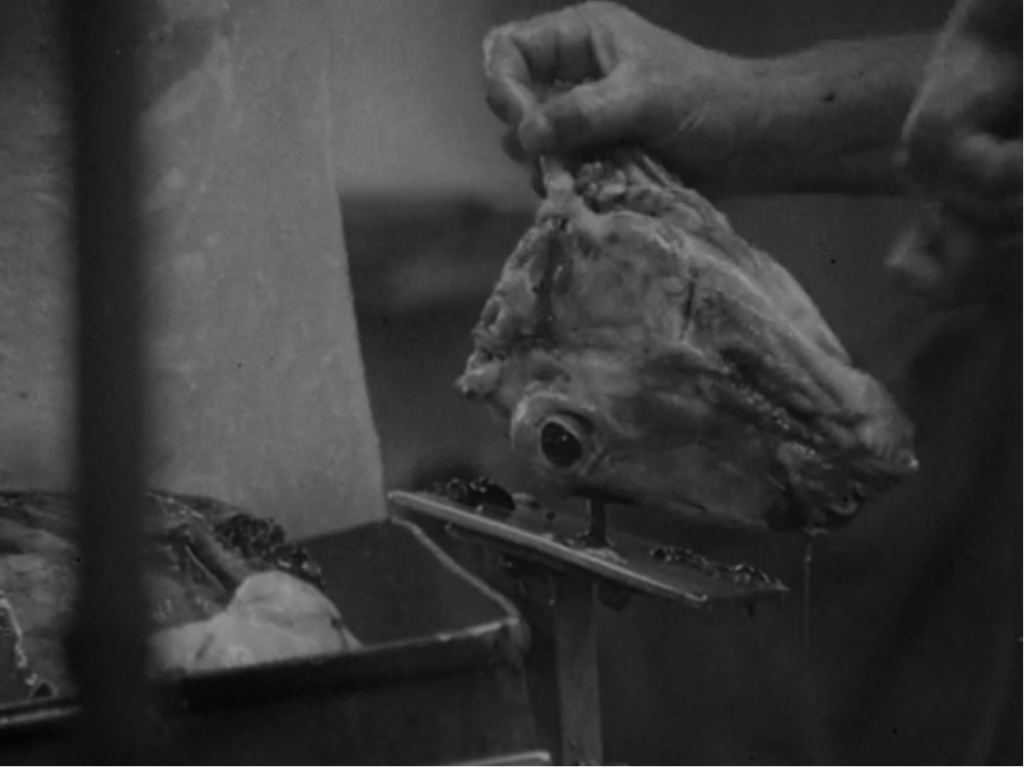
Figure 1: Killer of Sheep [58:59]
The third and most extensive sequence delves further into the death/life of its nonhuman subjects. Once more, the imagery of slaughter occurs in reverse. As O'Brien observes: "Rather than appearing at the beginning of the sequence, as the linear narrative logic of slaughter would insist, the image of the sheep being led to slaughter follows a series of shots detailing the various processes of disassembly (hide removal, dismemberment, cleanup)."85 This scene also includes the most graphic moment of animal violence in which a shot of a single sheep's skinned head is staked upside down and surgically stripped of its gullet. The sheep's eye stares back into the camera (see Figure 1), mirroring the ensuing gaze from the live sheep, which O'Brien characterizes as a "direct look of supplication not only to the slaughterhouse workers but also to us, the audience."86 I argue that the gestural congruity between animal carcass and live sheep functions not merely as a petition, but as proof of its failure. Burnett insinuates that we, as passively implicated viewers, have not and will not take responsibility for or action against these mechanisms of industrial slaughter. The film's intent is not only to garner sympathy for the oppressed. Little Walter's bluesy single "Mean Old World" plays over the butchering images, injecting the scene with themes of isolation, recognition, and resolve with lyrics like "Gonna pack my things and go" and "Seem like, to me, you don't want me." The melancholic tone is not beseeching. Rather, it gives the impression that we need to search for alternative routes towards restitution accounting for nonhuman life.
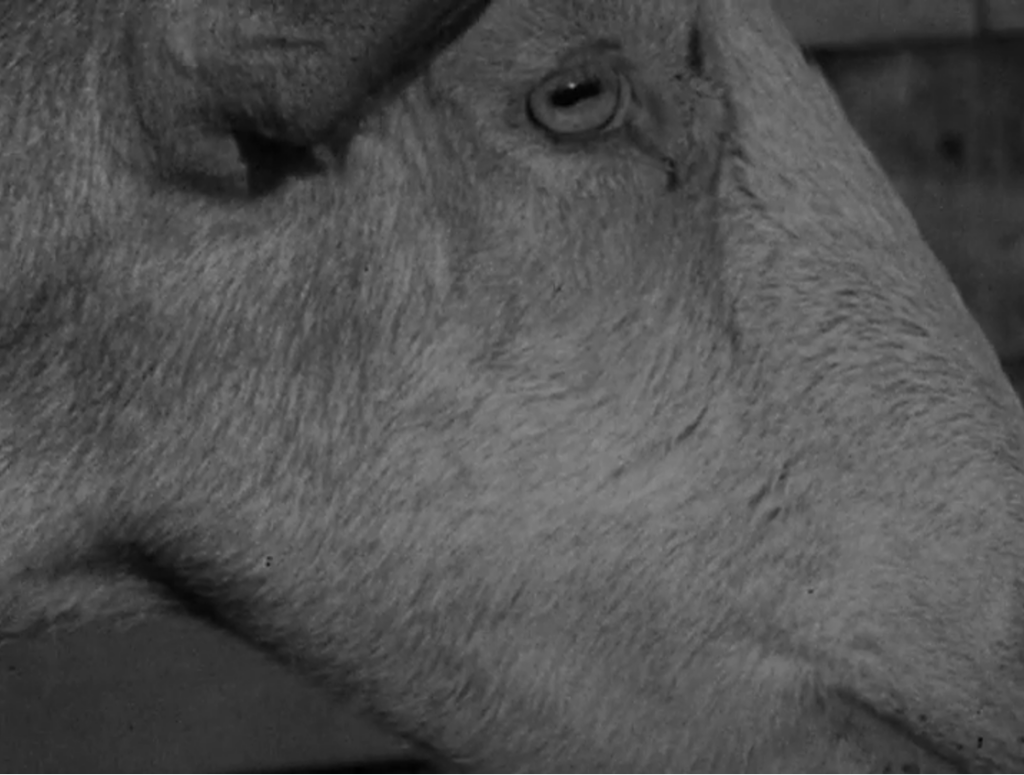
Figure 2: Killer of Sheep [1:05:25]
The final slaughterhouse sequence is preceded by a rare occasion for joy in Watts, when a young woman announces that she is pregnant. The camera zooms onto her belly as she makes a swelling gesture with her hand. Stan's wife gently grips her shoulder and laughs cheerfully as the image dissolves back to Stan herding sheep toward the killing floor. While this scene veers away from the visceral imagery of animal butchery, the correlation between human fetus and sheep could be interpreted as another example of how the community is likened to lambs being led to slaughter. However, the affective register of Dinah Washington's song, "This Bitter Earth," suggests also that race and animality need not share only in their suffering, but perhaps also in their fleeting intimacies. As Washington sings, "What good is love / that no one shares?" This confluence of aural and visual expressions recalls the stolen moments of happiness that occur emerge and persist within the state's hegemonic institutional practices. The song plays during an earlier scene in which Stan dances with his wife and is the only song to repeat in the film. The slow pacing in both sequences mirrors each other and provides a final disruption to the regulated momentum of the slaughterhouse. The embrace of Stan and his wife mirrors a short interlude of two rams tenderly nuzzling. The scene ends with a familiar lingering shot of the animal's eye (see Figure 2). By staging multi-layered acts of care as static and unproductive interruptions to the slaughterhouse, Killer of Sheep recognizes the agency effaced by entangled taxonomies of racialization and speciation.
I return briefly now to Okja, where the genetically engineered super-pig — a visual amalgamation of pig, manatee, and dog features — has been referred to as a "garishly anthropomorphized sympathy machine."87 This exaggerated representation of livestock makes it difficult to register multi-optic vision in the film. The bleak depiction of the meat manufacturing business in the film clearly resonates with the animal rights movement, and the slaughterhouse sequence impresses an overwhelming feeling of hopelessness in the viewer. As the film progresses, viewers may wonder when, if ever, this system of exploitation can be challenged. Mija reaches Okja just before the moment of slaughter. A racialized (presumably Hispanic) laborer holds the bolt gun (see Figures 3-5). This triangular encounter coalesces the experiences of raced and animal bodies in the slaughterhouse. Neither of these characters share a common language, but the slaughterer hesitates to pull the trigger when Mija shows him a photograph of the pair at a much younger age, lying together in the countryside. The scene becomes suspended in this moment: Mija staring up at the worker, who holds the photograph in one hand and a gun pointed at Okja's head in the other. During this pause, only the worker's eyes and head are in motion. The viewer follows a series of movements in the camera angle, in which shallow focuses bring specific aspects to the fore. The viewer's eye is first drawn to Mija's face, then to the photograph, then to the laborer's face as he looks at the photo, then to a closer look at the photo in the grips of the worker's bloodied glove, then to Mija again, and finally to Okja. This last image is accompanied by a squeal and prominently displays Okja's left eye. The laborer, against the slaughterhouse's most basic infrastructural imperatives, begins to take notice. He sees Okja as if for the first time in an ephemeral instant of mutual recognition. The production line, to the chagrin of Mirando's CEO, is impeded only in this multi-optic exchange.
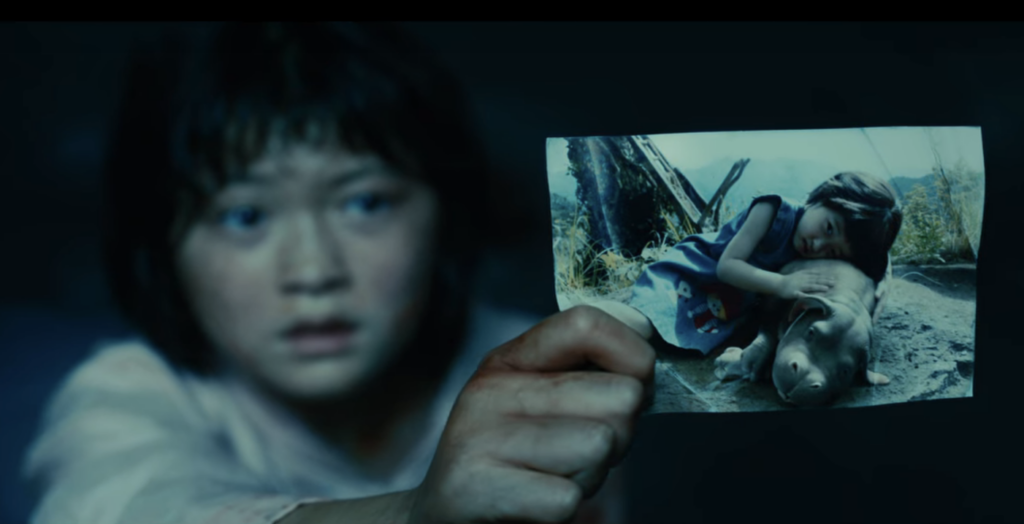
Figure 3: Okja [1:43:13]
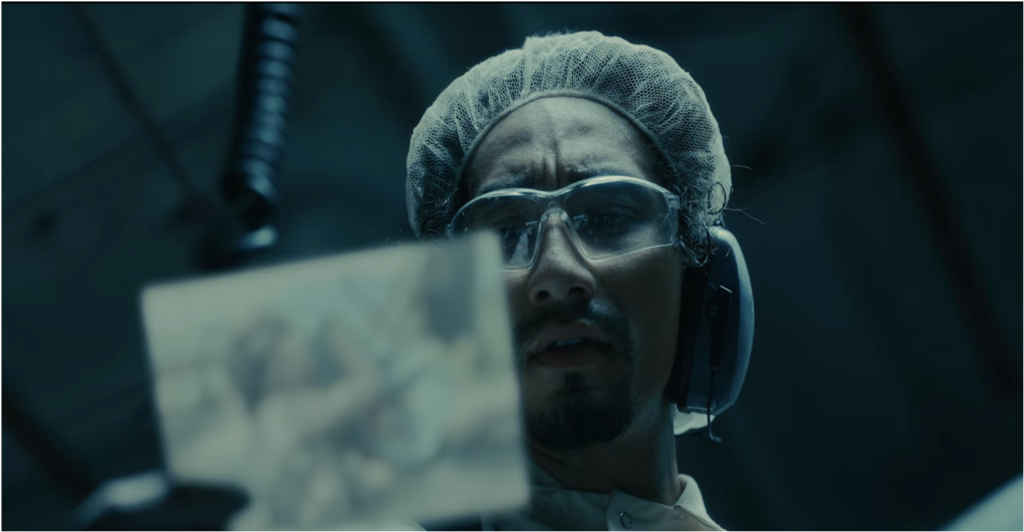
Figure 4: Okja [1:43:15]
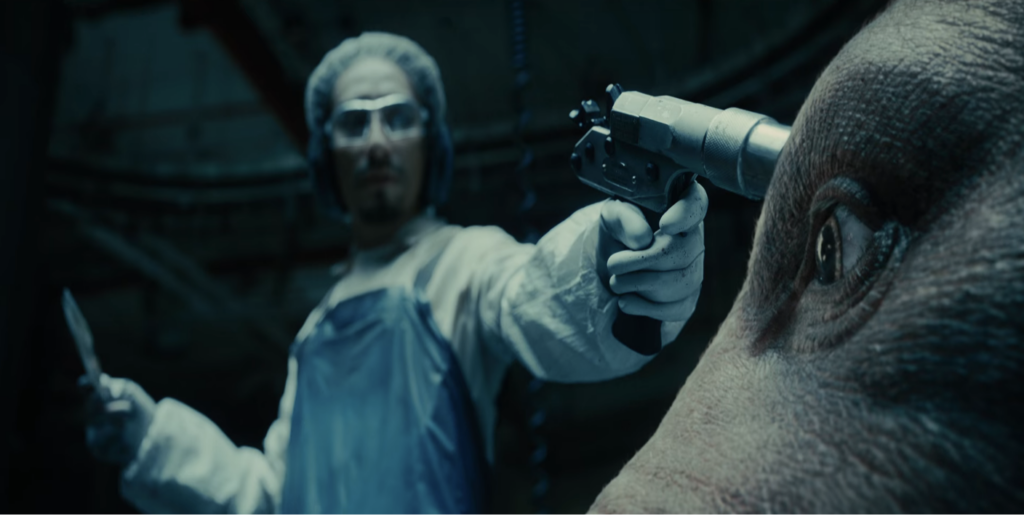
Figure 5: Okja [1:43:22]
Conclusion
While this exchange is significant in its challenge to the systems of exploitation that facilitate industrial slaughter, its impact is short-lived. Okja ultimately leverages Mija and Okja's exceptional relationship as a small victory, even as Mirando continues to breed and slaughter super-pigs on a massive scale. The audience, emotionally invested in the interspecies bond, is likely relieved to see Mija and Okja escape from the slaughterhouse unscathed. The heartwarming ending, however, overlooks the outlying conditions of their release. Mirando does not spare Okja because she is moved by the connection she shares with Mija. On the contrary, the CEO explains that they can "only sell the dead ones." At this point, Mija offers to exchange a miniature golden pig she received from her father to purchase Okja. Without much hesitation, the CEO agrees to the deal. Exiting the building, she pronounces: "Our first ever Mirando super pig sale. Pleasure doing business with you." Okja must be financially reclassified from livestock to companion animal to adhere to the law of capital. This transformation allows Okja to remain legible in the global market economy because, as Donna Haraway has noted, the companion animal "has a pedigree of the mating between technoscientific expertise and late industrial pet-keeping practices."88 Companionship is not framed as an alternative to slaughter; rather, they work in conjunction toward the same end. We can almost hear the gears turning in the CEO's head as she imagines the pet industry as another lucrative method of animal exploitation. Transnational capitalist networks continue to circumscribe the ways in which discourses of speciation, alongside other forms of oppression, are to be consumed.
Ephemeral moments of mutual recognition must be made visible through multi-optics which acknowledge entangled taxonomies of power in pursuit of an existence outside of domination. In doing so, the passive audience is challenged to recognize what Kim refers to as "new ways of imagining ourselves in relation to others."89 Slaughterhouse narratives envision new collectives, thus revealing what Kim calls an "ethics of mutual avowal," wherein a reimagined "we" may be constructed "in resistance to the neoliberal elites waging war against racialized groups, animals, nature, and others."90 In illuminating the effects of our visual modes of consumption, I have charted a pathway toward confronting the "transindividual" life/death of livestock and racialized/sexualized others in tandem.91 The double bind of species-based exclusion and anthropomorphism that compromises most animal representation is meaningfully addressed by these "new animal figures ... under capture," forged from entangled assemblages of species, race, and sex.92 The aim here is not necessarily to decipher latent "animal signs of protest," but to realize how unforeseen intimacies emerge in even the most enduring sites of state-sanctioned violence.93
In this context, the unrequited longing of a song like "This Bitter Earth" is an odd choice to resolve Killer of Sheep. In fact, Burnett originally intended to end the film with Dinah Washington's rendition of "Unforgettable," but he was unable to acquire the publishing rights. This song of love advances a direct and intimate address: "that's why darling, it's incredible / that someone so unforgettable / thinks that I am unforgettable too." These lyrics register the shared fungibility of sheep meant for slaughter and the black residents of Watts. In the face of overwhelming despondency, however, we must recognize the "importance of miniscule movements, glimmers of hope, scraps of food, the interrupted dreams of freedom found in those spaces deemed devoid of full human life."94 Manifested in this alternate ending, then, is also a profound solidarity. An affinity that surfaces even in the shadows of the slaughterhouse.
This is the first article from a forthcoming Post45 special issue titled "Race and Animality."
Akash Belsare is an assistant professor of English at the University of Illinois Springfield. His research addresses racialization and animalization across literary, visual, and popular culture. His previous scholarship has appeared in Contemporary Literature and The Post-Bildungsroman: Coming of Age at the Margins. His public writing has appeared in the Chicago Sun-Times, The Fulcrum, and The Opinion Pages.
Banner image By Animal Freedom - Shackles, CC BY 2.0, https://commons.wikimedia.org/w/index.php?curid=87446256
References
I wish to thank Samantha Pergadia and Alex Alston for their editorial guidance; the Center for American Literary Studies at Penn State for supporting this work during its early development; the Circle for Asian American Literary Studies for organizing the instructive "Consuming Asian America" panels at the 2023 Association for Asian American Studies Conference; Tina Chen for your incisive feedback; and Colette Slagle for all that you give.
- Noëlie Vialles, Animal to Edible, trans. J.A. Underwood (Cambridge University Press, 1994), 22.[⤒]
- Charlie LeDuff, "At a Slaughterhouse, Some Things Never Die," in Zoontologies: The Question of the Animal, ed. Cary Wolfe (University of Minnesota Press, 2003), 185.[⤒]
- LeDuff, "At a Slaughterhouse," 185.[⤒]
- Michael Grabell, "Exploitation and Abuse at the Chicken Plant," The New Yorker, April 1, 2017.[⤒]
- Samantha Pergadia, "Slaughterhouse Intimacies," New Literary History 54, no. 2 (2023): 1014.[⤒]
- Gabriel N. Rosenberg, "A Race Suicide among the Hogs: The Biopolitics of Pork in the United States, 1865-1930," American Quarterly 68, no. 1 (2016): 53-55. Rosenberg explains the material and symbolic entanglement of racialization and speciation as follows: "Speciation is the process of locating a form-of life within the taxonomy and, thus, elaborating its difference in relationship to other species. Like race, particular bodies with material characteristics and possibilities are located within this discursive taxonomy and subject to debility on its basis" (54, emphasis in original).[⤒]
- Claire Jean Kim, Dangerous Crossings: Race, Species, and Nature in a Multicultural Age (Cambridge University Press, 2015), 19 (emphasis in original).[⤒]
- Paula Young Lee, Meat, Modernity, and the Rise of the Slaughterhouse (University of New Hampshire Press, 2008), 8.[⤒]
- See Michel Foucault's chapter on "Panopticism," in Discipline & Punish: The Birth of the Prison, trans. Alan Sheridan (Random House, 1977), 195-228.[⤒]
- Alex Blanchette, Porkopolis: American Animality, Standardized Life, and the Factory Farm (Duke University Press, 2020), 15. Blanchette's comprehensive ethnographic study of factory hog farming and agribusiness is exemplary in its treatment of both porcine animals and racialized labor on the factory farm. In many ways, it presents a counterpoint to the kind of exposé writing I am critiquing in this article.[⤒]
- Saidiya V. Hartman, Scenes of Subjection: Terror, Slavery, and Self-Making in Nineteenth-Century America (Oxford University Press, 1997).[⤒]
- Nicole Shukin, Animal Capital: Rendering Life in Biopolitical Times (University of Minnesota Press, 2009), 100.[⤒]
- Shukin, Animal Capital, 100.[⤒]
- Kim, Dangerous Crossings, 19.[⤒]
- Lee, Meat, 238.[⤒]
- Lee, Meat, 238.[⤒]
- Clare Palmer and Alex Mackintosh also reasonably extend a Foucauldian analysis of power to nonhuman animals, emphasizing the easily observable altered behaviors of animals on factory farms and in slaughterhouses. The consciousness of animal bodies under surveillance is not relevant to the application of disciplinary biopower. See Palmer, "'Taming the Wild Profusion of Existing Things'? A Study of Foucault, Power, and Human/Animal Relationships" and Mackintosh, "Foucault's Menagerie: Cock Fighting, Bear Baiting, and the Genealogy of Human-Animal Power" in Foucault and Animals, eds. Matthew Chrulew and Dinesh Joseph Wadiwel (Brill, 2017).[⤒]
- Lee, Meat, 238.[⤒]
- Laura Anh Williams, "Gender, Race, and the Epistemology of the Abattoir in My Year of Meats," Feminist Studies 40, no. 2 (2014): 252-53.[⤒]
- Williams, "Gender," 267.[⤒]
- Lee, Meat, 238.[⤒]
- Lee, Meat, 237.[⤒]
- Shukin, Animal Capital, 94.[⤒]
- Antoine Traisnel, Capture: Animal Pursuits and the Making of a New Animal Condition (University of Minnesota Press, 2020), 11.[⤒]
- Traisnel, Capture, 1.[⤒]
- Foucault, Discipline & Punish, 201.[⤒]
- Traisnel, Capture, 180.[⤒]
- Lee, Meat, 238.[⤒]
- Ruth L. Ozeki, My Year of Meats (Penguin Books, 1998), 280.[⤒]
- Ozeki, My Year of Meats, 281.[⤒]
- Shukin, Animal Capital, 97.[⤒]
- Shukin, Animal Capital, 98.[⤒]
- Ozeki, My Year of Meats, 201.[⤒]
- Bong Joon-ho, director, Okja (Plan B Entertainment, 2017), Netflix.[⤒]
- Vialles, Animal to Edible, 51.[⤒]
- Foucault, Discipline & Punish, 200.[⤒]
- See Alexander Weheliye, Habeas Viscus: Racializing Assemblages, Biopolitics, and Black Feminist Theories of the Human (Duke University Press, 2014); Bénédicte Boisseron, Afro-Dog: Blackness and the Animal Question (Columbia University Press, 2018); Zakiyyah Iman Jackson, Becoming Human: Matter and Meaning in an Antiblack World (New York University Press, 2020).[⤒]
- Kim, Dangerous Crossings, 15 (emphasis in original).[⤒]
- Lee, Meat, 5.[⤒]
- Lee, Meat, 5.[⤒]
- Ozeki, My Year of Meats, 210.[⤒]
- Ozeki, My Year of Meats, 219-20.[⤒]
- Ozeki, My Year of Meats, 220.[⤒]
- Ozeki, My Year of Meats, 258.[⤒]
- Ozeki, My Year of Meats, 254.[⤒]
- Ozeki, My Year of Meats, 267.[⤒]
- Ozeki, My Year of Meats, 326.[⤒]
- Ozeki, My Year of Meats, 283-84.[⤒]
- Williams, "Gender," 268.[⤒]
- Williams, "Gender," 266-67.[⤒]
- David Palumbo-Liu, The Deliverance of Others: Reading Literature in a Global Age (Duke University Press, 2012), 14.[⤒]
- Jeffrey Santa Ana, Racial Feelings: Asian America in a Capitalist Culture of Emotion (Temple University Press, 2015), 195 (emphasis in original).[⤒]
- Ozeki, My Year of Meats, 360.[⤒]
- Ozeki, My Year of Meats, 358.[⤒]
- Ozeki, My Year of Meats, 334.[⤒]
- Tobias Menely, The Animal Claim: Sensibility and the Creaturely Voice (The University of Chicago Press, 2015), 205.[⤒]
- Charles Burnett, director, Killer of Sheep (Milestone Films, 1977), DVD.[⤒]
- Cynthia Young, Soul Power: Culture, Radicalism, and the Making of a U.S. Third World Left (Duke University Press, 2006), 214.[⤒]
- Young, Soul Power, 215.[⤒]
- Young, Soul Power, 5.[⤒]
- Sarah O'Brien, "Nous revenons à nos moutons: Regarding Animals in Charles Burnett's Killer of Sheep," Cinema Journal 54, no. 3 (2015): 38.[⤒]
- O'Brien, "Nous revenons," 37.[⤒]
- O'Brien, "Nous revenons," 32.[⤒]
- Young, Soul Power, 241-42.[⤒]
- Kim, Dangerous Crossings, 18.[⤒]
- Kim, Dangerous Crossings, 19.[⤒]
- Kim, Dangerous Crossings, 20-21.[⤒]
- Kim, Dangerous Crossings, 19 (emphasis in original).[⤒]
- Boisseron, Afro-Dog, xiv.[⤒]
- Shukin, Animal Capital, 130.[⤒]
- Ozeki, My Year of Meats, 130.[⤒]
- Ozeki, My Year of Meats, 360.[⤒]
- Ozeki, My Year of Meats, 336.[⤒]
- Kim, Dangerous Crossings, 20.[⤒]
- Ozeki, My Year of Meats, 251.[⤒]
- Ozeki, My Year of Meats, 281.[⤒]
- Pergadia, "Slaughterhouse Intimacies," 1027.[⤒]
- Ozeki, My Year of Meats, 338-39.[⤒]
- Ozeki, My Year of Meats, 339.[⤒]
- Ozeki, My Year of Meats, 334.[⤒]
- O'Brien, "Nous revenons," 40.[⤒]
- O'Brien, "Nous revenons," 21.[⤒]
- O'Brien, "Nous revenons," 54.[⤒]
- O'Brien, "Nous revenons," 54.[⤒]
- O'Brien, "Nous revenons," 21.[⤒]
- O'Brien, "Nous revenons," 21.[⤒]
- Austin K. Collins, "'Okja' is a Meaty Anti-Capitalist Fable," The Ringer, June 28, 2017.[⤒]
- Donna Haraway, The Companion Species Manifesto: Dogs, People, And Significant Otherness (Prickly Paradigm Press, 2003), 14.[⤒]
- Kim, Dangerous Crossings, 20.[⤒]
- Kim, Dangerous Crossings, 20.[⤒]
- Traisnel, Capture, 22.[⤒]
- Traisnel, Capture, 181.[⤒]
- Shukin, Animal Capital, 129.[⤒]
- Kim, Dangerous Crossings, 12.[⤒]
Related reading
 Manifest Diversity and the Empire of Finance
Susan Sontag and the Americanization of the Nouveau Roman
Manifest Diversity and the Empire of Finance
Susan Sontag and the Americanization of the Nouveau Roman
 The Programming Era: The Art of Conversation Design from ELIZA to Alexa
 “The Trouble Spot”: Racialized Paranoia and the Vision of the State in The Spook Who Sat by the Door
Cartoon Viscera
“The Trouble Spot”: Racialized Paranoia and the Vision of the State in The Spook Who Sat by the Door
Cartoon Viscera
 Toward a Trans Fag Phenomenology: the Orientation(s) of Desire and the Afterlives of Lou Sullivan
 Big Color Analytics: Privatization, Precarity, Pantone
The Blues Brothers, Tammy Wynette, and the Long Denouement of the 1960s
Big Color Analytics: Privatization, Precarity, Pantone
The Blues Brothers, Tammy Wynette, and the Long Denouement of the 1960s
 Side Hustle: College Sports and the Future of Academic Labor
Toward a Poetics of the Detainee
Side Hustle: College Sports and the Future of Academic Labor
Toward a Poetics of the Detainee