Summertime Sadness: Remembering Ricardo L. Ortiz
Author's Note: I love the books referenced in this short essay and hope those who read this memorial will also read the novels I discuss. They are all truly beautiful, each in their own way.
Apart from the 16-line sentence that begins Ricardo Ortiz's Latinx Literature Now: Between Evanescence and Event, it is the footnote that takes center stage. His intellectual legacy in relation to the state of Cuban American literary production now lies, for me, within that first footnote. Echoing the first sentence it is attached to, its own first sentence is 9 lines long. Excerpt: "This essay . . . understands latinidad's own current and ongoing potentialization as all promise and no guarantees; rather than serving as an ontological or epistemological ground for the basis of any claim."1 This footnote references and captures the focus of his monograph, which is "the question of the status of literature" and thus the "status of latinidad" in order "to describe the behaviors of Latinx literary textuality."2 So, what is the status of recently published Cuban American literature? How is it related to the status of latinidad? (Following Ricardo L. Ortiz—and, as he notes, José Esteban Muñoz—I italicize latinidad throughout this essay to signal its status as desire, as wish, as project.) What are the behaviors of its textuality?
Cuban American literature has gone rogue. No longer a constant yearning for a lost Cuba that is forever beyond its grasp, it now looks not to the 1959 Cuban Revolution and its immediate aftermath, not to a hyphenated self, and not to a possible or impossible return. Now it looks at all things Cuban in or from the US as inescapable traps: traps experienced by characters that have no memory of Cuba, neither their own nor their parents' or grandparents' or anyone else's. There is no ¿Qué pasa USA? in these pages.3
Take Say Hello to My Little Friend (2024) by Jennine Capó Crucet. The title is a reference to the 1983 film, Scarface, with its allusions to the 1980s Cuban Miami criminality that still haunts the city. Izzy, the novel's protagonist and a Pitbull impersonator, can only imitate the rapper, and badly at that. His Cuba is not the failed revolution but the recovery of the memory of what happened to him as a child in the harrowing crossing of the Florida Straits. In the end he is swallowed whole by Lolita (a tragic whale trapped in the Miami Seaquarium that Miamians identify with and that the novel identifies with Miami). He, like Lolita, doesn't belong anywhere.
The new Cuban Miami novel also replaces memory, nostalgia, longing and belonging with a sad overwhelming anxiety. Tell It to Me Singing (2024) by Tita Ramírez references the Cuban saying "Dímelo cantando," which is how someone might answer the phone to get the most recent gossip or news. Its anxiety-ridden protagonist, Mónica, cannot find herself no matter how hard she looks within or without. Whether at the pay-as-you-go motel on Eighth Street or on a frantic trip to Costa Rica to find her lovelorn mother, there is no Cuba to go back to, to remember, to imagine as a past or future. Only her war-torn veteran boyfriend remains. A Cuban American young man who constantly rejects her because he too does not belong anywhere but at war, serving tour after tour so he doesn't have to call anywhere home.
Even canonical writers who exemplify a nostalgic Cuban American literature, like Ana Menéndez of In Cuba I was a German Shepherd (2001), have opened their novels to an all-devouring and empty Cuban American nowhere. Menéndez's The Apartment (2023) is set in Miami Beach where an array of non-Cuban characters fill its pages. The book closes with a desperately lonely Cuban young man, a recent arrival, who in the end dies by suicide. There is no future for him there/here, a place where he must sell his body in order to send money to his family on the island.
While Ricardo was not necessarily interested in Cuban Miami in Latinx Literature Now—he was a Cuban from LA and proud of it—he would have been enthralled by the textual behaviors of recent Cuban American novels such as Of Women and Salt (2021) by Gabriela García; Mayra (2025) by Nicky Gonzalez; A Haunting in Hialeah Gardens (2023) by Raul Palma; and Blood in the Cut (2024) by Alejandro Nodarse. The settings in these novels include Westchester, Kendall, and the Everglades. In this expanded Cuban Miami city-space, Gabriela García presents us with a heroin-addicted character, Jeannette, who dies of an overdose after her mother tells her to turn in the undocumented Salvadoran teenager who has entered their lives. The teenager's mother is in a detention center, and the two of them are sent to Mexico instead of their home country. Jeanette tries to heal her betrayal of the young girl with a trip to Cuba that serves only to further alienate her from Cuba, from Cuban Miami, from herself. She realizes that she doesn't belong anywhere. Here, looking away, denying immigration's violence, not being able or willing to identify with other immigrants, destroys the Cuban Miami ideal the mother had so carefully curated.
Ricardo would have loved Of Women and Salt as well as Tell It to Me Singing because of the new "trialectic" of El Salvador, Miami, and Cuba or Costa Rica, Miami, Cuba. I am referencing here the fifth chapter of Latinx Literature Now, "The Testimonial Imagination or, Literary Practice 'After' Testimonio." The move from testimonio to fiction occurs in this chapter between Rigoberta Menchú's testimonio about Civil War-torn Guatemala (I, Rigoberta Menchú, 1983), Reinaldo Arenas's memoir about his life in Cuba (Before Night Falls, 1992), and Cristina García's novel The Lady Matador's Hotel (2012). García is an author also from LA, Ricardo notes. García's novel, he argues, contains a "still occluded-item in the archive," this being García's biography: her father was actually born in Guatemala, not Cuba.4 In this trialectic, Guatemala, Cuba, and Cuban Americans come together in latinidad. Tell It to Me Singing begins with a quote by Reinaldo Arenas: "Every person who lives outside his context is always a bit of a ghost, because I am here, but at the same time I remember a person who walked those streets, who is there, and that same person is me. So sometimes I really don't know if I am here or there."
Thus Ricardo would have also been fascinated by Vanishing Maps (2023), the sequel to Dreaming in Cuban (1992) by Cristina García. In this novel there is a possibility of a return to Cuba, but all of the characters find themselves in Berlin, seeking to be born again somewhere else, somewhere not Cuba. In the end, we don't know if any of them return to visit the island. Their lives in Berlin, or in other elsewheres, are far more appealing. In this trialectic, latinidad has gone back to Europe. I wonder what Ricardo might have written about that, especially given his next project on Cubans in Paris.
And Ricardo might have had a lot to say about the recent Cuban American gothic novel Mayra by Nicky Gonzalez. The characters are trapped in an emotional labyrinth of their own neurotic making that leads them to look at themselves in foggy mirrors in which their warped reflections mirror back empty ideological nothingness. Ingrid, the first-person narrator of Mayra, has no Cuba as a point of reference, except maybe her mother's lechón or the small croqueta she slips into her father's suit pocket at his funeral when she is seven. She has only a bland yet competitive friendship with the angry, belligerent and empty Mayra, a character who bites her in the neck before leaving for Cornell, the only remnant of her vampirish yet fading Cubanicity that dissipates into the great white north then vanishes into the Everglades when she hooks up with her zombie American boyfriend Benji. Ingrid and Mayra's only nostalgia is their past friendship back in Hialeah. Unsurprisingly, there is no Cuba in the past or future of these two characters, and definitely not the novel's present. Ingrid argues: "Home...that's where we're from," referencing Hialeah. Mayra's zombie boyfriend Benji responds: "Not at all. It's where we end up"(197), thus creating the stalemate that ends the friendship between the two women and any sense of belonging anywhere. Mayra just melts and disappears into Benji and the American home, the assimilated nowhere he has made for them, in which the house entraps her and she traps herself "nowhere, alone with her bliss."5
A Haunting in Hialeah Gardens by Raul Palma is a gothic novel like Mayra. In this iteration, Hialeah Gardens takes center stage. Hugo, a man deep in medical debt, has to conduct an exorcism in a house built by a wealthy Cuban American debt attorney, Alexi. Hugo's childhood working in Bolivian mines (another trialectic) haunts his present in Cuban Miami, a place he doesn't belong in or to, except through memories of his deceased Cuban American wife Meli. Built close to a dump site, this section of Hialeah is haunted by a deadly apparition at its very roots, calling out the xenophobic nature of Cuban Miami as well as its inexhaustible potentiality for abusing others, by taking their money, keeping them forever in debt to an ideal, lost, and ever-aspiring Cubanidad. At its core, it all stinks.
Then, Blood in the Cut moves between Kendall and the Everglades; the selling of horse meat drives the plot. The family's Carnicería Guerra is at risk because of gentrification by a trust fund baby from Boston. The mother has been murdered. The father is emotionally distant, silent, angry. The younger brother is trying to educate his way out. The main character Iggy is in love with his car but adrift without the love of his life, the idyllic Sofie. But a white militia training in the Everglades forces him to make a choice in which the toxic masculinity between men signals the corruption at the heart of Cuban America, now exposed for all to see. There is no Cuba in this novel, only the Glades, a "land dark and deep . . . [that] kept more secrets than it answered questions."6
I close this essay with Mirta Ojito's recent novel Deeper than the Ocean (2025). The reference to Cuban Miami is only through the character's mother, who lives there. She is annoying. Instead, it is Santander and the Canary Islands that occupy the text. Mara is the great granddaughter of Catalina who survived the Poor Man's Titanic, a real shipwreck off the coast of Key West that occurred in 1919, when 480 Spanish immigrants trying to reach Cuba drowned and disappeared; their bodies were never recovered. Mirta Ojito, who is best known as a Pulitzer Prize-winning journalist with the New York Times and the author of the award-winning memoir on emigrating from Cuba to the US titled Finding Mañana (2006) brings in the tragedy of immigration globally in this novel, not only through the catastrophic sinking of the Valbanera but also through the figure of a drowned little girl from Ghana whose body Mara inspects as part of writing a story about the cost of immigration. The reader, like the character, is heartbroken by the ruffles on the little girl's skirt and her toenails painted pink. In the narrator's painful words Mara/Mirta reminds us: we all wear our best when we are going somewhere new. At the end of the novel, Mara hires a boat to take her to the shipwreck, and jumps into the ocean, facing her worst fear, overcoming her generational trauma, or maybe, just maybe, drowning at sea. We don't know.
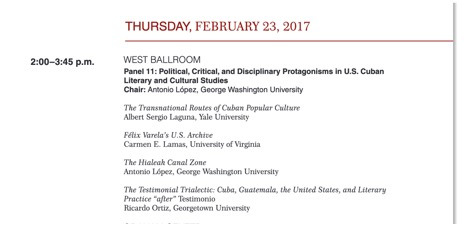
I end with this novel because Mirta's book came out on November 7, 2025. I had been in touch with Ricardo, and he was planning to go to her book launch at Politics and Prose in DC. A group of us had been together at a party at Mirta's house back in 2017 because of CRI (the Cuban Research Institute Biennial Conference): Tony López, Albert Laguna, Lázaro Lima, Ricardo Ortiz, and I. Ricardo actually presented on the testimonial trialectic at the conference. Mirta opened her home to us and invited writers and journalists from Miami to join. It is a beautiful memory, filled not with a lost Cuba but with found friendships that I will always cherish. Ricardo would have gone to that reading, would have been here at the Latina/o Studies Association Conference in Austin, 2026. And, he would have been so happy to be there, in Austin, Texas, with all of us, so complete, and he would have answered back to Ingrid, Mayra, and Benji. Home is not where you are from. Home is not where you end up. Home is where you are, here, right now, "all promises and no guarantees," yet in community, in love, in latinidad.
Carmen E. Lamas is Associate Professor of English at the University of Virginia. She is the author of the prize-winning book The Latino Continuum and the Nineteenth-Century Americas: Literature, Translation, and Historiography (Oxford UP).
References
- Ricardo L. Ortiz, Latinx Literature Now: Between Evanescence and Event (Palgrave Macmillan, 2019), xv. The footnote in question is the first one on the page. ↩︎
- Ortiz, Latinx Literature Now, xiv. ↩︎
- ¿Qué Pasa USA? (1977-1980) was a sitcom set in Miami's Little Havana and filmed in Miami. It depicts the Peña family and their challenges adjusting to US culture. Nostalgia for Cuba is the driving theme of the program. ↩︎
- Ortiz, Latinx Literature Now, 54. ↩︎
- Nicky Gonzalez, Mayra (Random House, 2026), 225. ↩︎
- Alejandro Nodarse, Blood in the Cut (Flatiron Books, 2024), 96. ↩︎