Summertime Sadness: Remembering Ricardo L. Ortiz
Jonathan Demme's documentary, The Agronomist (2003), concludes with a remarkable act of return after tracing the life of the Haitian journalist, agronomist, and democracy activist Jean Dominique. Dominique was best known for his work at Radio Haiti Inter, the independent radio station he founded, which had become one of the country's most influential voices before his assassination in 2000.1 After following him through decades of political journalism and exile, the documentary refuses to end with the image that has defined Dominique's public life: the journalist behind a microphone. His wife and fellow journalist, Michèle Montas, recounts stories from people who say they saw him after his death, still wandering the Haitian countryside, still discussing fertilizer with farmers, still inhabiting the landscape he once hoped to cultivate—all traces, in the afterlife, of his earlier life as an agronomist. As we hear her account, we see Dominique's ashes scattered into the Artibonite River (fig. 1).2
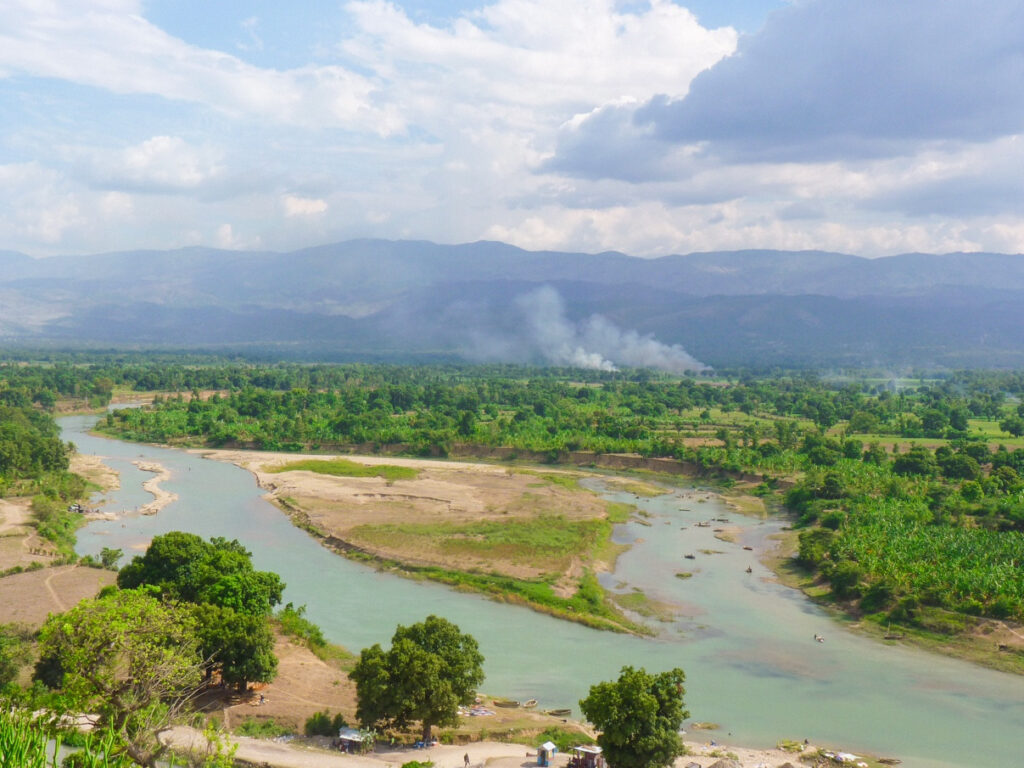
It is an unexpected ending for a film about journalism. Rather than commemorating Dominique's voice, the documentary remembers him as an agronomist. The effect is subtle but profound. By returning Dominique to the land, The Agronomist suggests that journalism was never a departure from agronomy. If Dominique could not cultivate Haiti's soil because of the country's unequal distribution of land, he cultivated another kind of field instead, one sustained through language, radio, and the circulation of stories. The documentary's closing gesture invites us to see agronomy less as Dominique's abandoned profession than as the enduring method that organized his life.
The more I return to The Agronomist, the more I think the film asks us to reconsider what an agronomist actually does. Agronomy is often understood as the science of cultivating land—of preparing soil, improving harvests, and sustaining the conditions under which life can grow. Dominique himself trained for precisely that work at the Faculté d'Agronomie in Port-au-Prince, after which he furthered his studies at the Institut National Agronomique in France. He returned to Haiti after this long course of study with the hope of supporting rural farmers. Yet, as the documentary makes clear, the unequal distribution of land made him feel that his vocation was impossible. In this sense, Dominique became an agronomist without land. Read one way, this marks a story of loss: an abandoned profession redirected into journalism. But Demme's closing images invite another reading. Dominique did not cease being an agronomist when he picked up a microphone. He simply relocated the work of cultivation. If the soil could no longer sustain collective life, language might. Through Radio Haiti Inter, the Kreyòl-language radio station he helped build into one of Haiti's most influential and widespread public forums, Dominique cultivated not crops but the conditions under which a public could imagine itself differently.
I first encountered The Agronomist as an undergraduate at Georgetown University in Ricardo Ortiz's seminar on testimonial fictions. At the time, I understood the documentary as narrating a transformation: an agronomist became a journalist because history had foreclosed the life he had imagined. I read journalism as the substitute for an agricultural vocation that political circumstances had rendered impossible. Returning to the documentary fifteen years later, however, I realize that I have also been returning to Ricardo's classroom. The documentary has remained remarkably constant. I have not. What once appeared to me as a story of political resistance now reads as a meditation on cultivation. Dominique never ceased being an agronomist; journalism became the medium through which that vocation endured. That shift in my own reading owes less to a new interpretation than to the habits of reading that Ricardo and I cultivated together over many years of mentorship. More than any particular argument, he taught me to return to texts with the expectation that they would continue to reveal new relations as I changed alongside them.
Returning to The Agronomist after Ricardo's death, I find myself thinking not only about Dominique differently, but about Ricardo himself. What strikes me now is that the agronomist offers a way of describing Ricardo's own intellectual practice. He approached Latinx Studies much as Dominique approached journalism—not as a bounded profession or settled field, but as an ongoing labor of cultivation beyond the boundaries of his most visible field. His scholarship continually crossed disciplinary, linguistic, and geographic borders, bringing Haiti into conversation with latinidad, queer theory into dialogue with diaspora, and literature into relation with histories that exceeded national frames. In the essay "Edwidge Danticat's Latinidad: The Farming of Bones and the Cultivation (of Fields) of Knowledge," Ricardo reads Danticat's "farming of bones"—its entanglement of agricultural labor, historical violence, and literary production—as an invitation to reconsider the linguistic and geographic boundaries through which latinidad and its disciplinary knowledge have been defined.3 These crossings were never simply additive. They altered the terrain itself, expanding what Latinx Studies could ask and whom it could include. Looking back, I realize that Ricardo was interested in doing more than writing about the field. He cultivated the conditions through which the field could continue to grow.
Looking back, I realize that the expansiveness of Ricardo's scholarship and the generosity of his mentorship were never separate practices. Both were forms of cultivation. Whether through a seminar question, an unexpected intellectual connection, or an archive that seemed to appear where no one thought to look, he continually created the conditions under which other people—and other ways of thinking—could take root. Looking back, I realize how many of my own questions began as seeds Ricardo quietly planted years earlier. It was Ricardo who first introduced me to works like Sin Nombre (2009) and The Agronomist, texts that would become the foundation of my dissertation, my book project, my own teaching, and now this essay. At the time, I could not have imagined how far those questions would travel.
Ricardo's mentorship rarely consisted of directing my scholarship toward predetermined conclusions. Instead, he cultivated the confidence to trust my own questions: to take documentary film seriously as an object of literary inquiry, to move across Central American, Caribbean, and Latinx archives without worrying whether disciplinary and national boundaries had already been drawn, and to pursue lines of inquiry that might at first seem too small or too idiosyncratic to matter. Even though I was an undergraduate when we first met, Ricardo had the rare ability to take my questions seriously before I fully knew how to take them seriously myself. He never asked me to become the kind of scholar he was. He cultivated the conditions under which I could become the scholar my own questions required.
Returning to The Agronomist, I began to see that return is not simply the documentary's final gesture but its governing logic. Dominique's life is not preserved by resisting loss but through a transformation of loss that, paradoxically, makes him available for renewed relation. The film imagines political and intellectual labor as something that continues because others return to it, take it up again, and carry it elsewhere. As I began to recognize this movement, I realized that I had been living it myself. Returning to the documentary had also meant returning to Ricardo, and returning to Ricardo had changed how I understood the field he helped cultivate. Perhaps this is how intellectual fields endure—not through permanence, but through return. Ricardo had a name for this way of thinking: evanescence.
As Ricardo understood it, evanescence names neither disappearance nor instability. It describes a mode of existence that persists through relation rather than permanence.4 Latinidad does not cohere once and for all into a stable object of knowledge. It flickers into being through encounters, affiliations, aesthetic practices, and conversations that remain deliberately unfinished. Used as a methodology to read with and alongside The Agronomist, evanescence suggests that cultivation is always provisional, and I have begun to see the figure of the agronomist illuminated in unexpected ways. Fields require continual tending because they are never complete. Their vitality depends not on any suggestion of their permanence, but on their capacity to return.
Academic fields are often imagined as territories to be defended, disciplines to be institutionalized, or archives to be expanded—silos into which the field's yields can be stored and protected. These ways of imagining a field are predicated on permanence, stability, market value, and clearly marked boundaries. Yet returning to The Agronomist—and to Ricardo's scholarship—has made me wonder whether another metaphor is available. What if a field is less a territory than a place of return and renewal? What becomes possible when we imagine Latinx Studies not as a field we enter once, but as a place to which we continually return, whose cultivation we must undertake to make return possible in the first place?
Thinking of Latinx Studies as a place of return shifts our attention away from institutional permanence and toward the practices that continually renew the field: rereading, relation, mentorship, and cultivation. We return not because the questions remain unchanged, but because they refuse completion. Each return brings different historical conditions, different archives, different interlocutors, and different readers. The field remains alive precisely because it does not ask us to preserve its unchanging past; it asks us to encounter that past again, differently. Like Dominique's agronomy, the work of cultivation is never complete. It depends upon returning to the field again and again, under changing historical conditions. Return, in this sense, asks us to imagine knowledge less as accumulation than as renewed encounter. A field becomes a place of return because generations of scholars, teachers, and students continually cultivate it as one.
If this understanding of return offers anything to the future of Latinx Studies, it is a different way of imagining what sustains a field. Fields endure not simply through institutions, departments, or expanding archives, important as those remain. They endure because people continue returning—to texts, to classrooms, to mentors, and to one another's questions. Every generation inherits a field already in motion, and every return reshapes that inheritance without beginning anew. Perhaps the future of Latinx Studies depends less on securing fixed boundaries than on our willingness to cultivate the conditions that make those returns possible. Sometimes those returns arrive in unexpected forms.
Since late August 2025, credible witnesses have continued to report sightings of Ricardo Ortiz. He has been observed in ongoing conversations about the future of Latinx Studies—its imminent collapse, its endless reinvention, its commitment to remaining productively unfinished. Accounts suggest that these conversations are rarely concluded. More recently, he has been spotted in a Starbucks in Adams Morgan, latte in hand, peering over his glasses at a half-written paragraph, pausing as though waiting for a citation or theoretical intervention that has not yet fully arrived. Ricardo, like Dominique, returns less as a fixed figure than as a presence that continues circulating through the questions, classrooms, and conversations he helped cultivate.
Returning to The Agronomist, I have come to see that the film's closing moments are not simply a memorial to Jean Dominique but a meditation on how political and intellectual labor endures. Rather than allowing Dominique's life to conclude with the violence of his assassination, the documentary returns him to agronomy, to the river, and to the work of cultivation that first animated his life.5 Even Michèle Montas's closing remembrance refuses the finality of death, imagining him still moving through the countryside, still conversing, still tending to the concerns that shaped his life. Dominique's work survives not because it escapes loss but because it remains available for renewed relation—taken up again by others, in other places, under different historical conditions.
Ricardo's legacy endures in much the same way. His scholarship, his mentorship, and the questions he cultivated do not ask to be preserved unchanged. They ask to be returned to. Each return becomes another relation, another conversation, another beginning. The work of tending begins again with each return.
Angie C. Bonilla writes about migration, film, Latinx literature, and visual culture. She is completing her first book, "Migrant Figures: Visual Embodiments of Race, Gender, and Sexuality in the Era of Border Deterrence," which examines migration through film, literature, photography, and contemporary art. She is the author of "Writing Herself into the Frame: Jenna Ortega and the Aesthetics of Latina Self-Authorship." A proud Hoya, she first met Ricardo Ortiz as an undergraduate at Georgetown and continued learning alongside him through graduate school and into her early career. When she's not writing, she's usually bullet journaling. Follow her bujo practice on Instagram at @latinabujomagik.
References
- The Agronomist, directed by Jonathan Demme (2003, THINKFilm), DVD. ↩︎
- The Agronomist, dir. Demme. ↩︎
- In this reading of The Farming of Bones, Ricardo connects the agricultural labor represented in Danticat's novel to the literary labor through which its histories become available as knowledge. Particularly suggestive for an understanding of intellectual cultivation is Ricardo's concluding reading of the young boy who helps Amabelle cross the border. Against the figure of the Pwofesé ("professor" in Haitian Kreyól), Ricardo identifies the student as the bearer of the novel's most genuine knowledge, a child who both transports and survives Amabelle and her story. The boy's writing and open-ended "perhaps," which comes near the novel's conclusion, suggest the possibilities of knowledge that does not presume the authority to speak definitively. For the full essay, see Aftermaths: Exile, Migration, and Diaspora Reconsidered, ed. Marcus Bullock and Peter Y. Paik (Rutgers University Press, 2009), 150-68. ↩︎
- Ricardo L. Ortiz, Latinx Literature Now: Between Evanescence and Event (New York: Palgrave Macmillan, 2019). ↩︎
- The Agronomist. ↩︎